. 2016:2016:2934340.
doi: 10.1155/2016/2934340. Epub 2016 Dec 21.

Spatholobus suberectus Column Extract Inhibits Estrogen Receptor Positive Breast Cancer via Suppressing ER MAPK PI3K/AKT Pathway

Affiliations

Spatholobus suberectus Column Extract Inhibits Estrogen Receptor Positive Breast Cancer via Suppressing ER MAPK PI3K/AKT Pathway

Jia-Qi Sun et al. Evid Based Complement Alternat Med. 2016.

Abstract

Although Chinese herbal compounds have long been alternatively applied for cancer treatment in China, their treatment effects have not been sufficiently investigated. The Chinese herb Spatholobus suberectus is commonly prescribed to cancer patients. HPLC analysis has shown that the main components of Spatholobus suberectus are flavonoids that can be classified as phytoestrogens, having a structure similar to estrogen. This study was designed to investigate the effects of Spatholobus suberectus column extract (SSCE) on the estrogen receptor-positive (ER+) breast cancer cell line MCF-7 and its possible molecular mechanism. In our study, MTT assay was performed to evaluate cell viability. The results show that SSCE (80, 160, and 320 μg/ml) significantly decreased the viability of MCF-7 cells. SSCE also triggered apoptosis, arrested the cell cycle at the G0/G1 phase, and inhibited cell migration. A dual-luciferase reporter system showed that SSCE suppressed intranuclear p-ER activity; Western blot analysis confirmed the repressed expression of phosphorylated-ER alpha (p-ERα), ERK1/2, p-ERK1/2, AKT, p-AKT, p-mTOR, PI3K, and p-PI3K, indicating that SSCE suppressed the MAPK PI3K/AKT signaling pathway. Collectively, our results suggest that SSCE causes apoptosis, an arrest in the G0/G1 phase, and a decrease in migration in ER+ MCF-7 cells via hypoactivity of the ER and suppression of the MAPK PI3K/AKT pathway.


Conflict of interest statement

The authors declare that there are no competing interests.

Figures
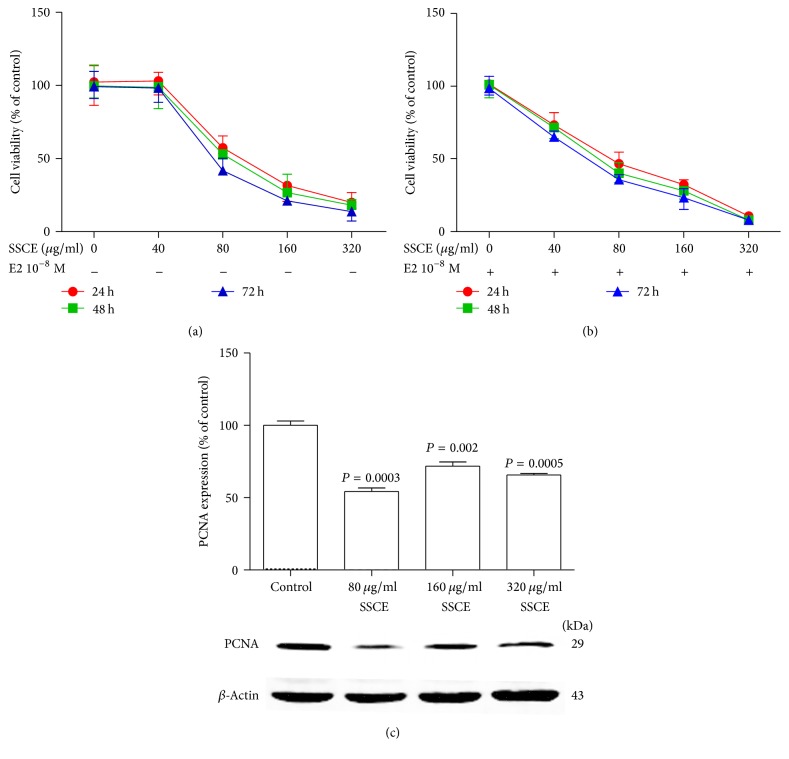
Figure 1
Figure 1
Inhibition of the viability of MCF-7 cells with SSCE treatment. (a) SSCE treatment in the absence of 17β-estradiol (E2) inhibited the proliferation of MCF-7 cells. The IC50 of SSCE treated for 24 h, 48 h, and 72 h was 109 μg/ml, 102 μg/ml, and 83 μg/ml, respectively. (b) Addition of 10−8 M E2 promoted the effect of SSCE. The IC50 of SSCE in the presence of 10−8 M E2 was 81 μg/ml, 68 μg/ml, and 60 μg/ml for a 24 h, 48 h, and 72 h incubation, respectively. (c) The proliferation-related protein (PCNA) level was decreased upon treatment with SSCE (80 μg/ml, 160 μg/ml, and 320 μg/ml) for 24 h compared to control.
Figure 2
Figure 2
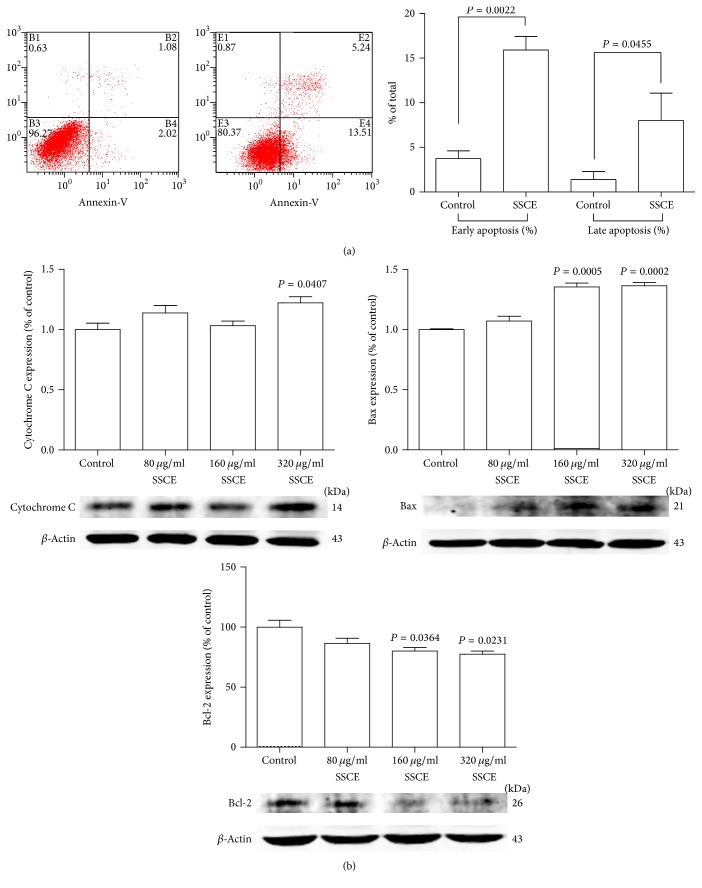
(a) SSCE (160 μg/ml) treatment for 24 h induced apoptosis of MCF-7 cells with a significant increase in the proportion of both early and late apoptotic cells analyzed by FACS. (b) Western blot analysis and quantification of the band intensity show that after SSCE (80 μg/ml, 160 μg/ml, and 320 μg/ml) treatment for 24 h, the expression levels of apoptosis-related proteins cytochrome C and Bax were elevated, and Bcl-2 expression was suppressed.
Figure 3
Figure 3
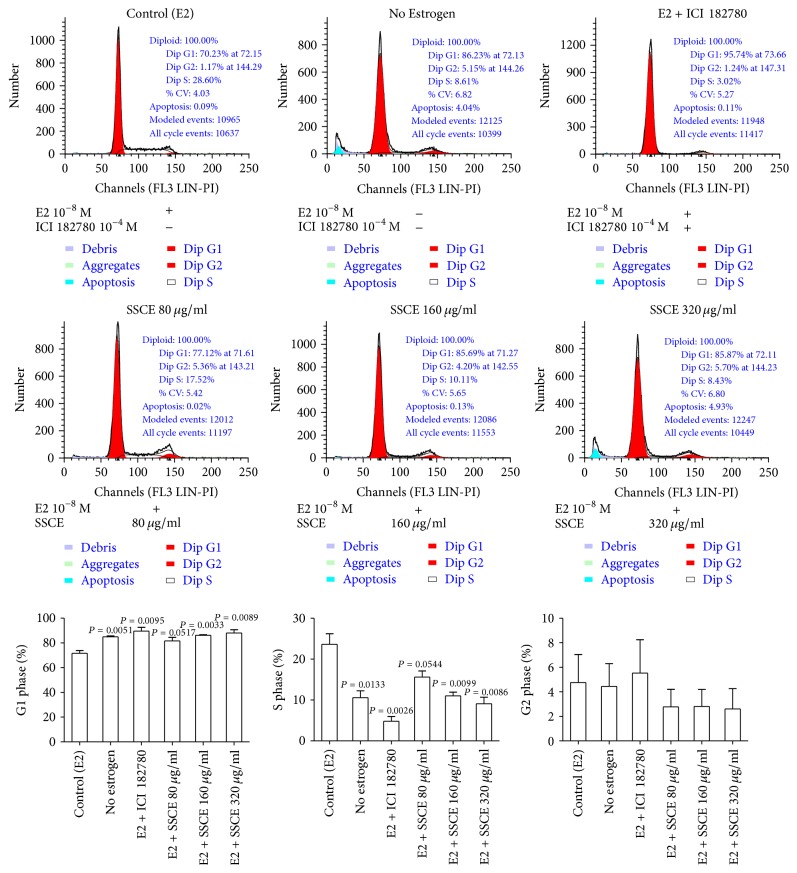
The control groups included MCF-7 cells cultured in DMEM with 10−8 M E2 and cells cultured in the absence of E2. When treated with SSCE (80 μg/ml, 160 μg/ml, and 320 μg/ml) in the presence of 10−8 M E2, the proportion of cells in the G1 phase of the cell cycle was exacerbated. The proportion of cells in the S phase was reduced in SSCE treated groups. There was no difference in the proportion of cells in the G2 phase between these groups. The cells were cultured in phenol red-free DMEM with charcoal-stripped FBS.
Figure 4
Figure 4
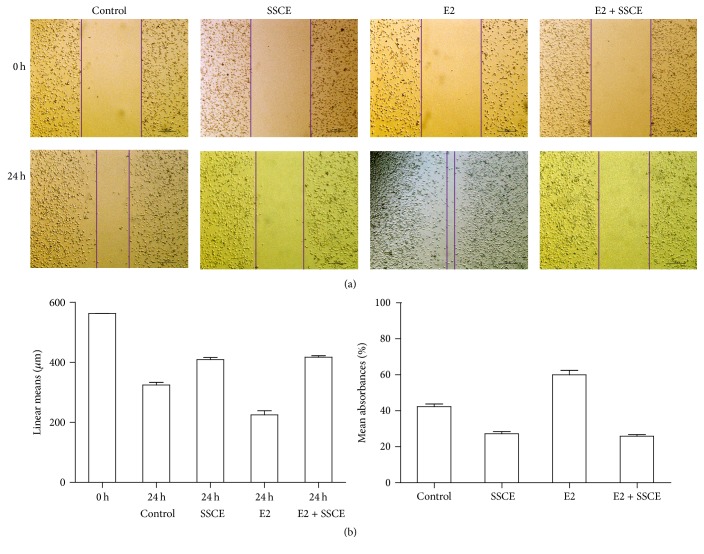
Wound healing assays to assess the effect of SSCE on migration ability. MCF-7 cells were cultured in a 6-well plate to approximately 90% confluency. A wound was generated by a scratch in the middle of the plate using a pipette. The wound closure was measured upon treatment with E2 (10−8 M) and SSCE (160 mg/ml) alone or E2 (10−8 M) + SSCE (160 mg/ml) for 24 h. (a) Representative images show the wound at 0 and 24 h. The migration of MCF-7 cells was promoted by E2 and inhibited by SSCE both in the presence and absence of E2. (b) The linear mean length and the confidence interval for each wounded area 24 h after the scratch are presented and compared to 0 h. The linear mean length of the control and the cells treated with SSCE and SSCE + E2 were significantly reduced compared to that in the other groups (P < 0.001). There was a significant difference noted in the linear means between the control and the E2-treated cells (P < 0.001). The rate of closure with the condition interval for each group 24 h after scratch is presented. The rates of closure of the SSCE group and SSCE + E2 group were significantly lower than that in the other groups.
Figure 5
Figure 5
(a) The activity of nucleus ERE, p-ERα, and p-ERβ in MCF-7 cells cultured without estrogen detected by a double-fluorescence enzyme reporting system is shown. Relative to ERE, the activation of p-ERα and p-ERβ in the control group was significantly higher than that in MCF-7 cells cultured with SSCE (160 μg/ml and 320 μg/ml) for 12 h. (b) p-ERα and p-ERβ protein levels after treatment with SSCE (80 μg/ml, 160 μg/ml, and 320 μg/ml) cultured for 24 h were detected by Western blot. SSCE inhibited p-ERα expression in a concentration-dependent manner. However, SSCE did not affect the expression of p-ERβ.
Figure 6
Figure 6
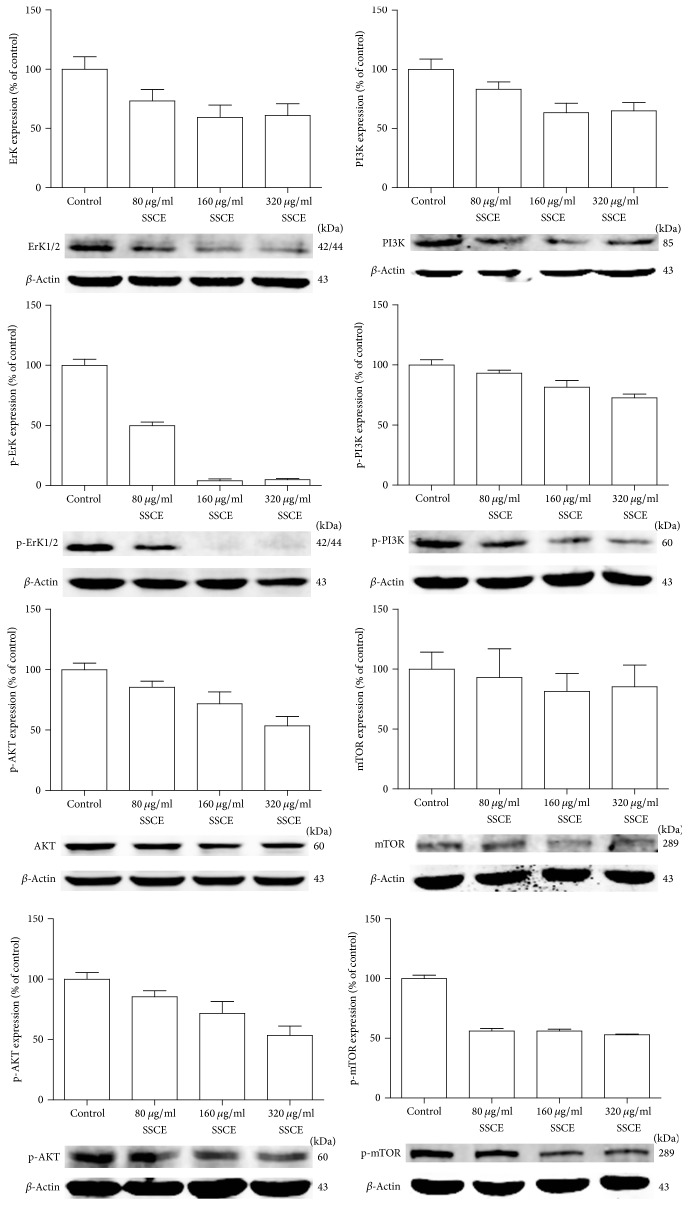
Western blot analysis showing that expression levels of ERK1/2, p-ERK1/2, AKT, p-AKT, PI3K, p-PI3K, and p-mTOR were significantly inhibited in the MCF-7 cells treated with SSCE (80 μg/ml, 160 μg/ml, and 320 μg/ml) in a concentration-dependent manner. The expression of mTOR had no obvious association with the SSCE concentration.
Figure 7
Figure 7
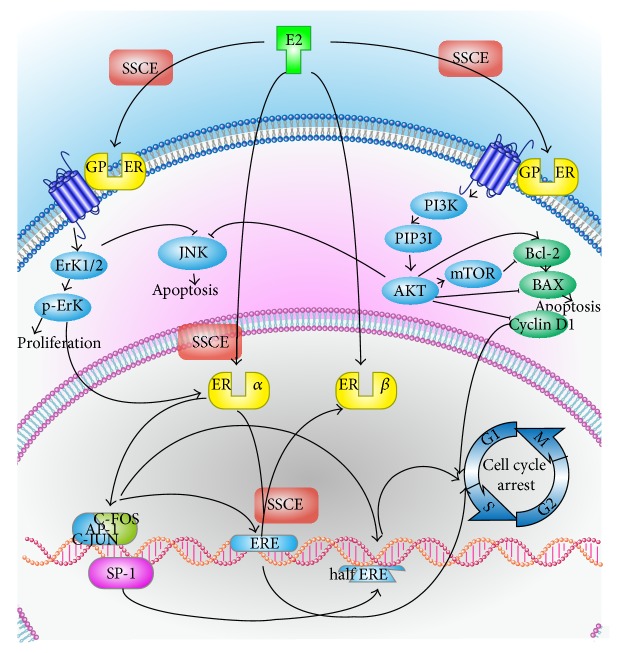
The classic mechanism for E2 action is E2 diffusing into the nucleus, binding to the nucleus estrogen receptor (ER), combining with ERE on DNA, starting transcription translation and inducing the cycle of multiplication in cancer cells. In addition, activated ERα can activate AP-1 and SP-1, which are transcription enhancers that can promote the transcription translation of ERE and enable incomplete ERE (half ERE) to transcribe and translate. SSCE may affect the activation of ERα, decreasing p-ERα, reducing the combination ability of ER and ERE, and stopping ERE from transcribing and translating. On the other hand, E2 can combine with GPER on the cell membrane, increase the expression of ERK, promote cell proliferation, activate the PI3K-AKT pathway, increase the activation of mTOR and the upregulation of Bcl-2 and cyclin D, downregulate Bax, reduce apoptosis, and start the cell cycle. Both ERK and AKT can inhibit JNK, reducing apoptosis. SSCE may downregulate the PI3K-AKT, ERK pathway by GPER, resulting in a downregulation of Bcl-2, upregulation of Bax, reduction in the inhibition of JNK, promotion of cell apoptosis, and downregulation of cyclin D, thereby blocking the cell cycle.

References

    1. Torre L. A., Bray F., Siegel R. L., Ferlay J., Lortet-Tieulent J., Jemal A. Global cancer statistics, 2012. CA: A Cancer Journal for Clinicians. 2015;65(2):87–108. doi: 10.3322/caac.21262. - DOI - PubMed
    1. Theriault R. L., Carlson R. W., Allred C., et al. Breast cancer, version 3.2013: featured updates to the NCCN guidelines. Journal of the National Comprehensive Cancer Network. 2013;11(7):753–761. - PMC - PubMed
    1. De Marchi T., Foekens J. A., Umar A., Martens J. W. Endocrine therapy resistance in estrogen receptor (ER)-positive breast cancer. Drug Discovery Today. 2016;21(7):1181–1188. doi: 10.1016/j.drudis.2016.05.012. - DOI - PubMed
    1. Zhang S., Xuan L. New phenolic constituents from the stems of Spatholobus suberectus. Helvetica Chimica Acta. 2006;89(6):1241–1245. doi: 10.1002/hlca.200690121. - DOI
    1. Su E.-Y., Fang Y.-H., Chen H.-S. Clinical observation of treating 62 patients with severe aplastic anemia failing in immunosuppressive therapy by integrative medicine. Zhongguo Zhong Xi Yi Jie He Za Zhi. 2012;32(12):1616–1620. - PubMed

LinkOut - more resources