Quantifying the ON and OFF Contributions to the Flash ERG with the Discrete Wavelet Transform
- PMID: 28097047
- PMCID: PMC5235331
- DOI: 10.1167/tvst.6.1.3
Quantifying the ON and OFF Contributions to the Flash ERG with the Discrete Wavelet Transform
Abstract
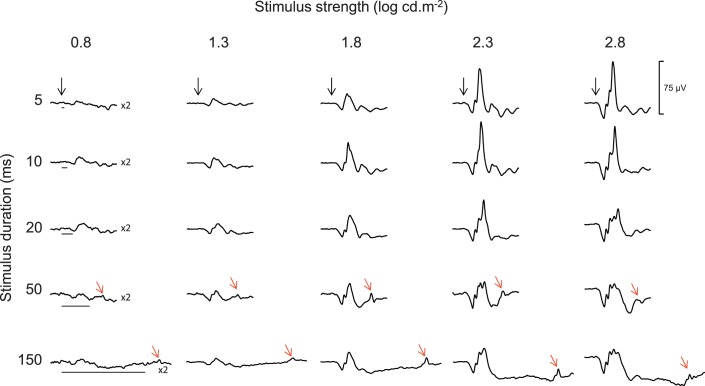
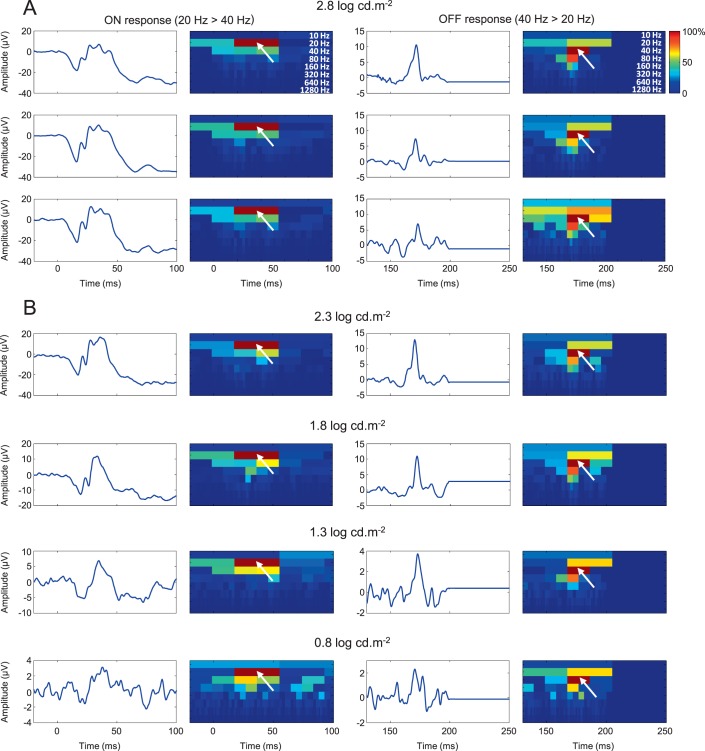
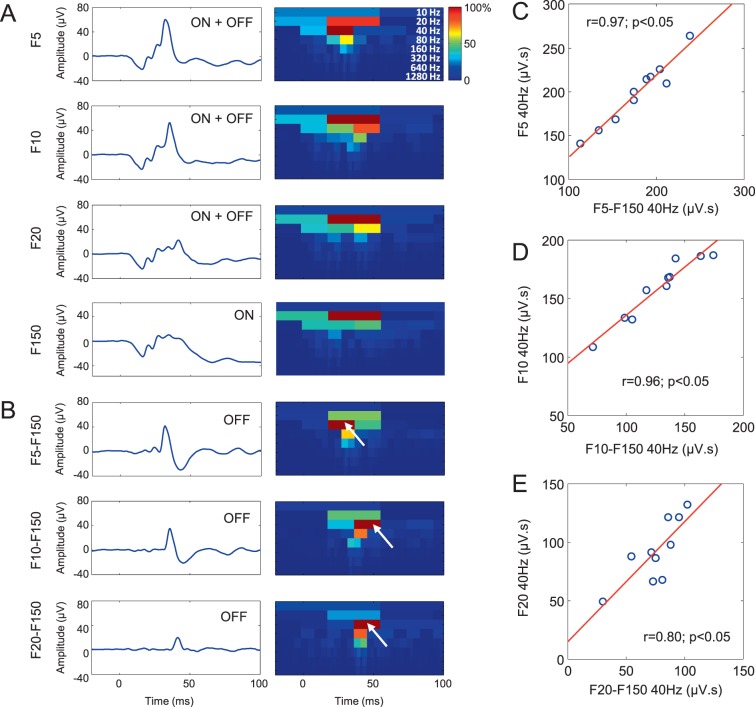
Purpose: Discrete wavelet transform (DWT) analyses suggest that the 20- and 40-Hz components of the short-flash photopic electroretinogram (ERG) are closely related to the ON and OFF pathways, respectively. With the DWT, we examined how the ERG ON and OFF components are modulated by the stimulus intensity and/or duration.
Methods: Discrete wavelet transform descriptors (20, 40 Hz and 40:20-Hz ratio) were extracted from ERGs evoked to 25 combinations of flash durations (150-5 ms) and strengths (0.8-2.8 log cd.m-2).
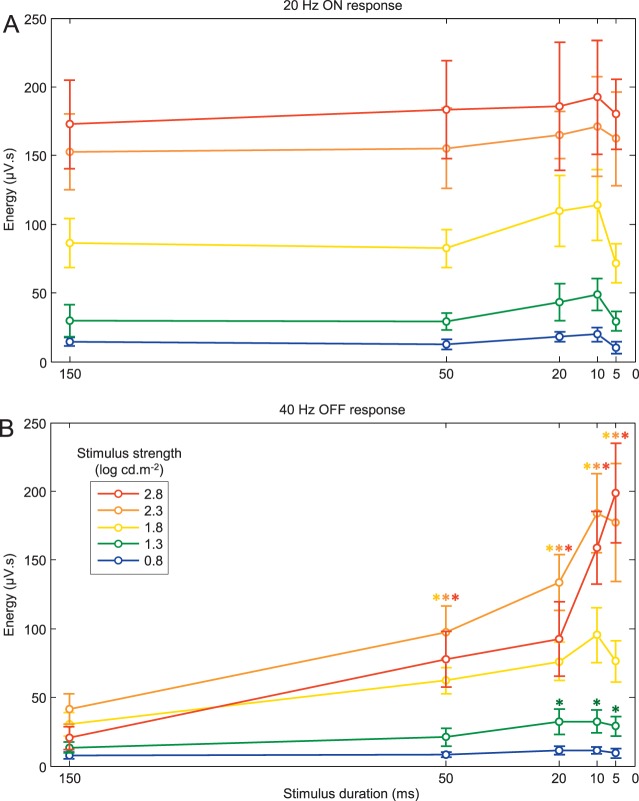
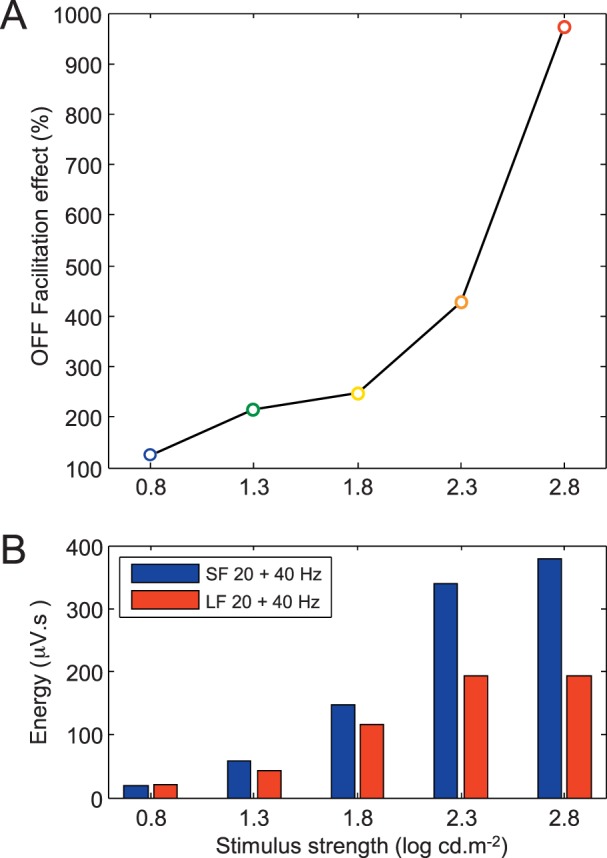
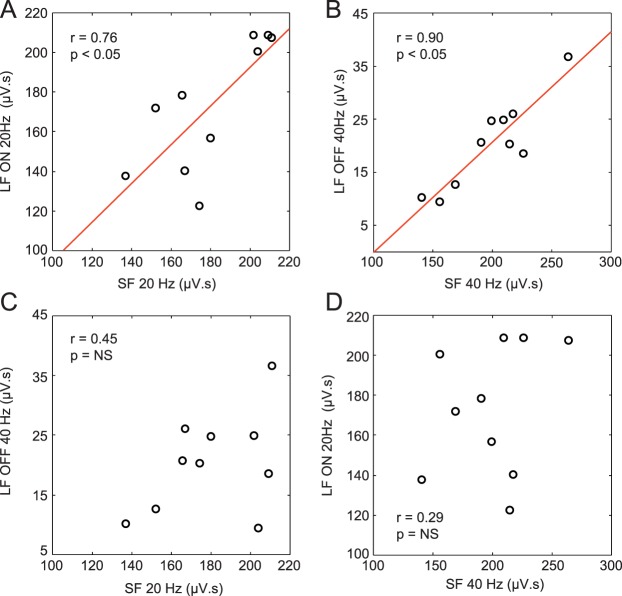
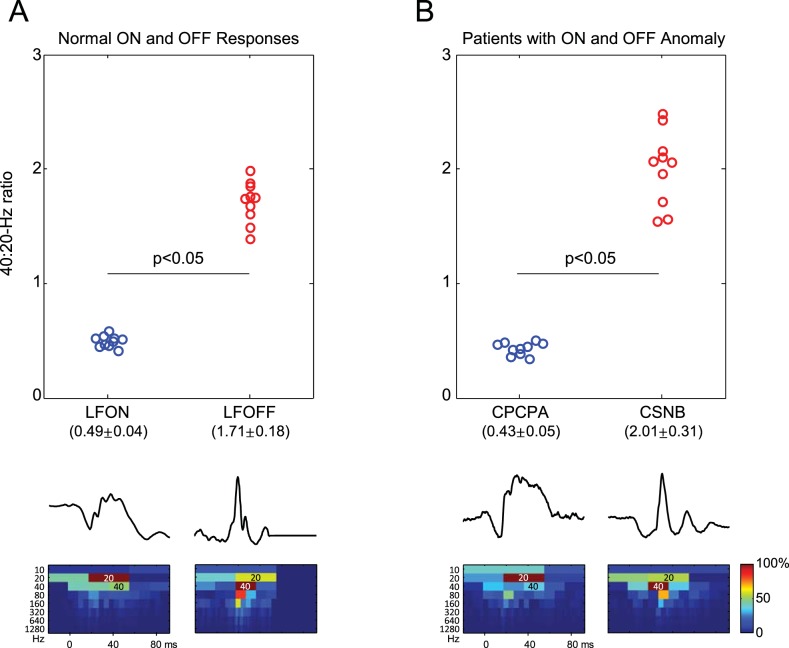
Results: In ERGs evoked to the 150-ms stimulus (to separate the ON and OFF ERGs), the 40:20-Hz ratio of ON ERGs (mean ± SD: 0.49 ± 0.04) was significantly smaller (P < 0.05) than that of OFF ERGs (1.71 ± 0.18) owing to a significantly (P < 0.05) higher contribution of the 20 and 40 Hz components to the ON and OFF ERGs, respectively. With brighter stimuli, the ON and OFF components increased similarly (P < 0.05). While progressively shorter flashes had no impact (P > 0.05) on the ON component, it exponentially enhanced (P < 0.05) the OFF component.
Conclusions: Discrete wavelet transform allows for an accurate determination of ON and OFF retinal pathways even in ERGs evoked to a short flash. To our knowledge, the significant OFF facilitatory effect evidenced with shorter stimuli has not previously been reported.
Translational relevance: The DWT approach should offer a rapid, easy, and reproducible approach to retrospectively and prospectively evaluate the function of the retinal ON and OFF pathways using the standard (short-flash duration) clinical ERG stimulus.
Keywords: ON and OFF; electroretinogram; human; stimulus duration; stimulus strength; wavelet transform.
Conflict of interest statement
M. Gauvin, None; M. Sustar, None; J.M. Little, None; J. Brecelj, None; J.M. Lina, None; P. Lachapelle, None
Figures
References
-
- Sieving PA,, Murayama K,, Naarendorp F. Push-pull model of the primate photopic electroretinogram: a role for hyperpolarizing neurons in shaping the b-wave. Vis Neurosci. 1994. ; 11: 519–532. - PubMed
-
- Gauvin M,, Little JM,, Lina JM,, Lachapelle P. Functional decomposition of the human ERG based on the discrete wavelet transform. J Vis. 2015. ; 15: 14. - PubMed
-
- Ueno S,, Kondo M,, Ueno M,, Miyata K,, Terasaki H,, Miyake Y. Contribution of retinal neurons to d-wave of primate photopic electroretinograms. Vision Res. 2006. ; 46: 658–664. - PubMed
-
- Hawlina M,, Konec B. New noncorneal HK-loop electrode for clinical electroretinography. Doc Ophthalmol. 1992. ; 81: 253–259. - PubMed
LinkOut - more resources
Full Text Sources
Other Literature Sources
Miscellaneous