Review
. 2016:2016:8163803.
doi: 10.1155/2016/8163803. Epub 2016 Dec 21.

IgE-Related Chronic Diseases and Anti-IgE-Based Treatments

Affiliations
Review

IgE-Related Chronic Diseases and Anti-IgE-Based Treatments

Arnau Navinés-Ferrer et al. J Immunol Res. 2016.

Abstract

IgE is an immunoglobulin that plays a central role in acute allergic reactions and chronic inflammatory allergic diseases. The development of a drug able to neutralize this antibody represents a breakthrough in the treatment of inflammatory pathologies with a probable allergic basis. This review focuses on IgE-related chronic diseases, such as allergic asthma and chronic urticaria (CU), and on the role of the anti-IgE monoclonal antibody, omalizumab, in their treatment. We also assess the off-label use of omalizumab for other pathologies associated with IgE and report the latest findings concerning this drug and other new related drugs. To date, omalizumab has only been approved for severe allergic asthma and unresponsive chronic urticaria treatments. In allergic asthma, omalizumab has demonstrated its efficacy in reducing the dose of inhaled corticosteroids required by patients, decreasing the number of asthma exacerbations, and limiting the effect on airway remodeling. In CU, omalizumab treatment rapidly improves symptoms and in some cases achieves complete disease remission. In systemic mastocytosis, omalizumab also improves symptoms and its prophylactic use to prevent anaphylactic reactions has also been discussed. In other pathologies such as atopic dermatitis, food allergy, allergic rhinitis, nasal polyposis, and keratoconjunctivitis, omalizumab significantly improves clinical manifestations. Omalizumab acts in two ways: by sequestering free IgE and by accelerating the dissociation of the IgE-Fcε receptor I complex.


Conflict of interest statement

The authors declare that there are no competing interests regarding the publication of this paper.

Figures
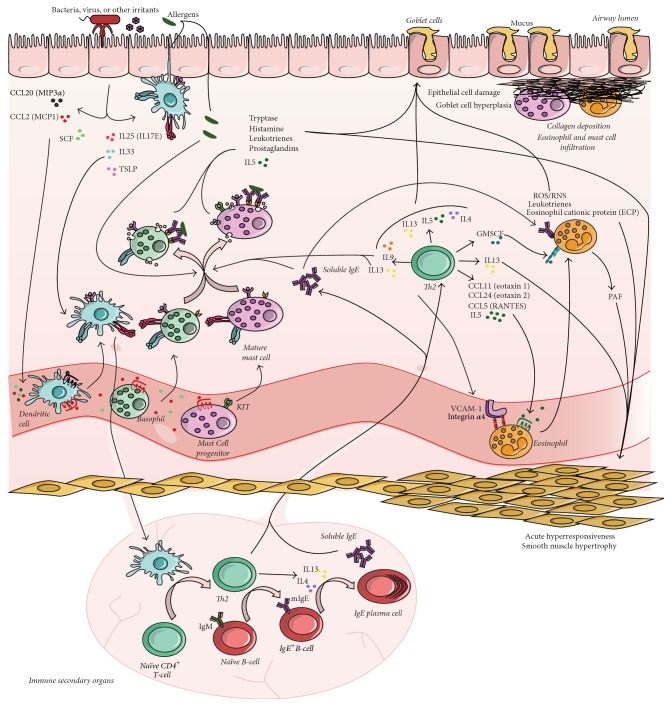
Figure 1
Figure 1
Pathophysiology of allergic asthma. Volatile allergens and/or other irritants can activate sentinel dendritic cells and/or epithelial cells in the airway epithelium that will also recruit and activate dendritic cells. The activation of dendritic cells will trigger Th2 responses, leading to the accumulation of soluble IgE as well as several cytokines. These cytokines will recruit mast cell progenitors, as well as basophils and eosinophils, which will be activated and secrete proinflammatory cytokines and other soluble factors such as histamine, tryptase, prostaglandins, and leukotrienes. As a consequence, there will be an increase in mucus production and bronchoconstriction (for mechanistic details, see text). If this activation is maintained, the airway will suffer persistent structural changes that will cause chronic bronchoconstriction due to fibrosis in the subepithelium and smooth muscle hypertrophy. mIgE: membrane IgE; PAF: platelet-activating factor.
Figure 2
Figure 2
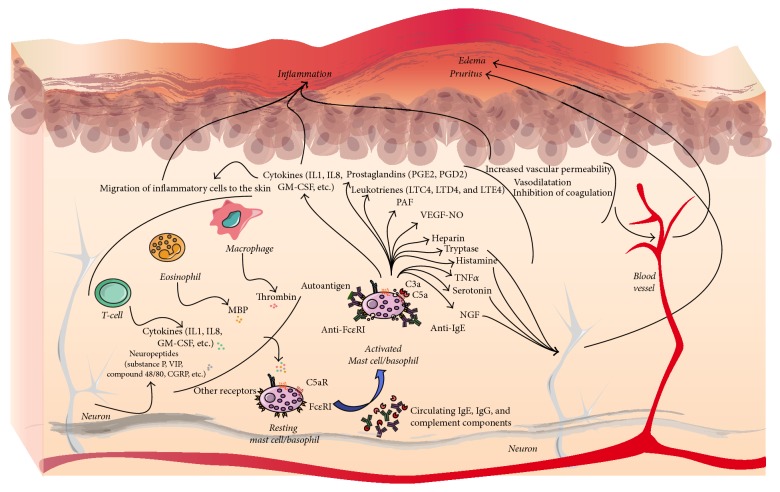
Pathophysiology of urticaria. In CSU patients, stimulation of mast cells (MC) and basophils (BS) can be triggered by IgE against autoantigens, by IgG against FcεRI or IgE against IgE itself, or by complement. Moreover, MC and BS can be stimulated by molecules secreted by other immune cells or neurons. Once activated, MC and BS secrete several preformed mediators, such as histamine or tryptase, and other de novo mediators, such as prostaglandins and leukotrienes, will promote inflammation, vascular permeability, and vasodilatation, as well as neuron stimulation. These effects are transduced into edema and pruritus. Secretion of cytokines by MC and BS triggers migration of other immune cells to the skin, which will contribute to skin inflammation. MBP: major basic protein; NFG: nerve growth factor; PAF: platelet-activating factor; NO: nitric oxide.
Figure 3
Figure 3
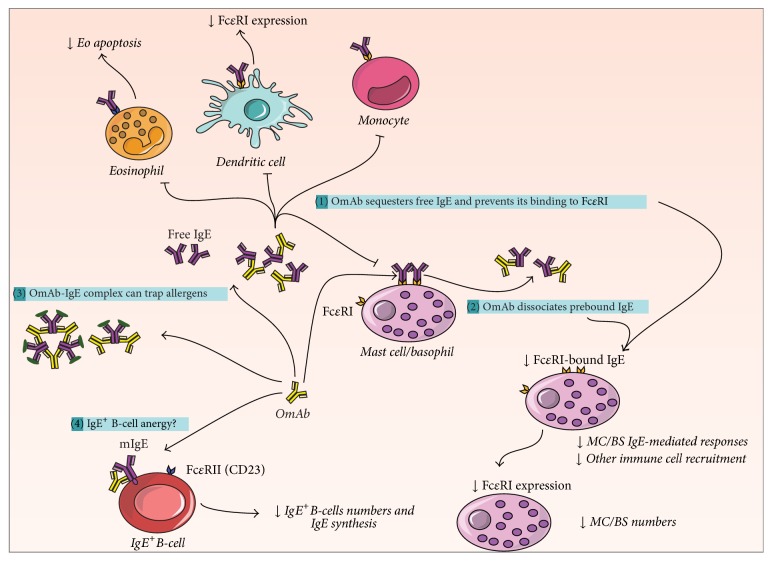
Mechanism of action of OmAb. The two main described mechanisms of action of OmAb are (1) its ability to sequester free IgE and block its binding to IgE receptors (FcεRI) and (2) its ability to accelerate the dissociation of IgE bound to FcεRI in mast cells (MC) and basophils (BS). As a consequence, there is a reduction of IgE-triggered responses, as well as a reduction of the number of eosinophils (Eo), mast cells (MC), and basophils (BS). As a complementary mechanism, IgE complexed with OmAb may trap allergens (3). Another less understood mechanism would lead to a reduction of IgE+ B-cell numbers and a decrease of IgE synthesis (4). mIgE: membrane IgE.

References

    1. Oettgen H. C. Fifty years later: emerging functions of IgE antibodies in host defense, immune regulation, and allergic diseases. Journal of Allergy and Clinical Immunology. 2016;137(6):1631–1645. doi: 10.1016/j.jaci.2016.04.009. - DOI - PMC - PubMed
    1. Asai K., Kitaura J., Kawakami Y., et al. Regulation of mast cell survival by IgE. Immunity. 2001;14(6):791–800. doi: 10.1016/S1074-7613(01)00157-1. - DOI - PubMed
    1. Kalesnikoff J., Huber M., Lam V., et al. Monomeric IgE stimulates signaling pathways in mast cells that lead to cytokine production and cell survival. Immunity. 2001;14(6):801–811. doi: 10.1016/S1074-7613(01)00159-5. - DOI - PubMed
    1. Ishizaka K. Basic mechanisms of IgE-mediated hypersensitivity. Current Opinion in Immunology. 1989;1(4):625–629. doi: 10.1016/0952-7915(89)90031-9. - DOI - PubMed
    1. Babu K. S., Polosa R., Morjaria J. B. Anti-IgE—emerging opportunities for Omalizumab. Expert Opinion on Biological Therapy. 2013;13(5):765–777. doi: 10.1517/14712598.2013.782391. - DOI - PubMed

MeSH terms