. 2017 Jan 5;3(1):e126.
doi: 10.1212/NXG.0000000000000126. eCollection 2017 Feb.

ABCA7 loss-of-function variants, expression, and neurologic disease risk

Affiliations

ABCA7 loss-of-function variants, expression, and neurologic disease risk

Mariet Allen et al. Neurol Genet. .

Abstract

Objective: To investigate and characterize putative "loss-of-function" (LOF) adenosine triphosphate-binding cassette, subfamily A member 7 (ABCA7) mutations reported to associate with Alzheimer disease (AD) risk.

Methods: We genotyped 6 previously reported ABCA7 putative LOF variants in 1,465 participants with AD, 381 participants with other neuropathologies (non-AD), and 1,043 controls and assessed the overall mutational burden for association with different diagnosis groups. We measured brain ABCA7 protein and messenger RNA (mRNA) levels using Western blot and quantitative PCR, respectively, in 11 carriers of the 3 most common variants, and sequenced all 47 ABCA7 exons in these participants to screen for other coding variants.

Results: At least one of the investigated variants was identified in 45 participants with late-onset Alzheimer disease, 12 participants with other neuropathologies, and 11 elderly controls. Association analysis revealed a significantly higher burden of these variants in participants with AD (p = 5.00E-04) and those with other neuropathologies (p = 8.60E-03) when compared with controls. Concurrent analysis of brain ABCA7 mRNA and protein revealed lower protein but not mRNA in p.L1403fs carriers, lower mRNA but not protein in p.E709fs carriers, and additional deleterious mutations in some c.5570+5G>C carriers.

Conclusions: Our results suggest that LOF may not be a common mechanism for these ABCA7 variants and expand the list of neurologic diseases enriched for them.


Figures
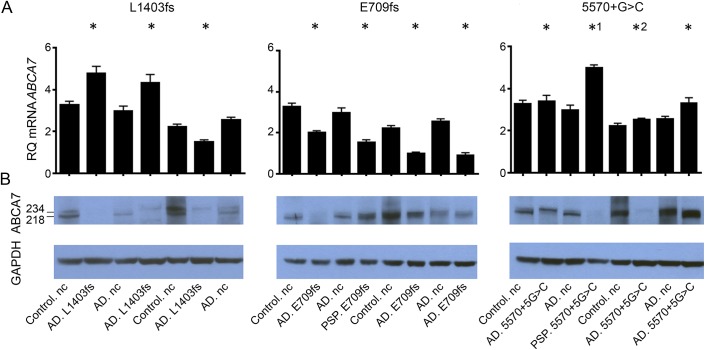
Figure 1
Figure 1. Brain ABCA7 protein and messenger RNA expression in mutation carriers and noncarriers
(A) ABCA7 messenger RNA (mRNA) and (B) protein isolated from human brain tissue (temporal cortex) were assessed using quantitative PCR and Western blot, respectively, for carriers and noncarriers (nc) of the 3 most frequent ABCA7 putative loss-of-function mutations investigated (L1403fs, E709fs, and 5570+G>C). Mutation carriers with a pathologic diagnosis of either Alzheimer disease (AD) or progressive supranuclear palsy (PSP) were analyzed. Two clinically normal control (control.nc) and 2 pathologic AD participants (AD.nc) without any predicted deleterious ABCA7 mutations were analyzed as mutation noncarriers. *1 and *2 indicate 5570+G>C carriers with additional ABCA7 predicted deleterious mutations. The Western blots from the human brain lysates have 2 bands, 1 at 234 kDa corresponding to full-length ABCA7 protein (ENSP00000414062) and 1 at 218 kDa that is the expected molecular weight of a known alternative isoform ENSP00000465322 (ENST00000433129) starting in exon 7. *Denotes ABCA7 mutation carriers. GAPDH = glyceraldehyde 3-phosphate dehydrogenase; RQ = relative quantity.
Figure 2
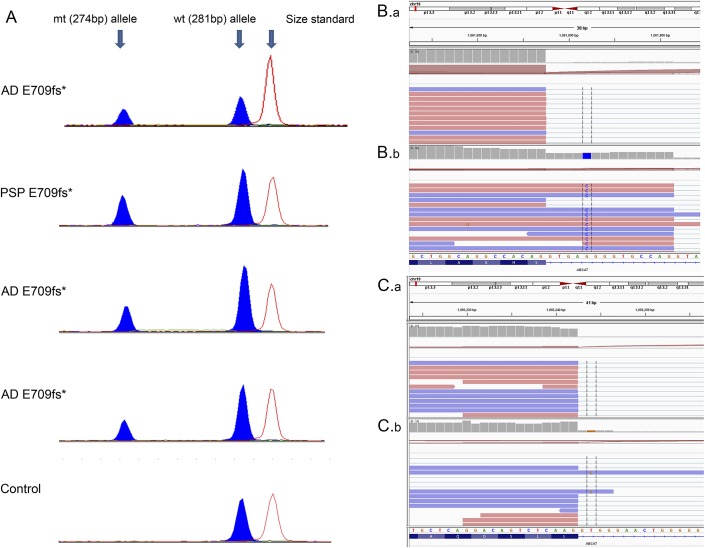
Figure 2. Brain ABCA7 messenger RNA expression measurements with semiquantitative PCR or RNA sequencing in select mutation carriers and noncarriers
(A) Relative messenger RNA (mRNA) levels of E709fs mutant (mt) and wild-type (wt) alleles in Alzheimer disease (AD) and progressive supranuclear palsy (PSP) carriers measured using semiquantitative PCR. A control noncarrier is shown for reference. Peak heights indicate relative mRNA levels and show reduced levels of the E709fs mutant allele. (B.b) RNAseq data for canonical splice-site mutation carriers for 5570+G>C and (C.b) 4416+2T>G are shown. B.a and C.a are from a participant without these splice-site mutations. RNAseq data are viewed using Integrative Genomics Viewer (IGV). Intronic reads for the mutant allele are included in the mRNA of both canonical splice-site mutation carriers, indicating that these mutations alter splicing. *Denotes ABCA7 mutation carriers.

References

    1. Steinberg S, Stefansson H, Jonsson T, et al. Loss-of-function variants in ABCA7 confer risk of Alzheimer's disease. Nat Genet 2015;47:445–447. - PubMed
    1. Cuyvers E, De Roeck A, Van den Bossche T, et al. Mutations in ABCA7 in a Belgian cohort of Alzheimer's disease patients: a targeted resequencing study. Lancet Neurol 2015;14:814–822. - PubMed
    1. Vardarajan BN, Ghani M, Kahn A, et al. Rare coding mutations identified by sequencing of Alzheimer disease genome-wide association studies loci. Ann Neurol 2015;78:487–498. - PMC - PubMed
    1. Le Guennec K, Nicolas G, Quenez O, et al. ABCA7 rare variants and Alzheimer disease risk. Neurology 2016;86:2134–2137. - PMC - PubMed
    1. Del-Aguila JL, Fernandez MV, Jimenez J, et al. Role of ABCA7 loss-of-function variant in Alzheimer's disease: a replication study in European-Americans. Alzheimers Res Ther 2015;7:73. - PMC - PubMed

LinkOut - more resources