


Adherence with physical activity monitoring wearable devices in a community-based population: observations from the Washington, D.C., Cardiovascular Health and Needs Assessment
- PMID: 28097627
- PMCID: PMC5684058
- DOI: 10.1007/s13142-016-0454-0
Adherence with physical activity monitoring wearable devices in a community-based population: observations from the Washington, D.C., Cardiovascular Health and Needs Assessment
Abstract
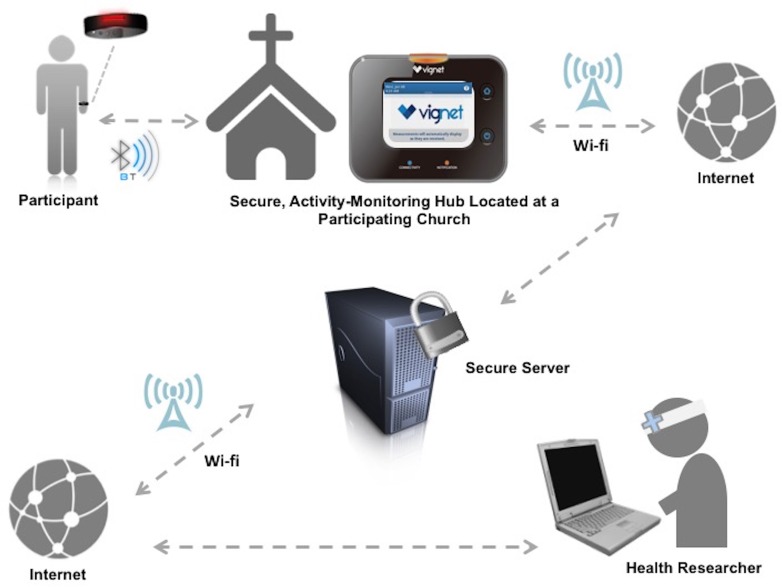
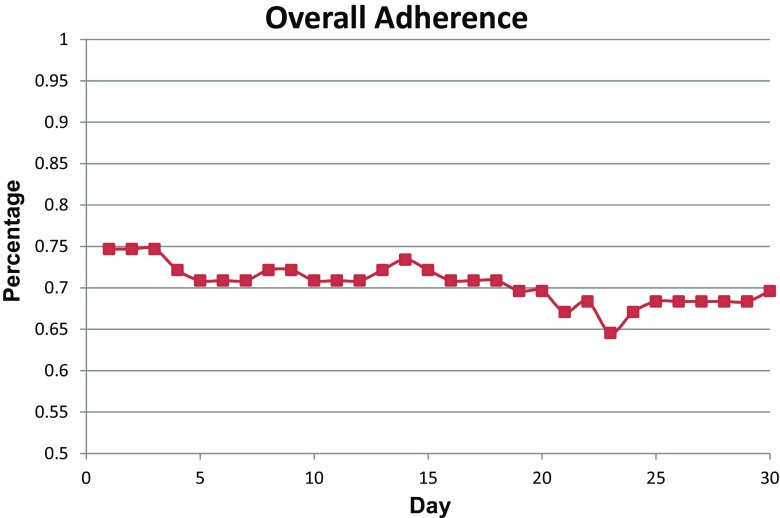
Wearable mobile health (mHealth) technologies offer approaches for targeting physical activity (PA) in resource-limited, community-based interventions. We sought to explore user characteristics of PA tracking, wearable technology among a community-based population within a health and needs assessment. In 2014-2015, we conducted the Washington, D.C., Cardiovascular Health and Needs Assessment in predominantly African-American churches among communities with higher obesity rates and lower household incomes. Participants received a mHealth PA monitor and wirelessly uploaded PA data weekly to church data collection hubs. Participants (n = 99) were 59 ± 12 years, 79% female, and 99% African-American, with a mean body mass index of 33 ± 7 kg/m2. Eighty-one percent of participants uploaded PA data to the hub and were termed "PA device users." Though PA device users were more likely to report lower household incomes, no differences existed between device users and non-users for device ownership or technology fluency. Findings suggest that mHealth systems with a wearable device and data collection hub may feasibly target PA in resource-limited communities.
Keywords: Activity monitoring; African-American; Community-based participatory research; Obesity; Physical activity; mHealth technology.
Conflict of interest statement
Disclosure of potential conflict of interest and funding sources
The views expressed in this manuscript are those of the authors and do not necessarily represent the views of the National Heart, Lung, and Blood Institute; the National Institutes of Health; or the U.S. Department of Health and Human Services. The authors declare that they have no conflict of interest.
This study was funded by grant HL006168. Funding for TP-W, LY, and VM is provided through the Division of Intramural Research of the National Heart, Lung, and Blood Institute (NHLBI) of the National Institutes of Health (NIH). Funding for CA is provided through a professional services contract (contract #HHSN268201300173P) through the Division of Intramural Research of NHLBI at NIH. Funding for ST and JA-B is provided through the Office of Intramural Training and Education of the NIH. Funding for GW and AB is provided through the Clinical Center, NIH. Funding for MP-L is provided through the Division of Intramural Research of NHLBI at NIH.
Research involving human participants
Statement of human rights: All procedures involving human participants performed in the Washington, D.C. CV Health and Needs Assessment study were in accordance with the ethical standards of the National Heart, Lung, and Blood Institute (NHLBI) Institutional Review Board study and with the 1964 Helsinki declaration and its later amendments or comparable ethical standards.
Informed consent
Written informed consent was obtained from all individual participants included in the study.
Figures
References
-
- Kochanek, K.D., et al., Mortality in the United States, 2013. NCHS Data Brief, 2014(178): p. 1–8. - PubMed
-
- Smedley BD, S.A., Nelson AR, editors, Unequal treatment: confronting racial and ethnic disparities in health care. Washington DC: 2002 by the National Academy of Sciences; 2003. - PubMed
-
- Cooper R, Cutler J, Desvigne-Nickens P, Fortmann SP, Friedman L, Havlik R, et al. Trends and disparities in coronary heart disease, stroke, and other cardiovascular diseases in the United States: findings of the national conference on cardiovascular disease prevention. Circulation. 2000;102(25):3137–3147. doi: 10.1161/01.CIR.102.25.3137. - DOI - PubMed
-
- Mensah GA M.A., Ford ES, Greenlund KJ, Croft JB, State of disparities in cardiovascular health in the United States. Circulation 2005;111(10):1233–1241. doi: 10.1161/01.cir.0000158136.76824.04. - PubMed
Publication types
MeSH terms
Grants and funding
LinkOut - more resources
Full Text Sources
Other Literature Sources
Medical
