


The risk factors for postpartum depression: A population-based study
- PMID: 28098957
- PMCID: PMC5462547
- DOI: 10.1002/da.22597
The risk factors for postpartum depression: A population-based study
Abstract
Background: Postpartum depression (PPD) can result in negative personal and child developmental outcomes. Only a few large population-based studies of PPD have used clinical diagnoses of depression and no study has examined how a maternal depression history interacts with known risk factors. The objective of this study was to examine the impact of a depression history on PPD and pre- and perinatal risk factors.
Methods: A nationwide prospective cohort study of all women with live singleton births in Sweden from 1997 through 2008 was conducted. Relative risk (RR) of clinical depression within the first year postpartum and two-sided 95% confidence intervals were estimated.
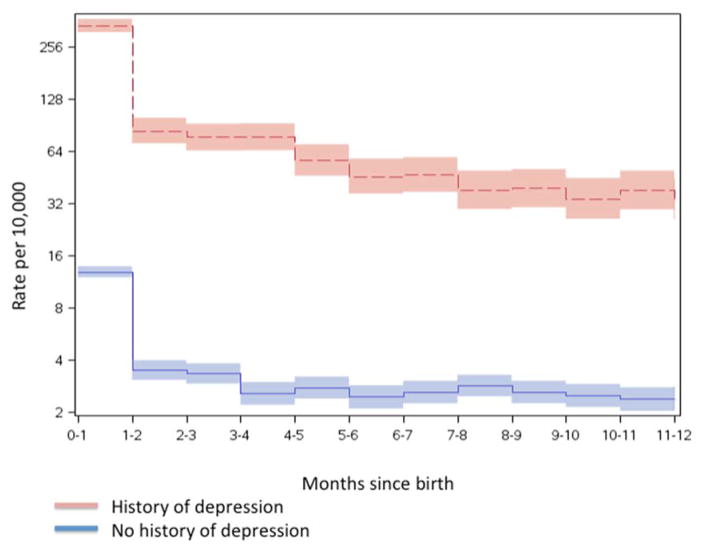
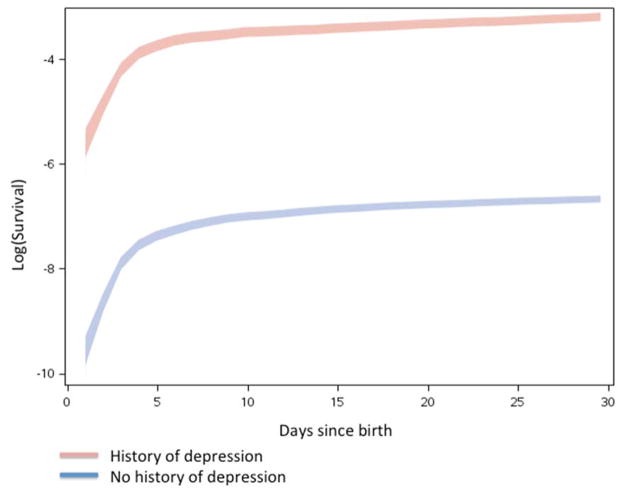
Results: The RR of PPD in women with a history of depression was estimated at 21.03 (confidence interval: 19.72-22.42), compared to those without. Among all women, PPD risk increased with advanced age (1.25 (1.13-1.37)) and gestational diabetes (1.70 (1.36-2.13)). Among women with a history of depression, pregestational diabetes (1.49 (1.01-2.21)) and mild preterm delivery also increased risk (1.20 (1.06-1.36)). Among women with no depression history, young age (2.14 (1.79-2.57)), undergoing instrument-assisted (1.23 (1.09-1.38)) or cesarean (1.64(1.07-2.50)) delivery, and moderate preterm delivery increased risk (1.36 (1.05-1.75)). Rates of PPD decreased considerably after the first postpartum month (RR = 0.27).
Conclusion: In the largest population-based study to date, the risk of PPD was more than 20 times higher for women with a depression history, compared to women without. Gestational diabetes was independently associated with a modestly increased PPD risk. Maternal depression history also had a modifying effect on pre- and perinatal PPD risk factors.
Keywords: assessment/diagnosis; depression; epidemiology; maternal-child; pregnancy and postpartum.
© 2017 Wiley Periodicals, Inc.
Conflict of interest statement
H Larsson has served as a speaker for Eli-Lilly and Shire and has received a research grant from Shire; all outside the submitted work.
Conflict of Interest Disclosures: Larsson has served as a speaker for Eli-Lilly and has received a research grant from Shire; both outside the submitted work.
Figures
References
-
- Gaynes BN, Gavin N, Meltzer-Brody S, et al. Perinatal Depression: Prevalence, Screening Accuracy, and Screening Outcomes. Rockville, MD: Agency for Healthcare Research and Quality; Feb, 2005. Evidence Report/Technology Assessment No. 119. (Prepared by the RTI-University of North Carolina Evidence-based Practice Center, under Contract No. 290-02-0016.) AHRQ Publication No. 05-E006-2. - PMC - PubMed
-
- Davé S, Petersen I, Sherr L, Nazareth I. Incidence of maternal and paternal depression in primary care: a cohort study using a primary care database. Arch Pediatr Adolesc Med. 2010;164(11):1038–44. - PubMed
-
- Robertson E, Grace S, Wallington T, Stewart DE. Antenatal risk factors for postpartum depression: a synthesis of recent literature. Gen Hosp Psychiatry. 2004;26(4):289–95. - PubMed
MeSH terms
Grants and funding
LinkOut - more resources
Full Text Sources
Other Literature Sources
Medical
