


Hepatitis B incidence and prevention with antiretroviral therapy among HIV-positive individuals in Uganda
- PMID: 28099188
- PMCID: PMC5380792
- DOI: 10.1097/QAD.0000000000001399
Hepatitis B incidence and prevention with antiretroviral therapy among HIV-positive individuals in Uganda
Abstract
Objective: Antiretroviral therapy (ART) may interfere with replication of hepatitis B virus (HBV), raising the hypothesis that HBV infection might be prevented by ART. We investigated the incidence and risk factors associated with HBV among HIV-infected adults in Rakai, Uganda.
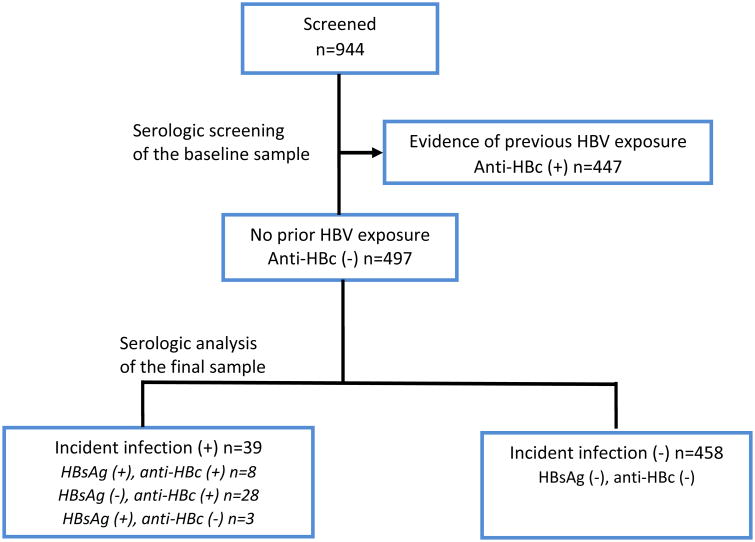
Methods: We screened stored sera from 944 HIV-infected adults enrolled in the Rakai Community Cohort Study between September 2003 and March 2015 for evidence of HBV exposure. Serum from participants who tested anti-hepatitis B core-negative (497) at baseline were tested over 3-7 consecutive survey rounds for incident HBV. Poisson incidence methods were used to estimate incidence of HBV with 95% confidence intervals (CIs), whereas Cox proportional regression methods were used to estimate hazard ratios (HRs).
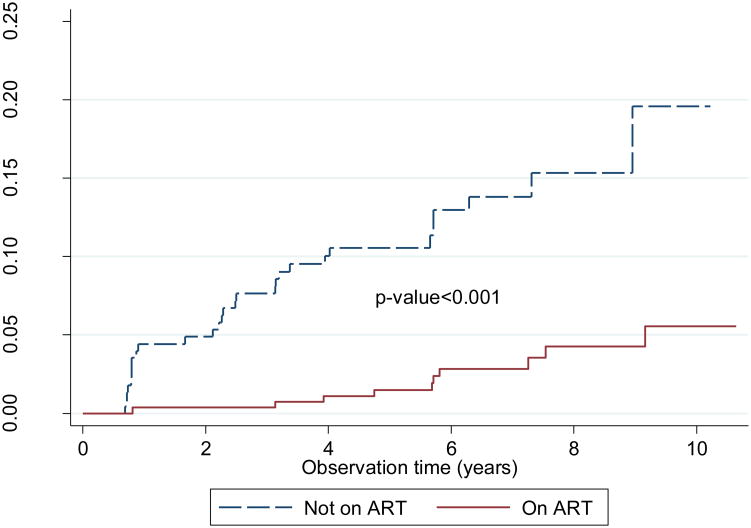
Results: Thirty-nine HBV infections occurred over 3342 person-years, incidence 1.17/100 person-years. HBV incidence was significantly lower with ART use: 0.49/100 person-years with ART and 2.3/100 person-years without ART [adjusted HR (aHR) 0.25, 95% CI 0.1-0.5, P < 0.001], and with lamivudine (3TC) use: 0.58/100 person-years) with 3TC and 2.25/100 person-years without 3TC (aHR 0.32, 95% CI 0.1-0.7, P = < 0.007). No new HBV infections occurred among those on tenofovir-based ART. HBV incidence also decreased with HIV RNA suppression: 0.6/100 person-years with 400 copies/ml or less and 4.0/100 person-years with more than 400 copies/ml (aHR, 6.4, 95% CI 2.2-19.0, P < 0.001); and with age: 15-29 years versus 40-50 years (aHR 3.2, 95% CI 1.2-9.0); 30-39 years versus 40-50 years (aHR 2.1, 95% CI 0.9-5.3).
Conclusion: HBV continues to be acquired in adulthood among HIV-positive Ugandans and HBV incidence is dramatically reduced with HBV-active ART. In addition to widespread vaccination, initiation of ART may prevent HBV acquisition among HIV-positive adults in sub-Saharan Africa.
Figures
References
-
-
The 2014 UNAIDS Global Statistics fact sheet
-
-
- Matthews PC, Geretti AM, Goulder PJ, Klenerman P. Epidemiology and impact of HIV coinfection with hepatitis B and hepatitis C viruses in Sub-Saharan Africa. Journal of clinical virology : the official publication of the Pan American Society for Clinical Virology. 2014;61(1):20–33. - PubMed
-
- Elizabeth W, Hwang M, Ramsey Cheung MD. Global Epidemiology of Hepatitis B Virus (HBV) Infection N A J Med Sci. 2011;4(1):7–13. 2011.
-
- Weber R, Ruppik M, Rickenbach M, Spoerri A, Furrer H, Battegay M, et al. Decreasing mortality and changing patterns of causes of death in the Swiss HIV Cohort Study. HIV medicine. 2013;14(4):195–207. - PubMed
-
- Joshi D, O'Grady J, Dieterich D, Gazzard B, Agarwal K. Increasing burden of liver disease in patients with HIV infection. Lancet (London, England) 2011;377(9772):1198–209. - PubMed
Publication types
MeSH terms
Substances
Grants and funding
- U01 AI100031/AI/NIAID NIH HHS/United States
- R01 AI114438/AI/NIAID NIH HHS/United States
- U54 CA190165/CA/NCI NIH HHS/United States
- R01 AI047608/AI/NIAID NIH HHS/United States
- Z01 AI001040/ImNIH/Intramural NIH HHS/United States
- R01 HD070769/HD/NICHD NIH HHS/United States
- P30 AI027757/AI/NIAID NIH HHS/United States
- HHSN261200800001C/RC/CCR NIH HHS/United States
- D43 TW010132/TW/FIC NIH HHS/United States
- U01 AI051171/AI/NIAID NIH HHS/United States
- D43 CA153720/CA/NCI NIH HHS/United States
- R01 HD050180/HD/NICHD NIH HHS/United States
- R37 DA013806/DA/NIDA NIH HHS/United States
- U01 AI075115/AI/NIAID NIH HHS/United States
- R01 AI110324/AI/NIAID NIH HHS/United States
- Z99 AI999999/ImNIH/Intramural NIH HHS/United States
- R25 TW009345/TW/FIC NIH HHS/United States
- HHSN261200800001E/CA/NCI NIH HHS/United States
LinkOut - more resources
Full Text Sources
Other Literature Sources
Medical
