. 2017 Jan 18;12(1):e0170459.
doi: 10.1371/journal.pone.0170459. eCollection 2017.

Social Contact Structures and Time Use Patterns in the Manicaland Province of Zimbabwe

Affiliations

Social Contact Structures and Time Use Patterns in the Manicaland Province of Zimbabwe

Alessia Melegaro et al. PLoS One. .

Abstract

Background: Patterns of person-to-person contacts relevant for infectious diseases transmission are still poorly quantified in Sub-Saharan Africa (SSA), where socio-demographic structures and behavioral attitudes are expected to be different from those of more developed countries.

Methods and findings: We conducted a diary-based survey on daily contacts and time-use of individuals of different ages in one rural and one peri-urban site of Manicaland, Zimbabwe. A total of 2,490 diaries were collected and used to derive age-structured contact matrices, to analyze time spent by individuals in different settings, and to identify the key determinants of individuals' mixing patterns. Overall 10.8 contacts per person/day were reported, with a significant difference between the peri-urban and the rural site (11.6 versus 10.2). A strong age-assortativeness characterized contacts of school-aged children, whereas the high proportion of extended families and the young population age-structure led to a significant intergenerational mixing at older ages. Individuals spent on average 67% of daytime at home, 2% at work, and 9% at school. Active participation in school and work resulted the key drivers of the number of contacts and, similarly, household size, class size, and time spent at work influenced the number of home, school, and work contacts, respectively. We found that the heterogeneous nature of home contacts is critical for an epidemic transmission chain. In particular, our results suggest that, during the initial phase of an epidemic, about 50% of infections are expected to occur among individuals younger than 12 years and less than 20% among individuals older than 35 years.

Conclusions: With the current work, we have gathered data and information on the ways through which individuals in SSA interact, and on the factors that mostly facilitate this interaction. Monitoring these processes is critical to realistically predict the effects of interventions on infectious diseases dynamics.


Conflict of interest statement

The authors have declared that no competing interests exist.

Figures
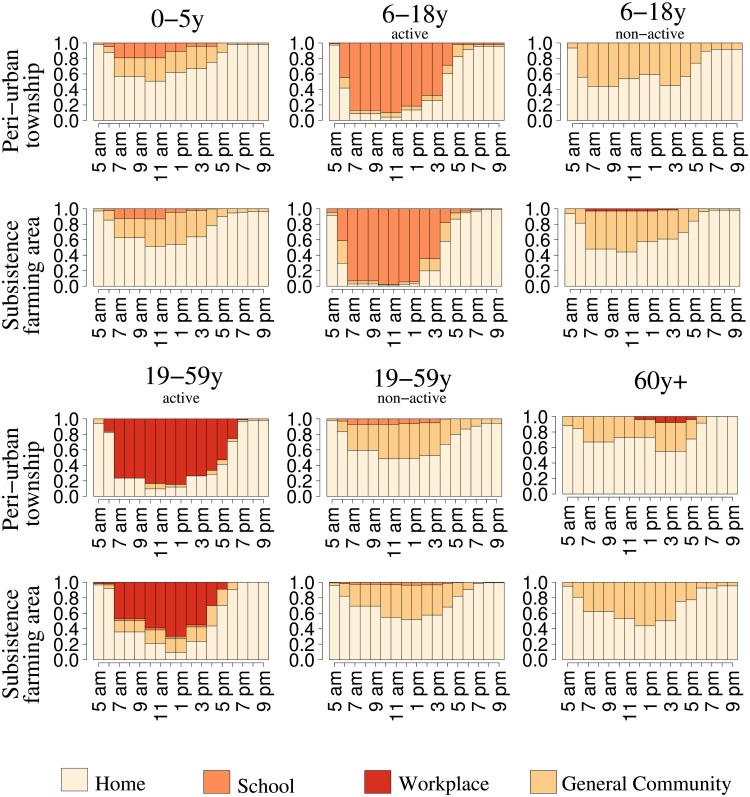
Fig 1
Fig 1. Patterns of time use by setting, age group, and site, Manicaland (Zimbabwe), 2013.
Proportion of individuals present in different settings (home, school, workplace, general community) at different hours of the day (from 5 am to 10 pm) during a weekday (from Monday to Friday), stratified by age group and site of residence. The age groups 6–18 years and 19–59 years are stratified between active and non-active students and workers, respectively.
Fig 2
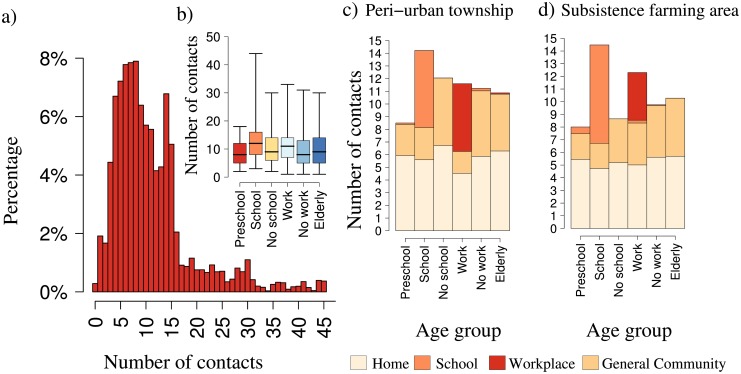
Fig 2. Number of contacts per participant, stratified by age and by activity class, Manicaland (Zimbabwe), 2013.
a) Distribution of the overall number of contacts reported by participants. b) Boxplot (2.5%, 25%, 50%, 75%, and 97.5% quantiles) of the number of contacts, stratified by age group of participant and by active participation to school or work: preschool (0–5 yrs.), school and no school (6–18 yrs.), work and no work (19–59 yrs.), and the elderly (60+ yrs.). c) Average number of contacts per setting, stratified by age group of participant and active participation to school and work, in the peri-urban township. d) As c), but for the subsistence farming area.
Fig 3
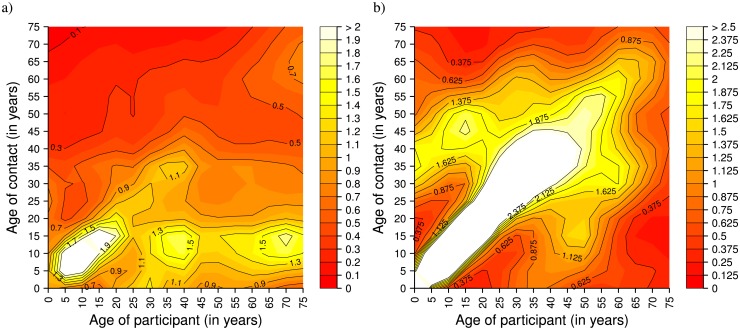
Fig 3. Comparison between social contacts in Manicaland (Zimbabwe) and in Italy.
a) Social contact matrix derived for Manicaland (Zimbabwe), 2013, considering all reported contacts and applying bivariate smoothing. The matrix shows the average number of contacts during working days (weekends and school holidays are excluded) of participants in the i-th age group with individuals in the j-th age group. b) As a), but for Italy (data from the POLYMOD study [4], weekends excluded).
Fig 4
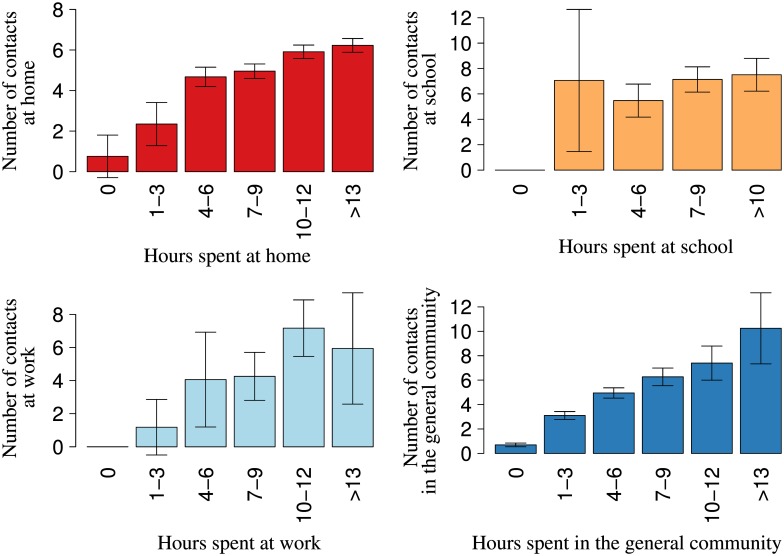
Fig 4. Number of social contacts per setting by total time spent.
Average number of setting-specific contacts by total time spent (in hours) by participants in the respective setting: a) at home, b) at school, c) at work, and d) in the general community, Manicaland (Zimbabwe), 2013. For each group of time spent in the setting, we reported the 95% CI around the average.
Fig 5
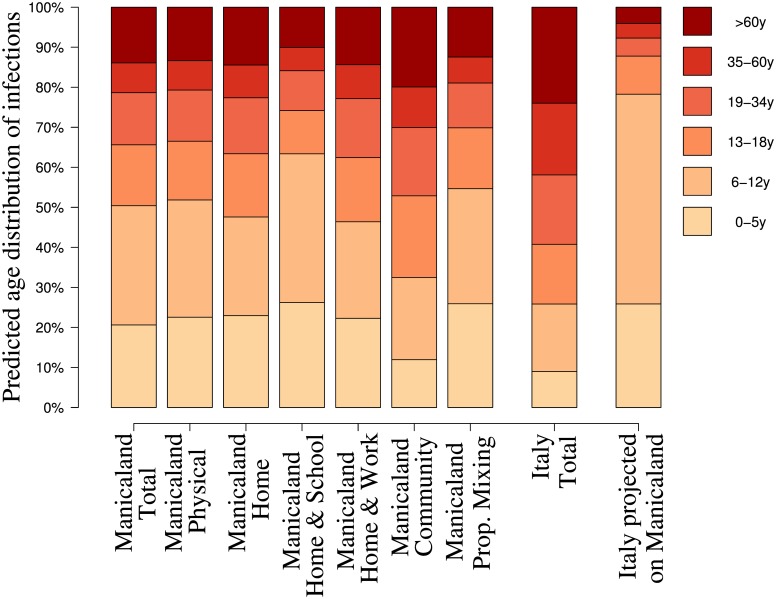
Fig 5. Predicted age distribution of infection cases by type of social contact structure, Manicaland (Zimbabwe), 2013.
Seven different social structures derived from the collected data were compared in terms of predicted age distribution of generated infection cases: (from left to right) overall contacts, physical contacts, home contacts, home and school contacts, home and work contacts, general community contacts, proportional mixing based on the average number of contacts in Manicaland and the population of Manicaland. For the sake of comparison, the predicted age distribution of cases is shown also for the overall contact matrix for Italy and for the Italian contact rates applied to the population of Zimbabwe [4].

References

    1. Anderson RM, May RM. Infectious Diseases of Humans. Oxford, UK: Oxford University Press; 1991.
    1. Edmunds JW, Kafatos G, Wallinga J, Mossong JR. Mixing patterns and the spread of close-contact infectious diseases. Emerg Themes Epidemiol. 2006;3: 10 10.1186/1742-7622-3-10 - DOI - PMC - PubMed
    1. Wallinga J, Teunis P, Kretzschmar M. Using Data on Social Contacts to Estimate Age-specific Transmission Parameters for Respiratory-spread Infectious Agents. Am J Epidemiol. 2006;164: 936–944. 10.1093/aje/kwj317 - DOI - PubMed
    1. Mossong JR, Hens N, Jit M, Beutels P, Auranen K, Mikolajczyk RT, et al. Social contacts and mixing patterns relevant to the spread of infectious diseases. Riley S, editor. PLoS Med. 2008;5: 0381–0391. - PMC - PubMed
    1. Danon L, House TA, Read JM, Keeling MJ. Social encounter networks: collective properties and disease transmission. J R Soc Interface. 2012;9: 2826–2833. 10.1098/rsif.2012.0357 - DOI - PMC - PubMed