


Effects of Soil Salinity on the Expression of Bt Toxin (Cry1Ac) and the Control Efficiency of Helicoverpa armigera in Field-Grown Transgenic Bt Cotton
- PMID: 28099508
- PMCID: PMC5242435
- DOI: 10.1371/journal.pone.0170379
Effects of Soil Salinity on the Expression of Bt Toxin (Cry1Ac) and the Control Efficiency of Helicoverpa armigera in Field-Grown Transgenic Bt Cotton
Abstract
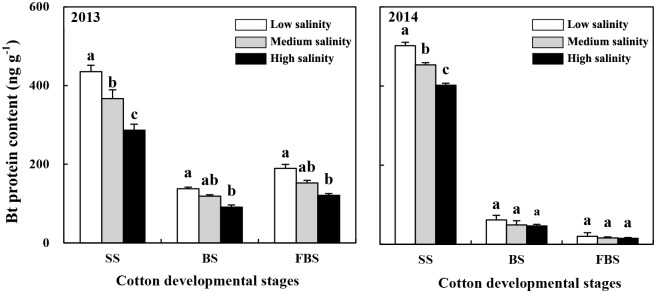
An increasing area of transgenic Bacillus thuringiensis (Bt) cotton is being planted in saline-alkaline soil in China. The Bt protein level in transgenic cotton plants and its control efficiency can be affected by abiotic stress, including high temperature, water deficiency and other factors. However, how soil salinity affects the expression of Bt protein, thus influencing the control efficiency of Bt cotton against the cotton bollworm (CBW) Helicoverpa armigera (Hübner) in the field, is poorly understood. Our objective in the present study was to investigate the effects of soil salinity on the expression of Bt toxin (Cry1Ac) and the control efficiency of Helicoverpa armigera in field-grown transgenic Bt cotton using three natural saline levels (1.15 dS m-1 [low soil-salinity], 6.00 dS m-1 [medium soil-salinity] and 11.46 dS m-1 [high soil-salinity]). We found that the Bt protein content in the transgenic Bt cotton leaves and the insecticidal activity of Bt cotton against CBW decreased with the increasing soil salinity in laboratory experiments during the growing season. The Bt protein content of Bt cotton leaves in the laboratory were negatively correlated with the salinity level. The CBW populations were highest on the Bt cotton grown in medium-salinity soil instead of the high-salinity soil in field conditions. A possible mechanism may be that the relatively high-salinity soil changed the plant nutritional quality or other plant defensive traits. The results from this study may help to identify more appropriate practices to control CBW in Bt cotton fields with different soil salinity levels.
Conflict of interest statement
The authors have declared that no competing interests exist.
Figures
References
-
- Kahlown MA, Azam M. Individual and combined effect of waterlogging and salinity on crop yields in the Indus basin. Irrig Drain. 2002;51: 329–338.
-
- Barrett-Lennard EG. The interaction between waterlogging and salinity in higher plants: causes, consequences and implications. Plant Soil. 2003;253: 35–54.
-
- Dong HZ. Underlying mechanisms and related techniques of stand establishment of cotton on coastal saline-alkali soil. Chin J Appl Ecol. 2012;23: 566–572. - PubMed
-
- National Soil Survey Office. Soils of China. China Agric. In Press; 1998.
-
- Tchiadje NFT. Strategies to reduce the impact of salt on crops (rice, cotton and chili) production: A case study of the tsunami-affected area of India. Desalination. 2007;206: 524–530.
MeSH terms
Substances
LinkOut - more resources
Full Text Sources
Other Literature Sources
