


PET/CT Scanner and Bone Marrow Biopsy in Detection of Bone Marrow Involvement in Diffuse Large B-Cell Lymphoma
- PMID: 28099514
- PMCID: PMC5242511
- DOI: 10.1371/journal.pone.0170299
PET/CT Scanner and Bone Marrow Biopsy in Detection of Bone Marrow Involvement in Diffuse Large B-Cell Lymphoma
Abstract
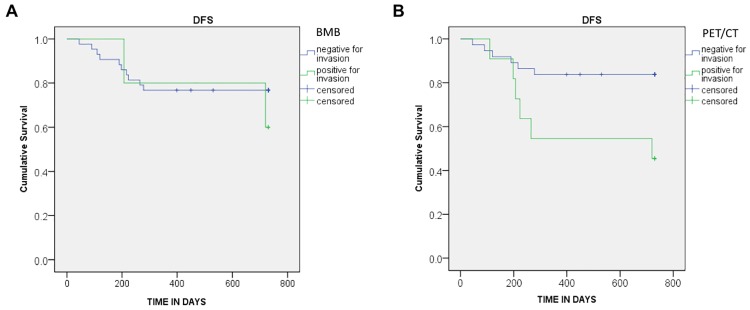
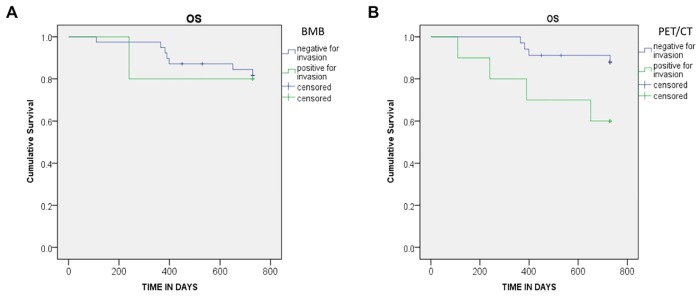
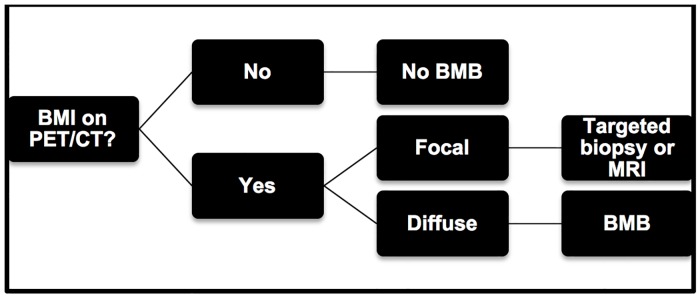
Evaluation of bone marrow involvement (BMI) is paramount in diffuse large B-cell lymphoma (DLBCL) for prognostic and therapeutic reasons. PET/CT scanner (PET) is now a routine examination for the staging of DLBCL with prognostic and therapeutic implications. This study evaluates the role of PET for detecting marrow involvement compared to bone marrow biopsy (BMB). This monocentric study included 54 patients diagnosed with DLBCL between 2009 and 2013 and who had FDG PET/CT in a pre-treatment setting. A correlation analysis of the detection of BMI by PET and BMB was performed. A prognostic evaluation of BMI by BMB and/or PET/CT and correlation with an overall 2-year survival were analyzed. PET was more sensitive for the detection of BMI than BMB (92.3% vs. 38.5%). It can be considered a discriminatory Pre-BMB test with a negative predictive value of 97.6%. In addition, BMI by PET had a prognostic value with strong correlation with progression-free survival (PFS) (HR = 3.81; p = 0.013) and overall survival (OS) (HR = 4.12; p = 0.03) while the BMB had not. PET shows superior performance to the BMB for the detection of marrow involvement in DLBCL. It may be considered as the first line examination of bone marrow instead of the biopsy.
Conflict of interest statement
The authors have declared that no competing interests exist.
Figures
References
-
- Ministry of Public Health. National Cancer Registry. Cancer in Lebanon 2005–2007, Beirut (2015) www.moph.gov.lb. Accessed on December 12, 2015.
-
- Flowers CR, Sinha R, Vose JM. Improving outcomes for patients with wide diffuse B-cell lymphoma. CACancer J Clin. 2010;60:393–408. - PubMed
-
- Tilly H, Vitolo U, Walewski J, da Silva MG, Shpilberg O, Andre M, et al. Wide diffuse B-cell lymphoma(DLBCL): ESMO Clinical PracticeGuidelines for diagnosis, treatment and follow-up. Ann Oncol. 2012;23 (Suppl7):vii, 78–82. - PubMed
-
- Bain BJ. Morbidity associated with bone marrow aspiration and trephine biopsy -a review of UK data for 2004. Haematologica. 2006;91:1293–4. - PubMed
MeSH terms
Substances
LinkOut - more resources
Full Text Sources
Other Literature Sources
Medical
