


Concise Review: Induced Pluripotent Stem Cell Research in the Era of Precision Medicine
- PMID: 28100040
- PMCID: PMC5915333
- DOI: 10.1002/stem.2570
Concise Review: Induced Pluripotent Stem Cell Research in the Era of Precision Medicine
Abstract
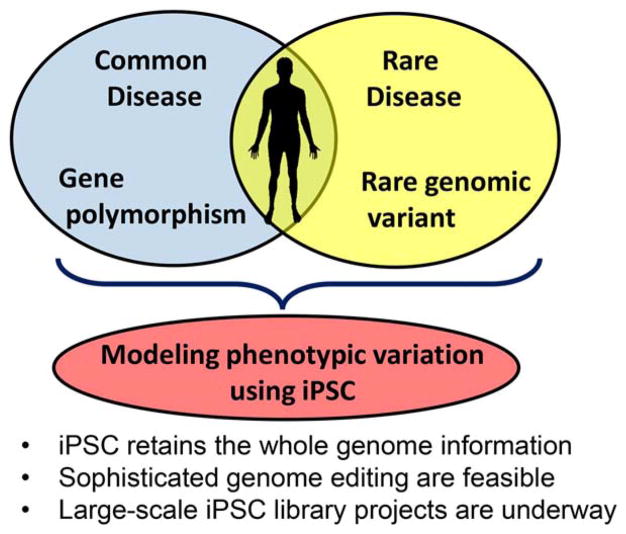
Recent advances in DNA sequencing technologies are revealing how human genetic variations associate with differential health risks, disease susceptibilities, and drug responses. Such information is now expected to help evaluate individual health risks, design personalized health plans and treat patients with precision. It is still challenging, however, to understand how such genetic variations cause the phenotypic alterations in pathobiologies and treatment response. Human induced pluripotent stem cell (iPSC) technologies are emerging as a promising strategy to fill the knowledge gaps between genetic association studies and underlying molecular mechanisms. Breakthroughs in genome editing technologies and continuous improvement in iPSC differentiation techniques are particularly making this research direction more realistic and practical. Pioneering studies have shown that iPSCs derived from a variety of monogenic diseases can faithfully recapitulate disease phenotypes in vitro when differentiated into disease-relevant cell types. It has been shown possible to partially recapitulate disease phenotypes, even with late onset and polygenic diseases. More recently, iPSCs have been shown to validate effects of disease and treatment-related single nucleotide polymorphisms identified through genome wide association analysis. In this review, we will discuss how iPSC research will further contribute to human health in the coming era of precision medicine. Stem Cells 2017;35:545-550.
Keywords: Experimental models; Genomics; Induced pluripotent stem cells.
© 2017 AlphaMed Press.
Conflict of interest statement
The authors indicate no potential conflicts of interest.
Figures
References
-
- Lander ES, Linton LM, Birren B, et al. Initial sequencing and analysis of the human genome. Nature. 2001;409:860–921. - PubMed
-
- Venter JC, Adams MD, Myers EW, et al. The sequence of the human genome. Science. 2001;291:1304–1351. - PubMed
-
- International HapMap Consortium. The international HapMap project. Nature. 2003;426:789–796. - PubMed
Publication types
MeSH terms
Grants and funding
LinkOut - more resources
Full Text Sources
Other Literature Sources
