


Allogeneic stem cell transplantation in adult patients with acute myeloid leukaemia and 17p abnormalities in first complete remission: a study from the Acute Leukemia Working Party (ALWP) of the European Society for Blood and Marrow Transplantation (EBMT)
- PMID: 28100265
- PMCID: PMC5241968
- DOI: 10.1186/s13045-017-0393-3
Allogeneic stem cell transplantation in adult patients with acute myeloid leukaemia and 17p abnormalities in first complete remission: a study from the Acute Leukemia Working Party (ALWP) of the European Society for Blood and Marrow Transplantation (EBMT)
Abstract
Background: Acute myeloid leukaemia (AML) with 17p abnormalities (abn(17p)) carries a very poor prognosis due to high refractoriness to conventional chemotherapy, and allogeneic stem cell transplantation (allo-SCT) appears as the only potential curative option.
Methods: To address outcomes after allo-SCT in patients with abn(17p), we retrospectively analysed de novo or secondary AML undergoing SCT between 2000 and 2013 from the EBMT registry.
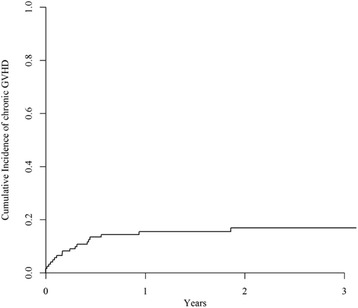
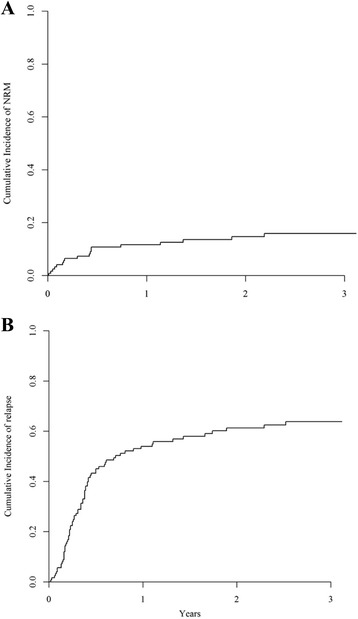
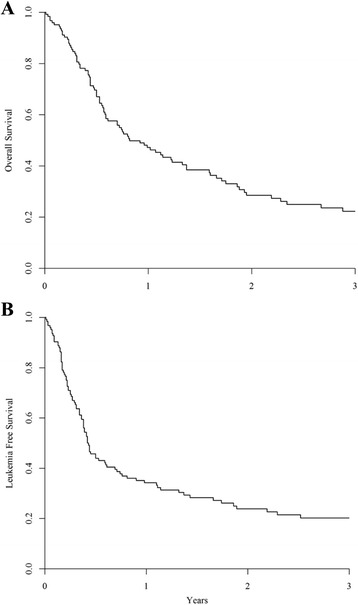
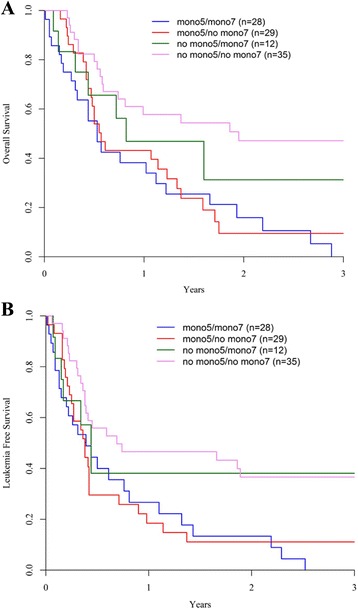
Results: One hundred thirty-nine patients with confirmed abn(17p) have been selected. At the time of transplant, one hundred twenty-five were in first remission (CR1). Median age was 54 years old. Abn(17p) was associated with a monosomal karyotype in 83% of patients, complex karyotype in 91%, monosomy 5 or 5q deletion (-5/5q-) in 55%, monosomy 7 (-7) in 39% and both -5/5q and -7 in 27%. Seventy-three patients (59%) had a reduced-intensity conditioning regimen. The 2-year overall survival (OS) and leukaemia-free survival (LFS) were 28 and 24%, respectively. The 2-year non-relapse mortality (NRM) was 15%, and 2-year relapse incidence (RI) was 61%. The cumulative incidence of grade II to IV acute graft-versus-host disease (GvHD) was 24% and that of chronic GvHD was 21%. In multivariate analysis, the presence of a -5/5q- in addition to abn(17p) was significantly and independently associated with worse OS, LFS and higher RI. Age and donor types did not correlate with outcome. Conditioning intensity was not statistically associated with OS, LFS and NRM when adjusted for patients' age.
Conclusions: In contrast to the dismal prognosis reported for AML patients harbouring abn(17p) undergoing conventional chemotherapy, allogeneic SCT provides responses in about 25% of those patients transplanted in CR1.
Keywords: 17p abnormalities; Acute myeloid leukaemia; First remission; Stem cell transplantation; Survival.
Figures
References
-
- Cornelissen JJ, van Putten WL, Verdonck LF, et al. Results of a HOVON/SAKK donor versus no-donor analysis of myeloablative HLA-identical sibling stem cell transplantation in first remission acute myeloid leukemia in young and middle-aged adults: benefits for whom? Blood. 2007;109:3658–66. doi: 10.1182/blood-2006-06-025627. - DOI - PubMed
-
- Grimwade D, Hills RK, Moorman AV, et al. Refinement of cytogenetic classification in acute myeloid leukemia: determination of prognostic significance of rare recurring chromosomal abnormalities among 5876 younger adult patients treated in the United Kingdom Medical Research Council trials. Blood. 2010;116:354–65. doi: 10.1182/blood-2009-11-254441. - DOI - PubMed
Publication types
MeSH terms
LinkOut - more resources
Full Text Sources
Other Literature Sources
Medical
