


Higher dietary flavonoid intakes are associated with lower objectively measured body composition in women: evidence from discordant monozygotic twins
- PMID: 28100511
- PMCID: PMC5320412
- DOI: 10.3945/ajcn.116.144394
Higher dietary flavonoid intakes are associated with lower objectively measured body composition in women: evidence from discordant monozygotic twins
Abstract
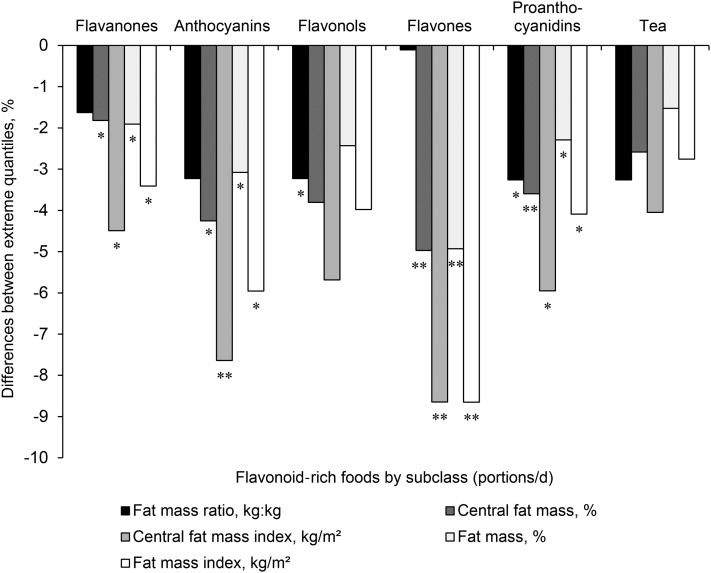
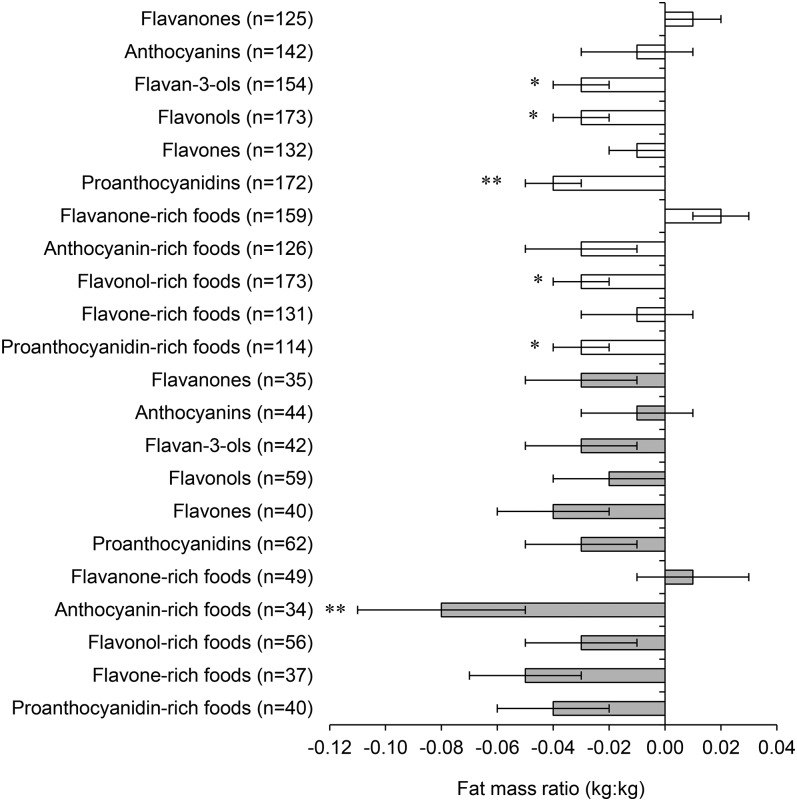
Background: Although dietary flavonoid intake has been associated with less weight gain, there are limited data on its impact on fat mass, and to our knowledge, the contribution of genetic factors to this relation has not previously been assessed.Objective: We examined the associations between flavonoid intakes and fat mass.Design: In a study of 2734 healthy, female twins aged 18-83 y from the TwinsUK registry, intakes of total flavonoids and 7 subclasses (flavanones, anthocyanins, flavan-3-ols, flavonols, flavones, polymers, and proanthocyanidins) were calculated with the use of food-frequency questionnaires. Measures of dual-energy X-ray absorptiometry-derived fat mass included the limb-to-trunk fat mass ratio (FMR), fat mass index, and central fat mass index.Results: In cross-sectional multivariable analyses, higher intake of anthocyanins, flavonols, and proanthocyanidins were associated with a lower FMR with mean ± SE differences between extreme quintiles of -0.03 ± 0.02 (P-trend = 0.02), -0.03 ± 0.02 (P-trend = 0.03), and -0.05 ± 0.02 (P-trend < 0.01), respectively. These associations were not markedly changed after further adjustment for fiber and total fruit and vegetable intakes. In monozygotic, intake-discordant twin pairs, twins with higher intakes of flavan-3-ols (n = 154, P = 0.03), flavonols (n = 173, P = 0.03), and proanthocyanidins (n = 172, P < 0.01) had a significantly lower FMR than that of their co-twins with within-pair differences of 3-4%. Furthermore, in confirmatory food-based analyses, twins with higher intakes of flavonol-rich foods (onions, tea, and pears; P = 0.01) and proanthocyanidin-rich foods (apples and cocoa drinks; P = 0.04) and, in younger participants (aged <50 y) only, of anthocyanin-rich foods (berries, pears, grapes, and wine; P = 0.01) had a 3-9% lower FMR than that of their co-twins.Conclusions: These data suggest that higher habitual intake of a number of flavonoids, including anthocyanins, flavan-3-ols, flavonols, and proanthocyanidins, are associated with lower fat mass independent of shared genetic and common environmental factors. Intervention trials are needed to further examine the effect of flavonoid-rich foods on body composition.
Keywords: body composition; diet; fat distribution; flavonoids; twins.
Figures
References
-
- Hughes LA, Arts IC, Ambergen T, Brants HA, Dagnelie PC, Goldbohm RA, van den Brandt PA, Weijenberg MP, Netherlands Cohort S. Higher dietary flavone, flavonol, and catechin intakes are associated with less of an increase in BMI over time in women: a longitudinal analysis from the Netherlands Cohort Study. Am J Clin Nutr 2008;88:1341–52. - PubMed
-
- Wang S, Noh SK, Koo SI. Green tea catechins inhibit pancreatic phospholipase A(2) and intestinal absorption of lipids in ovariectomized rats. J Nutr Biochem 2006;17:492–8. - PubMed
-
- Friedrich M, Petzke KJ, Raederstorff D, Wolfram S, Klaus S. Acute effects of epigallocatechin gallate from green tea on oxidation and tissue incorporation of dietary lipids in mice fed a high-fat diet. Int J Obes (Lond) 2012;36:735–43. - PubMed
-
- Wolfram S, Raederstorff D, Wang Y, Teixeira SR, Elste V, Weber P. TEAVIGO (epigallocatechin gallate) supplementation prevents obesity in rodents by reducing adipose tissue mass. Ann Nutr Metab 2005;49:54–63. - PubMed
Publication types
MeSH terms
Substances
Grants and funding
LinkOut - more resources
Full Text Sources
Other Literature Sources
