


A second type of magnitude effect: Reinforcer magnitude differentiates delay discounting between substance users and controls
- PMID: 28101922
- PMCID: PMC5321101
- DOI: 10.1002/jeab.235
A second type of magnitude effect: Reinforcer magnitude differentiates delay discounting between substance users and controls
Abstract
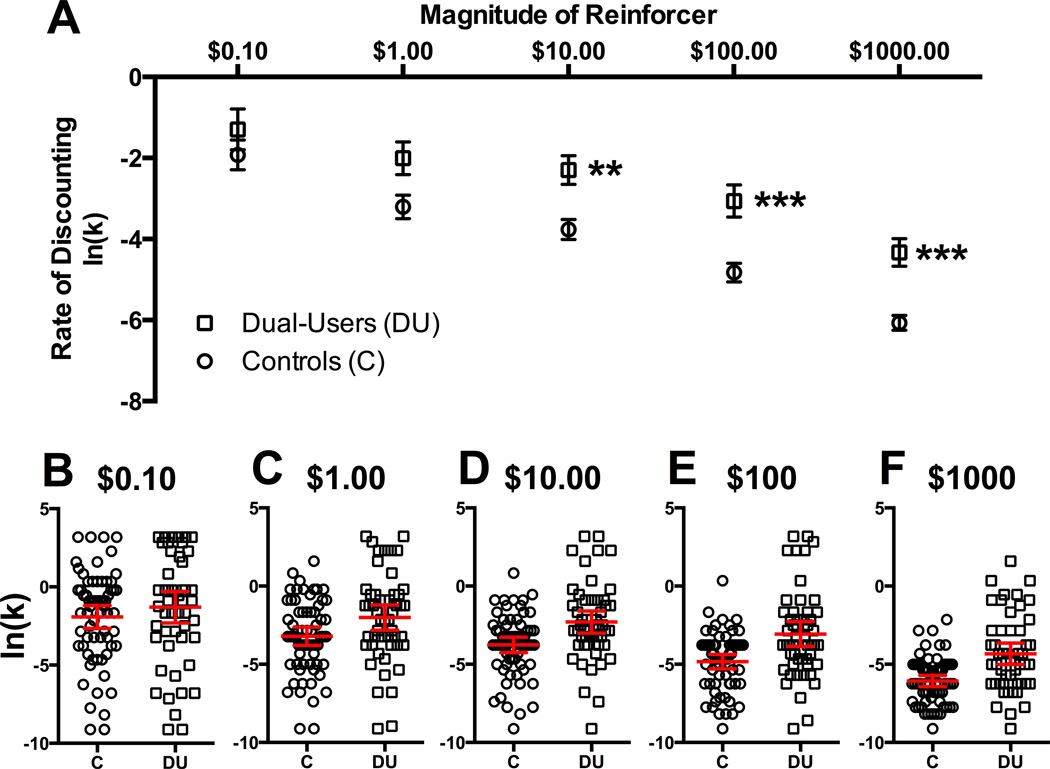
Basic research on delay discounting, examining preference for smaller-sooner or larger-later reinforcers, has demonstrated a variety of findings of considerable generality. One of these, the magnitude effect, is the observation that individuals tend to exhibit greater preference for the immediate with smaller magnitude reinforcers. Delay discounting has also proved to be a useful marker of addiction, as demonstrated by the highly replicated finding of greater discounting rates in substance users compared to controls. However, some research on delay discounting rates in substance users, particularly research examining discounting of small-magnitude reinforcers, has not found significant differences compared to controls. Here, we hypothesize that the magnitude effect could produce ceiling effects at small magnitudes, thus obscuring differences in delay discounting between groups. We examined differences in discounting between high-risk substance users and controls over a broad range of magnitudes of monetary amounts ($0.10, $1.00, $10.00, $100.00, and $1000.00) in 116 Amazon Mechanical Turk workers. We found no significant differences in discounting rates between users and controls at the smallest reinforcer magnitudes ($0.10 and $1.00) and further found that differences became more pronounced as magnitudes increased. These results provide an understanding of a second form of the magnitude effect: That is, differences in discounting between populations can become more evident as a function of reinforcer magnitude.
Keywords: crowdsourcing; delay discounting; humans; hypothetical; magnitude effect.
© 2017 Society for the Experimental Analysis of Behavior.
Figures
References
-
- Amlung M, Petker T, Jackson J, Balodis I, MacKillop J. Steep discounting of delayed monetary and food rewards in obesity: a meta-analysis. Psychological Medicine. 2016;46(11):2423–2434. https://doi.org/10.1017/S0033291716000866. - DOI - PubMed
-
- Baker F, Johnson MW, Bickel WK. Delay discounting in current and never-before cigarette smokers: similarities and differences across commodity, sign, and magnitude. Journal of Abnormal Psychology. 2003;112(3):382–392. Retrieved from http://www.ncbi.nlm.nih.gov/pubmed/12943017. - PubMed
-
- Bickel WK, George Wilson A, Franck CT, Terry Mueller E, Jarmolowicz DP, Koffarnus MN, Fede SJ. Using crowdsourcing to compare temporal, social temporal, and probability discounting among obese and non-obese individuals. Appetite. 2014;75:82–89. https://doi.org/10.1016/j.appet.2013.12.018. - DOI - PMC - PubMed
-
- Bickel WK, Jarmolowicz DP, Mueller ET, Koffarnus MN, Gatchalian KM. Excessive discounting of delayed reinforcers as a trans-disease process contributing to addiction and other disease-related vulnerabilities: emerging evidence. Pharmacology & Therapeutics. 2012;134(3):287–297. https://doi.org/10.1016/j.pharmthera.2012.02.004. - DOI - PMC - PubMed
-
- Bickel WK, Marsch LA. Toward a behavioral economic understanding of drug dependence: delay discounting processes. Addiction. 2001;96(1):73–86. https://doi.org/10.1080/09652140020016978. - DOI - PubMed
MeSH terms
Grants and funding
LinkOut - more resources
Full Text Sources
Other Literature Sources
Medical
