


Host-related factors explaining interindividual variability of carotenoid bioavailability and tissue concentrations in humans
- PMID: 28101967
- PMCID: PMC5516247
- DOI: 10.1002/mnfr.201600685
Host-related factors explaining interindividual variability of carotenoid bioavailability and tissue concentrations in humans
Abstract
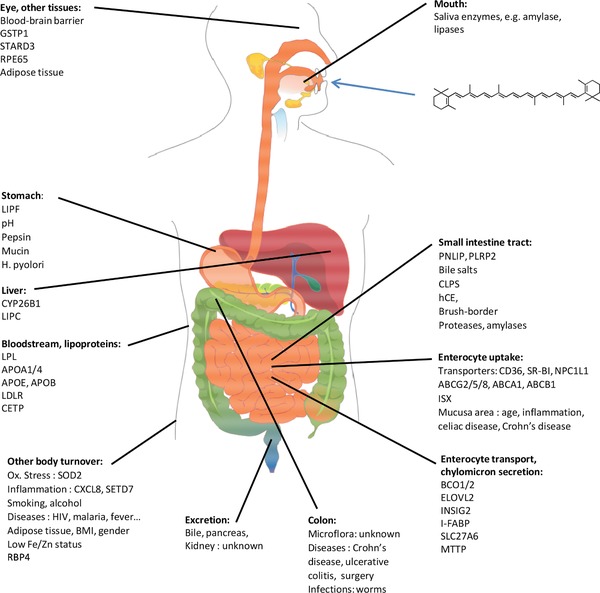
Carotenoid dietary intake and their endogenous levels have been associated with a decreased risk of several chronic diseases. There are indications that carotenoid bioavailability depends, in addition to the food matrix, on host factors. These include diseases (e.g. colitis), life-style habits (e.g. smoking), gender and age, as well as genetic variations including single nucleotide polymorphisms that govern carotenoid metabolism. These are expected to explain interindividual differences that contribute to carotenoid uptake, distribution, metabolism and excretion, and therefore possibly also their association with disease risk. For instance, digestion enzymes fostering micellization (PNLIP, CES), expression of uptake/efflux transporters (SR-BI, CD36, NPC1L1), cleavage enzymes (BCO1/2), intracellular transporters (FABP2), secretion into chylomicrons (APOB, MTTP), carotenoid metabolism in the blood and liver (LPL, APO C/E, LDLR), and distribution to target tissues such as adipose tissue or macula (GSTP1, StARD3) depend on the activity of these proteins. In addition, human microbiota, e.g. via altering bile-acid concentrations, may play a role in carotenoid bioavailability. In order to comprehend individual, variable responses to these compounds, an improved knowledge on intra-/interindividual factors determining carotenoid bioavailability, including tissue distribution, is required. Here, we highlight the current knowledge on factors that may explain such intra-/interindividual differences.
Keywords: Absorption; Biodistribution; Genetic polymorphisms; Intestine; Macula lutea.
© 2017 The Authors. Molecular Nutrition & Food Research published by WILEY-VCH Verlag GmbH & Co. KGaA, Weinheim.
Figures
References
-
- van Poppel, G. , Epidemiological evidence for beta‐carotene in prevention of cancer and cardiovascular disease. Eur. J. Clin. Nutr. 1996, 50(Suppl 3), S57–61. - PubMed
-
- Hamer, M. , Chida, Y. , Intake of fruit, vegetables, and antioxidants and risk of type 2 diabetes: systematic review and meta‐analysis. J. Hypertens. 2007, 25, 2361–2369. - PubMed
-
- Wang, Y. , Chung, S. J. , McCullough, M. L. , Song, W. O. et al., Dietary carotenoids are associated with cardiovascular disease risk biomarkers mediated by serum carotenoid concentrations. J. Nutr. 2014, 144, 1067–1074. - PubMed
-
- Wood, L. G. , Garg, M. L. , Blake, R. J. , Garcia‐Caraballo, S. et al., Airway and circulating levels of carotenoids in asthma and healthy controls. J. Am. Coll. Nutr. 2005, 24, 448–455. - PubMed
-
- Buijsse, B. , Feskens, E. J. , Schlettwein‐Gsell, D. , Ferry, M. et al., Plasma carotene and alpha‐tocopherol in relation to 10‐y all‐cause and cause‐specific mortality in European elderly: the Survey in Europe on Nutrition and the Elderly, a Concerted Action (SENECA). Am. J. Clin. Nutr. 2005, 82, 879–886. - PubMed
Publication types
MeSH terms
Substances
LinkOut - more resources
Full Text Sources
Other Literature Sources
Research Materials
Miscellaneous
