


Community-Based Entomological Surveillance Reveals Urban Foci of Chagas Disease Vectors in Sobral, State of Ceará, Northeastern Brazil
- PMID: 28103294
- PMCID: PMC5245826
- DOI: 10.1371/journal.pone.0170278
Community-Based Entomological Surveillance Reveals Urban Foci of Chagas Disease Vectors in Sobral, State of Ceará, Northeastern Brazil
Abstract
Background: The aim of this work was to explore the potential risk of vector-borne Chagas disease in urban districts in northeastern Brazil, by analyzing the spatiotemporal distributions and natural infection rates with Trypanosoma cruzi of triatomine species captured in recent years. The main motivation of this work was an acute human case of Chagas disease reported in 2008 in the municipality of Sobral.
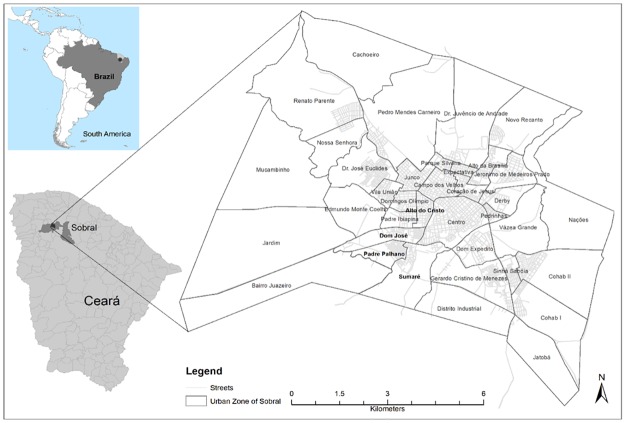
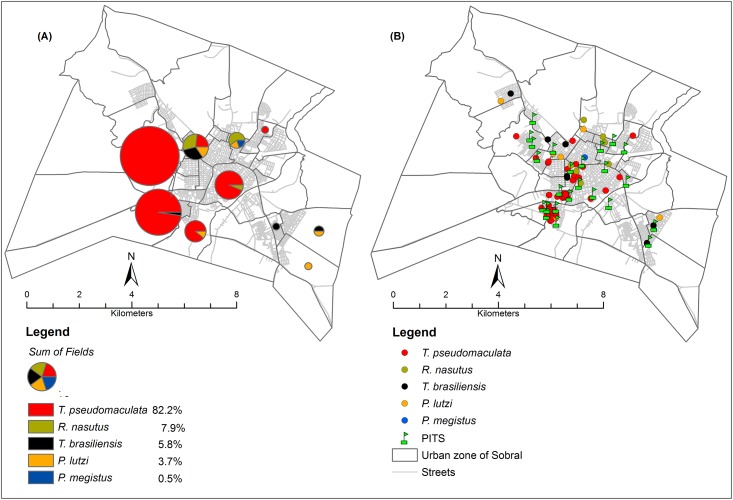
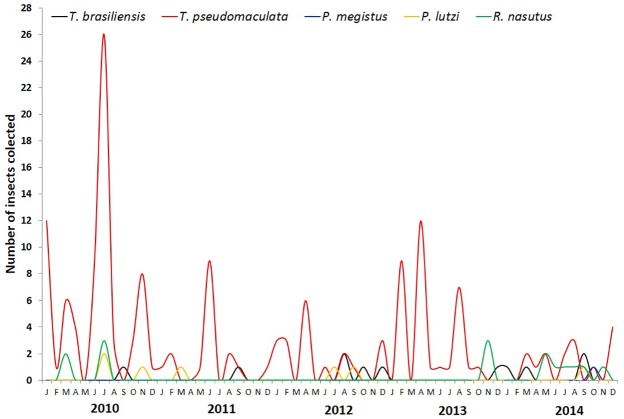
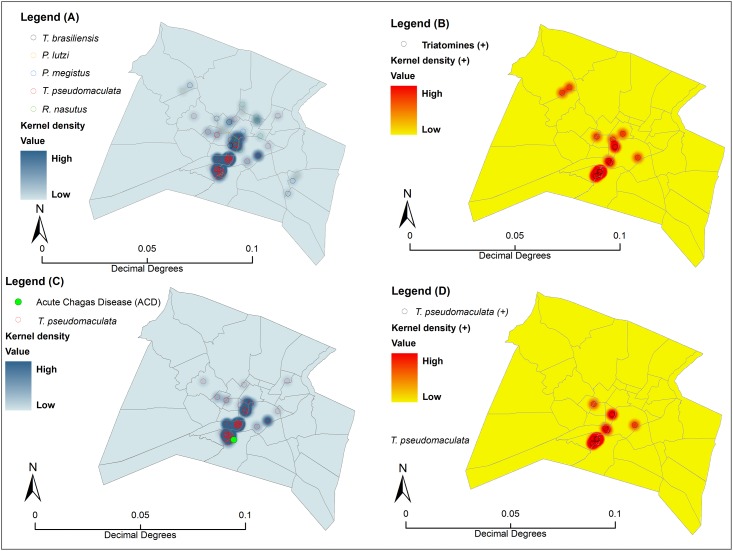
Methodology/principal findings: We analyzed data from community-based entomological surveillance carried out from 2010 to 2014. Triatomine natural T. cruzi infection was assessed by examination of insect feces by optical microscopy. Sites of triatomine capture were georeferenced through Google Earth and analyzed with ArcGIS. A total of 191 triatomines were collected, consisting of 82.2% Triatoma pseudomaculata, 7.9% Rhodnius nasutus, 5.8% T. brasiliensis, 3.7% Panstrongylus lutzi, and 0.5% P. megistus, with an overall natural infection index of 17.8%. Most infestations were reported in the districts of Dom José (36.2%), Padre Palhano (24.7%), and Alto do Cristo (10.6%). The overwhelming majority of insects (185/96.9%) were captured inside houses, and most insects tended to be collected in intermittent peaks. Moreover, captured triatomines tended to constitute colonies. The acute case reported in 2008 was found to be situated within a T. pseudomaculata hotspot.
Conclusion: The triatomine collection events carried out by dwellers were aggregated in time and space into distinct foci, suggesting that insects are intermittently and artificially introduced into the city, possibly via accidental migration from their natural reservoirs. The relatively high T. cruzi infection rate indicates considerable circulation of the parasite in these areas, increasing the risk of vector-borne Chagas disease infection. These data suggest a need to strengthen epidemiological surveillance and integrate appropriate control actions targeting triatomines, T. cruzi reservoirs, and human populations. Our data also identify Chagas disease transmission as a hazard in urban areas of Sobral.
Conflict of interest statement
The authors have declared that no competing interests exist.
Figures
References
-
- Chagas C. Nova tripanossomíase humana. Mem Inst Oswaldo Cruz 1 (2):1909;159–18
-
- World Health Organization. Chagas disease in Latin America: an epidemiological update based on 2010 estimates. WHO 2015; 90:33–44. - PubMed
-
- Dias JCP. Southern Cone Initiative for the elimination of domestic populations of Triatoma infestans and the interruption of transfusional Chagas disease. Historical aspects, present situation, and perspectives. Mem Inst Oswaldo Cruz. 2007; 102:11–18. - PubMed
MeSH terms
LinkOut - more resources
Full Text Sources
Other Literature Sources
Medical
