Review
. 2017 Jan 18;93(2):259-280.
doi: 10.1016/j.neuron.2016.12.013.

On the Globality of Motor Suppression: Unexpected Events and Their Influence on Behavior and Cognition

Affiliations
Review

On the Globality of Motor Suppression: Unexpected Events and Their Influence on Behavior and Cognition

Jan R Wessel et al. Neuron. .

Abstract

Unexpected events are part of everyday experience. They come in several varieties-action errors, unexpected action outcomes, and unexpected perceptual events-and they lead to motor slowing and cognitive distraction. While different varieties of unexpected events have been studied largely independently, and many different mechanisms are thought to explain their effects on action and cognition, we suggest a unifying theory. We propose that unexpected events recruit a fronto-basal-ganglia network for stopping. This network includes specific prefrontal cortical nodes and is posited to project to the subthalamic nucleus, with a putative global suppressive effect on basal-ganglia output. We argue that unexpected events interrupt action and impact cognition, partly at least, by recruiting this global suppressive network. This provides a common mechanistic basis for different types of unexpected events; links the literatures on motor inhibition, performance monitoring, attention, and working memory; and is relevant for understanding clinical symptoms of distractibility and mental inflexibility.

Keywords: attention; cognitive control; distraction; errors; motor inhibition; novels; surprise; unexpected events; working memory.


Figures

Figure 1
Figure 1
Three kinds of unexpected events. Left: Action error (self-produced unexpected event). Middle: Unexpected action outcome (unexpected event produced by the interaction between self and environment). Right: Unexpected perceptual event (unexpected event produced in the environment).
Figure 2
Figure 2
Behavioral tasks, and EEG and fMRI activity associated with three kinds of unexpected event. Top row shows typical tasks used to study each type of event and typical behavioral results (slowing of reaction time after the unexpected event). Middle row shows typical scalp EEG activity, highlighting the presence of a negativity-positivity complex waveform with fronto-central distribution after each type of event. Bottom shows typical brain networks activated (BOLD response) after all three types of events, including areas strongly implicated in motor stopping such as the right inferior frontal cortex (rIFC), the presupplementary motor area (preSMA) and the region in the vicinity of the subthalamic nucleus (STN). Figures reproduced based on data from Danielmeier et al., 2009; Wessel et al., 2012, Wessel & Aron, 2013, Kiehl et al., 2005.
Figure 3
Figure 3
Proposed Human Brain Circuit for Rapid Action Stopping. A) Top. Lesion, imaging and stimulation studies point to the right inferior frontal cortex (IFC) and the presupplementary motor area (preSMA) as prefrontal nodes for triggering stopping. Bottom. Right IFC (and preSMA) project via hyperdirect pathways to the subthalamic nucleus (STN). The STN is proposed to divergently excite Globus Pallidus Pars Interna (GPi), which in turn suppresses thalamocortical drive (i.e. there is reduced drive to primary motor and premotor cortex). Panels B–E represent cross-species evidence for role of STN in stopping. B) Human fMRI shows activation in vicinity of right STN for stop signal task, reproduced from Aron and Poldrack 2006, with permission from authors, permission from journal pending. White line demarcates approximate STN region based on hypointensity on structural scan. C. Single unit activity increases ~200 ms after NoGo cue in monkey prepotent Go/NoGo task, reproduced from Isoda and Hikosaka 2008, with permission from authors, permission from journal pending. D. The local field potential recorded from human STN shows a beneath-baseline reduction on Go trials (movement), and an above baseline increase on successful stop trials ~ 200 ms after the stop signal (dotted line), reproduced with permission from Ray et al. 2012. E. For rat stop signal task, STN single unit activity increases for both successful and failed stop trials, but the target (substantia nigra, akin to primate GPi) increases about 16 ms later only on successful but not failed stop trials, reproduced with permission from Schmidt et al. 2013.
Figure 4
Figure 4
Global motor suppression during stopping and following unexpected (perceptual) events. A) Methods of Transcranial Magnetic Stimulation (TMS). A TMS pulse over M1 induces corticospinal volleys which induce the motor evoked potential (MEP) in the hand. B) Stopping in the stop signal paradigm has global motor effects. All plots show the MEP from of a task-unrelated target muscle on the y-axis, split by trial types in the stop-signal task. Figures reproduced based on data from Wessel et al., 2013a, Majid et al., 2012, Cai et al., 2012. C) Increased global motor suppression measured with TMS relates to increased beta band power recorded from the STN. Simultaneous recordings of the MEP from the task-unrelated hand and the local-field potential (LFP) from the STN in Parkinson’s patients with a deep-brain stimulation electrode. Data reproduced from Wessel et al., in press. D) Global motor suppression from a task-unrelated effector is also evident following unexpected events. Figures reproduced based on data from Wessel & Aron, 2013.
Figure 5
Figure 5
The motor inhibition network interrupts verbal WM (adapted from Wessel et al., 2016). A) Source-level EEG. Combined EEG from the WM task and the SST were subjected to Independent Components Analysis (ICA). One IC that represented the process underlying successful stopping in the SST (the motor-suppression IC, MS-IC) was selected per subject. That component in the WM task then showed three results: a) activity was increased following surprising vs. standard tones, b) activity on surprising trials was greater the greater the decrement in WM (a single trial GLM was run in each subject, with the plot showing the group-average of the SURPRISE × WM interaction) and c) activity positively mediated the influence of the surprising tone on WM accuracy. B) STN group results. Left: increased activity in several frequency bands for surprising vs. standard tones in the WM task. Right: increased activity on surprising trials related to a greater decrement of WM (a single trial GLM was run in each subject, with the plot showing the group-average of the SURPRISE × WM interaction).
Figure 6
Figure 6
Proposed theoretical framework by which unexpected events interrupt cognition. A). Forms of working memory (cognition), is likely maintained in cortical areas via reverberating thalamocortical drive. B). An unexpected event, in this case perceptual novelty, putatively recruits the brain’s stopping system, including the STN of the basal ganglia which broadly suppresses thalamocortical drive. This erodes the cortical representation, corresponding to a concurrent loss of cognition.
Figure 7
Figure 7
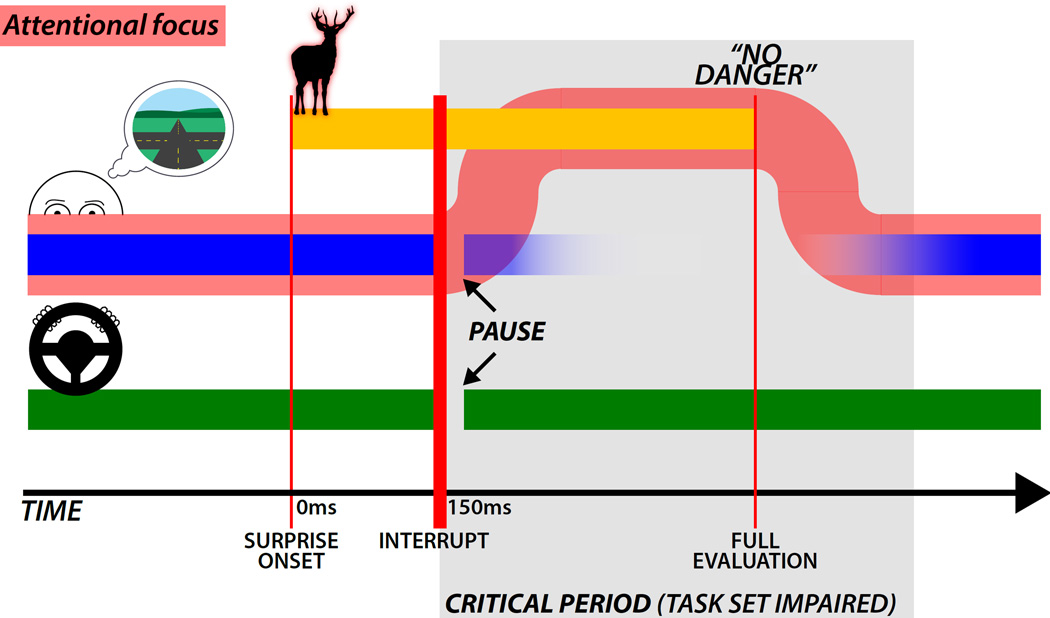
Proposed time-course of the surprise -> interruption -> attentional re-orienting sequence. Before the unexpected event (red line denoted “surprise onset”), the task set (broad blue line) is maintained in working memory - in this case the driver is representing the route ahead, and the skeletomotor system (green line) is active for postural, task and task-irrelevant muscles. Immediately following the unexpected event, both the working memory and motor systems are interrupted. The motor interruption is evident at 150 ms but is short-lived (Wessel and Aron, 2013). The interrupt allows the attention focus (broad, red line) to shift away from the current task set, and towards the unexpected event. The task-set representation decays (fading blue line) – due both to the global suppression induced by the interruption, which erodes, for example subvocally maintained if-then rules, and also the attention shift. Once the unexpected event is processed (“No Danger”), attentional focus can shift back onto the previous task set, and the task-set can be re-established. The time period between the initial interrupt, and the re-establishment of the task-set is a critical period (gray highlighting). If, for example in an experimental setting in the laboratory, the next relevant stimulus falls into this critical interval, we hypothesize that this would lead to a delay of RT on the next trial, as well as a reduction of accuracy. However, if the next stimulus appears after the task-set is reestablished, performance should be unimpaired (both RT and accuracy).

References

    1. Agam Y, Hamalainen MS, Lee AK, Dyckman KA, Friedman JS, Isom M, Makris N, Manoach DS. Multimodal neuroimaging dissociates hemodynamic and electrophysiological correlates of error processing. Proc Natl Acad Sci U S A. 2011;108:17556–17561. - PMC - PubMed
    1. Albert J, Lopez-Martin S, Hinojosa JA, Carretie L. Spatiotemporal characterization of response inhibition. NeuroImage. 2013;76:272–281. - PubMed
    1. Aron AR. From reactive to proactive and selective control: developing a richer model for stopping inappropriate responses. Biol Psychiatry. 2011;69:e55–e68. - PMC - PubMed
    1. Aron AR, Behrens TE, Smith S, Frank MJ, Poldrack RA. Triangulating a cognitive control network using diffusion-weighted magnetic resonance imaging (MRI) and functional MRI. The Journal of neuroscience : the official journal of the Society for Neuroscience. 2007;27:3743–3752. - PMC - PubMed
    1. Aron AR, Cai W, Badre D, Robbins TW. Evidence Supports Specific Braking Function for Inferior PFC. Trends Cogn Sci. 2015;19:711–712. - PubMed