Review
. 2017 Jan 19;16(1):5.
doi: 10.1186/s12937-016-0218-1.

Masquelier's grape seed extract: from basic flavonoid research to a well-characterized food supplement with health benefits

Affiliations
Review

Masquelier's grape seed extract: from basic flavonoid research to a well-characterized food supplement with health benefits

Antje R Weseler et al. Nutr J. .

Abstract

Careful characterization and standardization of the composition of plant-derived food supplements is essential to establish a cause-effect relationship between the intake of that product and its health effect. In this review we follow a specific grape seed extract containing monomeric and oligomeric flavan-3-ols from its creation by Jack Masquelier in 1947 towards a botanical remedy and nutraceutical with proven health benefits. The preparation's research history parallels the advancing insights in the fields of molecular biology, medicine, plant and nutritional sciences during the last 70 years. Analysis of the extract's flavanol composition emerged from unspecific colorimetric assays to precise high performance liquid chromatography - mass spectrometry and proton nuclear magnetic resonance fingerprinting techniques. The early recognition of the preparation's auspicious effects on the permeability of vascular capillaries directed research to unravel the underlying cellular and molecular mechanisms. Recent clinical data revealed a multitude of favorable alterations in the vasculature upon an 8 weeks supplementation which summed up in a health benefit of the extract in healthy humans. Changes in gene expression of inflammatory pathways in the volunteers' leukocytes were suggested to be involved in this benefit. The historically grown scientific evidence for the preparation's health effects paves the way to further elucidate its metabolic fate and molecular action in humans.

Keywords: Cardiovascular; Flavanols; Food; Grape seed; Health; Inflammation; Masquelier; Nutraceutical; Oxidative stress; Proanthocyanidins.


Figures

Fig. 1
Fig. 1
Molecular structure of monomeric and oligomeric flavan-3-ols
Fig. 2
Fig. 2
Timeline of achievements in the field of molecular biology, medicine and nutritional science during the last decade which are paralleled by achievements in the development and investigation of a grape seed extract by the French scientist Jack Masquelier. Today this preparation of monomeric and oligomeric flavan-3-ols is commercially available in the herbal remedy Endotélon® and as Masquelier’s® Original OPCs in nutraceuticals and food supplements
Fig. 3
Fig. 3
a-c Biosynthesis of monomeric and oligomeric flavan-3-ols in plants (panel a-c). a Shikimate pathway starting from phosphoenol pyruvate (PEP) and D-erythrose-4-phosphate (D-erythrose-4-P) leading to the formation of 4-hydroxycinnamoyl alcohol, DHAP = 3-deoxy-D-arabinose-heptulosonic acid-7-phosphate, NAD = nicotine-adenine dinucleotide, NADPH = reduced nicotine-adenine dinucleotide phosphate; b Formation of monomeric flavan-3-ols (+)-catechin and (-)-epicatechin from 4-hydroxycinnamoyl-CoA and 3 molecules of malonyl-CoA, F3H = flavanone-3-hydroxylase, F3’H = flavanone-3’-hydroxylase, DFR = dihydroflavanol-4-reductase, ANS = anthocyanidin synthase, ANR = anthocyanidin reductase, LAR = leucoanthocyanidin reductase; c Polymerization of monomeric flavan-3-ols to oligomeric proanthocyanidins, PPO = polyphenol oxidase, ? indicates uncertainty in existence/role of (intermediate) compound/enzyme
Fig. 4
Fig. 4
Representative chromatogram of Masquelier’s grape seed extract measured by high performance liquid chromatography (HPLC) using a C18 base-deactivated reversed-phase column (e.g. ProntoSIL 120-5-C18H, Bischoff Chromatography, Leonberg, Germany) with a gradient elution system of water/trifluoroacetic acid (TFA) 0.005% (v/v) and acetonitrile 65% (v/v)/TFA 0.005% (v/v) at a flow rate of 0.7 ml/min, at ambient column temperature and with UV detection at a wavelength of λ = 280 nm. The peaks in the chromatogram have been identified as the following individual monomeric and oligomeric flavan-3-ols: 1 = procyanidin B1, 2 = procyanidin B3, 3 = (+)-catechin, 4 = dimeric procyanidin consisting of (+)-catechin-(-)-epicatechin, 5 = procyanidin B4, 6 = procyanidin B2, 7 = (-)-epicatechin, 8 = prodcyanidin B2 gallate. The data were provided by the extract’s manufacturer
Fig. 5
Fig. 5
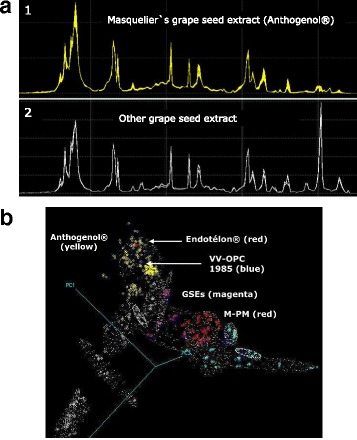
a Typical examples of an unassigned fingerprint proton nuclear magnetic resonance (1H-NMR) spectra of Masquelier’s grape seed extract (1) and another grape seed extract (2). b Three-dimensional plot of the principle component analysis (PCA) using unassigned fingerprint proton nuclear magnetic resonance (1H-NMR) spectra to compare the phytochemical content of different plant extracts e.g. from distinct manufacturers or from different batches. The small white dotted lines indicate the 95% confidence interval per cluster. The cluster of Masquelier’s grape seed extract (Anthogenol®, yellow) clearly distinguish from the cluster of French pine bark extract (M-PM, red) and other grape seed extracts (GSEs, magenta). Samples of the Endotélon extract (red) and samples of Masquelier’s extract from 1985 (VV-OPC 1985, yellow) are located within the cluster of Masquelier’s grape seed extract proofing the qualitative and quantitative equality of these extracts. The green-blue lines represent the 3 strongest principal components (PC), i.e. the variables derived from the 1H-NMR spectra which define the biggest differences between all the samples. The farther 2 samples are apart from each other in respect of one particular axis, the more different they are in this particular aspect. The data were provided by the extract’s manufacturer

References

    1. Nassiri-Asl M, Hosseinzadeh H. Review of the pharmacological effects of Vitis vinifera (grape) and its bioactive constituents: an update. Phytother Res. 2016;30(9):1392–403. doi: 10.1002/ptr.5644. - DOI - PubMed
    1. Olaku OO, Ojukwu MO, Zia FZ, White JD. The role of grape seed extract in the treatment of chemo/radiotherapy induced toxicity: a systematic review of preclinical studies. Nutr Cancer. 2015;67:730–740. doi: 10.1080/01635581.2015.1029639. - DOI - PubMed
    1. Kasdagly M, Radhakrishnan S, Reddivari L, Veeramachaneni DN, Vanamala J. Colon carcinogenesis: influence of Western diet-induced obesity and targeting stem cells using dietary bioactive compounds. Nutrition. 2014;30:1242–1256. doi: 10.1016/j.nut.2014.02.016. - DOI - PubMed
    1. Ting H, Deep G, Agarwal C, Agarwal R. The strategies to control prostate cancer by chemoprevention approaches. Mutat Res. 2014;760:1–15. doi: 10.1016/j.mrfmmm.2013.12.003. - DOI - PMC - PubMed
    1. Tong LX, Young LC. Nutrition: the future of melanoma prevention? J Am Acad Dermatol. 2014;71:151–160. doi: 10.1016/j.jaad.2014.01.910. - DOI - PubMed

Publication types