External validation and comparison of three prediction tools for risk of osteoporotic fractures using data from population based electronic health records: retrospective cohort study
- PMID: 28104610
- PMCID: PMC5244817
- DOI: 10.1136/bmj.i6755
External validation and comparison of three prediction tools for risk of osteoporotic fractures using data from population based electronic health records: retrospective cohort study
Abstract
Objective: To directly compare the performance and externally validate the three most studied prediction tools for osteoporotic fractures-QFracture, FRAX, and Garvan-using data from electronic health records.
Design: Retrospective cohort study.
Setting: Payer provider healthcare organisation in Israel.
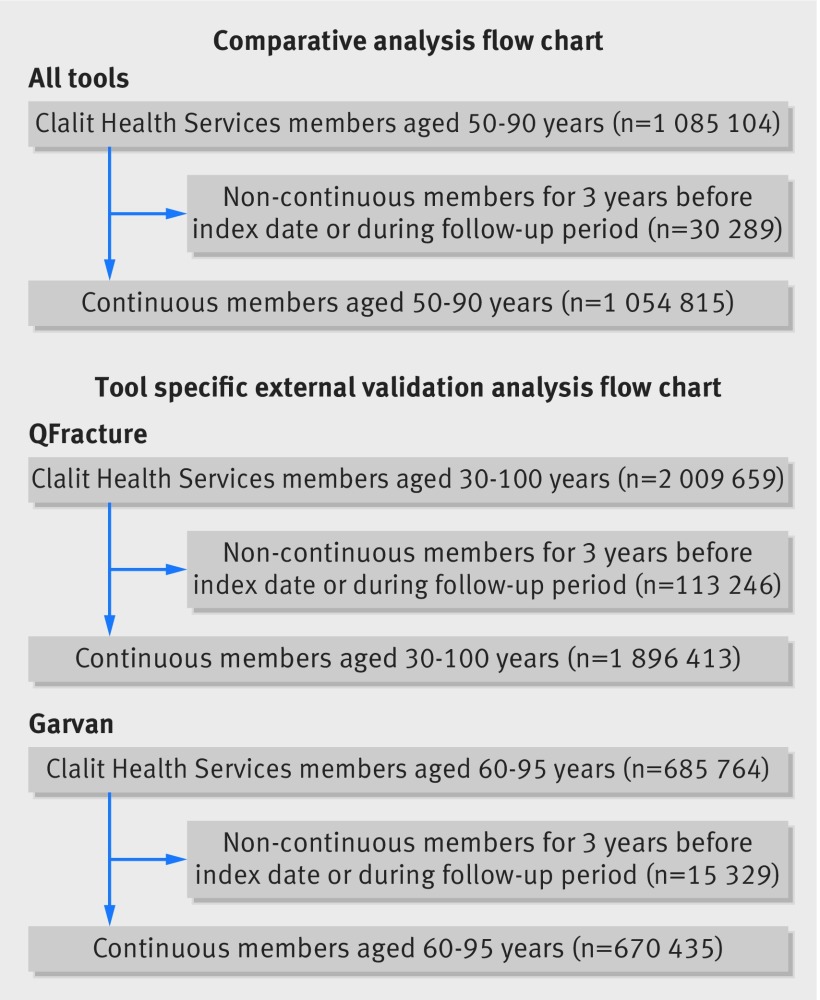
Participants: 1 054 815 members aged 50 to 90 years for comparison between tools and cohorts of different age ranges, corresponding to those in each tools' development study, for tool specific external validation.
Main outcome measure: First diagnosis of a major osteoporotic fracture (for QFracture and FRAX tools) and hip fractures (for all three tools) recorded in electronic health records from 2010 to 2014. Observed fracture rates were compared to probabilities predicted retrospectively as of 2010.
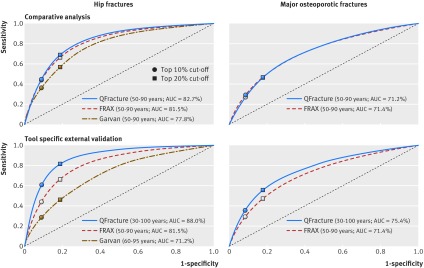
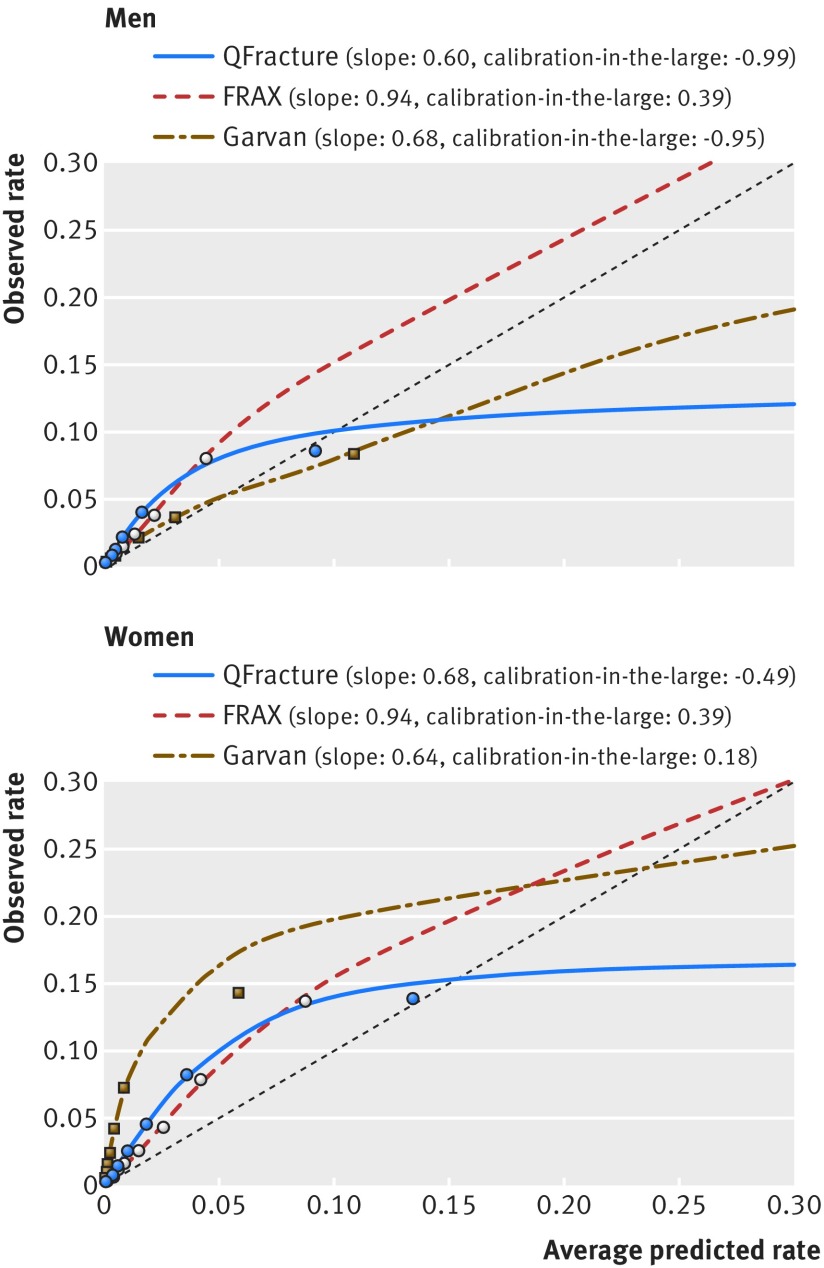
Results: The observed five year hip fracture rate was 2.7% and the rate for major osteoporotic fractures was 7.7%. The areas under the receiver operating curve (AUC) for hip fracture prediction were 82.7% for QFracture, 81.5% for FRAX, and 77.8% for Garvan. For major osteoporotic fractures, AUCs were 71.2% for QFracture and 71.4% for FRAX. All the tools underestimated the fracture risk, but the average observed to predicted ratios and the calibration slopes of FRAX were closest to 1. Tool specific validation analyses yielded hip fracture prediction AUCs of 88.0% for QFracture (among those aged 30-100 years), 81.5% for FRAX (50-90 years), and 71.2% for Garvan (60-95 years).
Conclusions: Both QFracture and FRAX had high discriminatory power for hip fracture prediction, with QFracture performing slightly better. This performance gap was more pronounced in previous studies, likely because of broader age inclusion criteria for QFracture validations. The simpler FRAX performed almost as well as QFracture for hip fracture prediction, and may have advantages if some of the input data required for QFracture are not available. However, both tools require calibration before implementation.
Published by the BMJ Publishing Group Limited. For permission to use (where not already granted under a licence) please go to http://group.bmj.com/group/rights-licensing/permissions.
Conflict of interest statement
All authors have completed the ICMJE uniform disclosure form at www.icmje.org/coi_disclosure.pdf and declare: no support from any organisation for the submitted work; no financial relationships with any organisations that might have an interest in the submitted work in the previous three years; no other relationships or activities that could appear to have influenced the submitted work.
Figures
References
-
- Pisani P, Renna MD, Conversano F, et al. Major osteoporotic fragility fractures: Risk factor updates and societal impact. World J Orthop 2016;7:171-81. 10.5312/wjo.v7.i3.171 pmid:27004165. - DOI - PMC - PubMed
-
- Roux C, Wyman A, Hooven FH, et al. GLOW investigators. Burden of non-hip, non-vertebral fractures on quality of life in postmenopausal women: the Global Longitudinal study of Osteoporosis in Women (GLOW). Osteoporos Int 2012;23:2863-71. 10.1007/s00198-012-1935-8 pmid:22398855. - DOI - PMC - PubMed
-
- Coughlan T, Dockery F. Osteoporosis and fracture risk in older people. Clin Med (Lond) 2014;14:187-91. 10.7861/clinmedicine.14-2-187 pmid:24715132. - DOI - PMC - PubMed
-
- Kanis JA, Johnell O, Oden A, Johansson H, McCloskey E. FRAX and the assessment of fracture probability in men and women from the UK. Osteoporos Int 2008;19:385-97. 10.1007/s00198-007-0543-5 pmid:18292978. - DOI - PMC - PubMed
-
- Lih A, Nandapalan H, Kim M, et al. Targeted intervention reduces refracture rates in patients with incident non-vertebral osteoporotic fractures: a 4-year prospective controlled study. Osteoporos Int 2011;22:849-58. 10.1007/s00198-010-1477-x pmid:21107534. - DOI - PubMed
Publication types
MeSH terms
LinkOut - more resources
Full Text Sources
Other Literature Sources
Medical
Molecular Biology Databases
Miscellaneous