


High prevalence of mutant KRAS in circulating exosome-derived DNA from early-stage pancreatic cancer patients
- PMID: 28104621
- PMCID: PMC5834026
- DOI: 10.1093/annonc/mdx004
High prevalence of mutant KRAS in circulating exosome-derived DNA from early-stage pancreatic cancer patients
Abstract
Background: Exosomes arise from viable cancer cells and may reflect a different biology than circulating cell-free DNA (cfDNA) shed from dying tissues. We compare exosome-derived DNA (exoDNA) to cfDNA in liquid biopsies of patients with pancreatic ductal adenocarcinoma (PDAC).
Patients and methods: Patient samples were obtained between 2003 and 2010, with clinically annotated follow up to 2015. Droplet digital PCR was performed on exoDNA and cfDNA for sensitive detection of KRAS mutants at codons 12/13. A cumulative series of 263 individuals were studied, including a discovery cohort of 142 individuals: 68 PDAC patients of all stages; 20 PDAC patients initially staged with localized disease, with blood drawn after resection for curative intent; and 54 age-matched healthy controls. A validation cohort of 121 individuals (39 cancer patients and 82 healthy controls) was studied to validate KRAS detection rates in early-stage PDAC patients. Primary outcome was circulating KRAS status as detected by droplet digital PCR. Secondary outcomes were disease-free and overall survival.
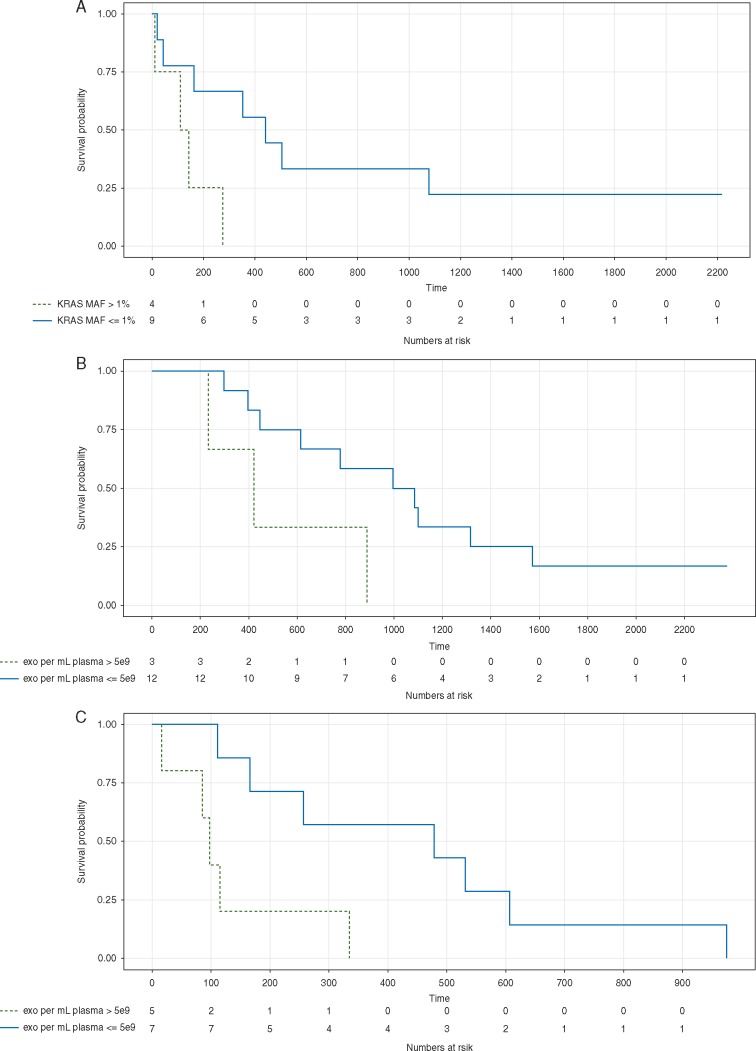
Results: KRAS mutations in exoDNA, were identified in 7.4%, 66.7%, 80%, and 85% of age-matched controls, localized, locally advanced, and metastatic PDAC patients, respectively. Comparatively, mutant KRAS cfDNA was detected in 14.8%, 45.5%, 30.8%, and 57.9% of these individuals. Higher exoKRAS MAFs were associated with decreased disease-free survival in patients with localized disease. In the validation cohort, mutant KRAS exoDNA was detected in 43.6% of early-stage PDAC patients and 20% of healthy controls.
Conclusions: Exosomes are a distinct source of tumor DNA that may be complementary to other liquid biopsy DNA sources. A higher percentage of patients with localized PDAC exhibited detectable KRAS mutations in exoDNA than previously reported for cfDNA. A substantial minority of healthy samples demonstrated mutant KRAS in circulation, dictating careful consideration and application of liquid biopsy findings, which may limit its utility as a broad cancer-screening method.
Keywords: KRAS; circulating tumor DNA; exosome; liquid biopsy; pancreatic cancer.
© The Author 2017. Published by Oxford University Press on behalf of the European Society for Medical Oncology. All rights reserved. For permissions, please email: journals.permissions@oup.com.
Figures
Comment in
-
Detecting mutant KRAS in liquid biopsies: a biomarker searching for a role.Ann Oncol. 2017 Apr 1;28(4):677-678. doi: 10.1093/annonc/mdx056. Ann Oncol. 2017. PMID: 28327928 No abstract available.
References
-
- Ryan DP, Hong TS, Bardeesy N.. Pancreatic adenocarcinoma. N Engl J Med 2014; 371: 1039–1049. - PubMed
-
- Yeo TP. Demographics, epidemiology, and inheritance of pancreatic ductal adenocarcinoma. Semin Oncol 2015; 42: 8–18. - PubMed
-
- Warner E. Clinical practice. Breast-cancer screening. N Engl J Med 2011; 365: 1025–1032. - PubMed
-
- Arteaga CL. Progress in breast cancer: overview. Clin Cancer Res 2013; 19: 6353–6359. - PubMed
-
- Lieberman DA. Clinical practice. Screening for colorectal cancer. N Engl J Med 2009; 361: 1179–1187. - PubMed
MeSH terms
Substances
Grants and funding
LinkOut - more resources
Full Text Sources
Other Literature Sources
Medical
Miscellaneous
