


Novel CagA ELISA exhibits enhanced sensitivity of Helicobacter pylori CagA antibody
- PMID: 28104980
- PMCID: PMC5221286
- DOI: 10.3748/wjg.v23.i1.48
Novel CagA ELISA exhibits enhanced sensitivity of Helicobacter pylori CagA antibody
Abstract
Aim: To develop a novel Helicobacter pylori (H. pylori) CagA antibody enzyme-linked immunosorbent assay (ELISA) suitable for detecting serum anti-CagA antibodies with high sensitivity.
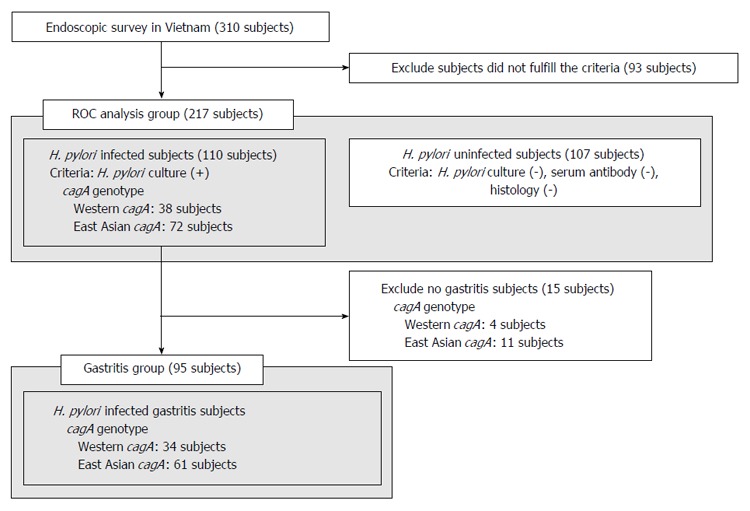
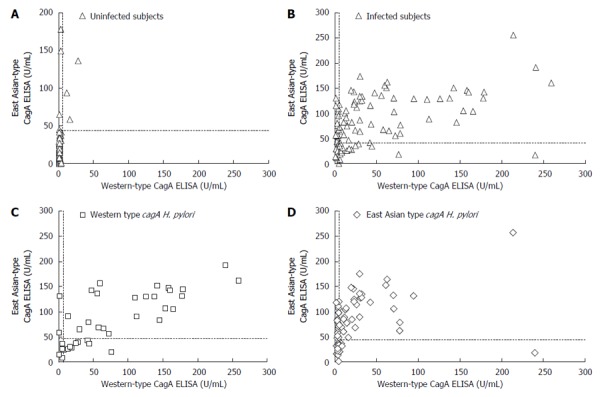
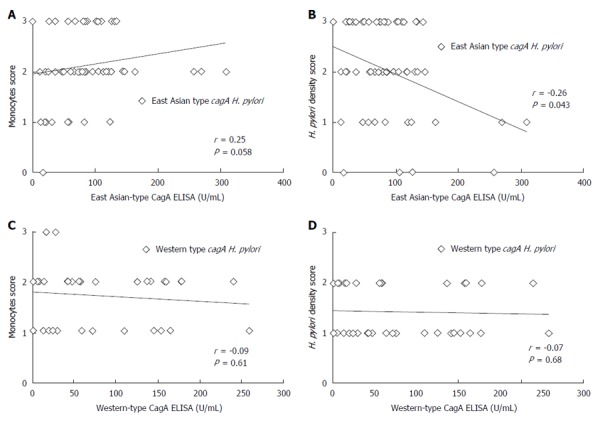
Methods: Recombinant East Asian-type CagA protein was purified and immobilized for ELISA. Serum samples from 217 Vietnamese individuals (110 H. pylori-infected and 107 uninfected individuals) were applied. Conventional ELISA from Western-type CagA and our East Asian-type CagA ELISA were evaluated by comparing 38 subjects with the Western-type genotype and 72 subjects with the East Asian-type cagA genotype. Histological scores of the gastric mucosa were determined using the updated Sydney System to examine the relationship with anti-CagA antibody titers.
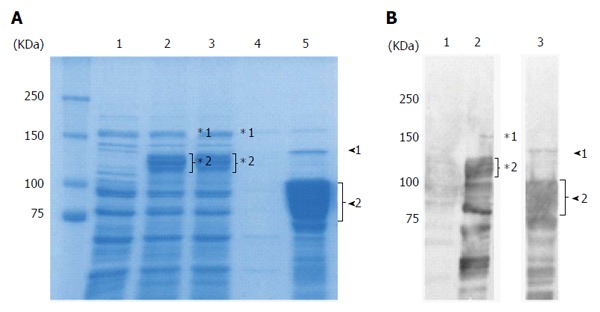
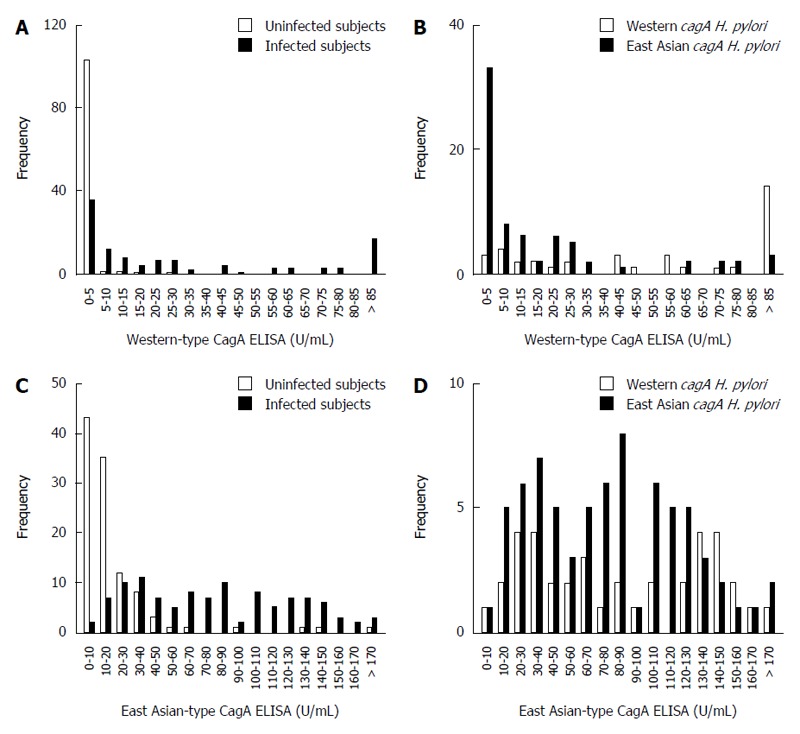
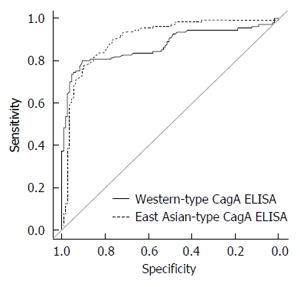
Results: Recombinant 70-100 kDa fragments were immobilized on the ELISA plate. In ROC analysis, the area under the curve of our East Asian-type CagA ELISA was comparable to that of conventional CagA ELISA. The sensitivity of the two ELISAs differed depending on the cagA genotype. The sensitivity of East Asian-type CagA ELISA was higher for subjects infected with East Asian-type cagA H. pylori (P < 0.001), and the sensitivity of the conventional CagA ELISA tended to be higher for subjects infected with Western cagA H. pylori (P = 0.056). The titer of anti-CagA antibody tended to correlate with monocyte infiltration scores (r = 0.25, P = 0.058) and was inversely correlated with H. pylori density (r = -0.26, P = 0.043).
Conclusion: The novel ELISA is useful to detect anti-CagA antibodies in East Asian countries, and the titer may be a marker for predicting chronic gastritis.
Keywords: Anti-CagA antibody; Enzyme-linked immunosorbent assay; Gastritis; Helicobacter pylori; Inflammation; cagA genotype.
Figures
References
-
- Fischer W. Assembly and molecular mode of action of the Helicobacter pylori Cag type IV secretion apparatus. FEBS J. 2011;278:1203–1212. - PubMed
-
- Mueller D, Tegtmeyer N, Brandt S, Yamaoka Y, De Poire E, Sgouras D, Wessler S, Torres J, Smolka A, Backert S. c-Src and c-Abl kinases control hierarchic phosphorylation and function of the CagA effector protein in Western and East Asian Helicobacter pylori strains. J Clin Invest. 2012;122:1553–1566. - PMC - PubMed
-
- Hatakeyama M. Oncogenic mechanisms of the Helicobacter pylori CagA protein. Nat Rev Cancer. 2004;4:688–694. - PubMed
Publication types
MeSH terms
Substances
LinkOut - more resources
Full Text Sources
Other Literature Sources
Medical
Research Materials
