


Body Adiposity Index Performance in Estimating Body Fat Percentage in Colombian College Students: Findings from the FUPRECOL-Adults Study
- PMID: 28106719
- PMCID: PMC5295084
- DOI: 10.3390/nu9010040
Body Adiposity Index Performance in Estimating Body Fat Percentage in Colombian College Students: Findings from the FUPRECOL-Adults Study
Abstract
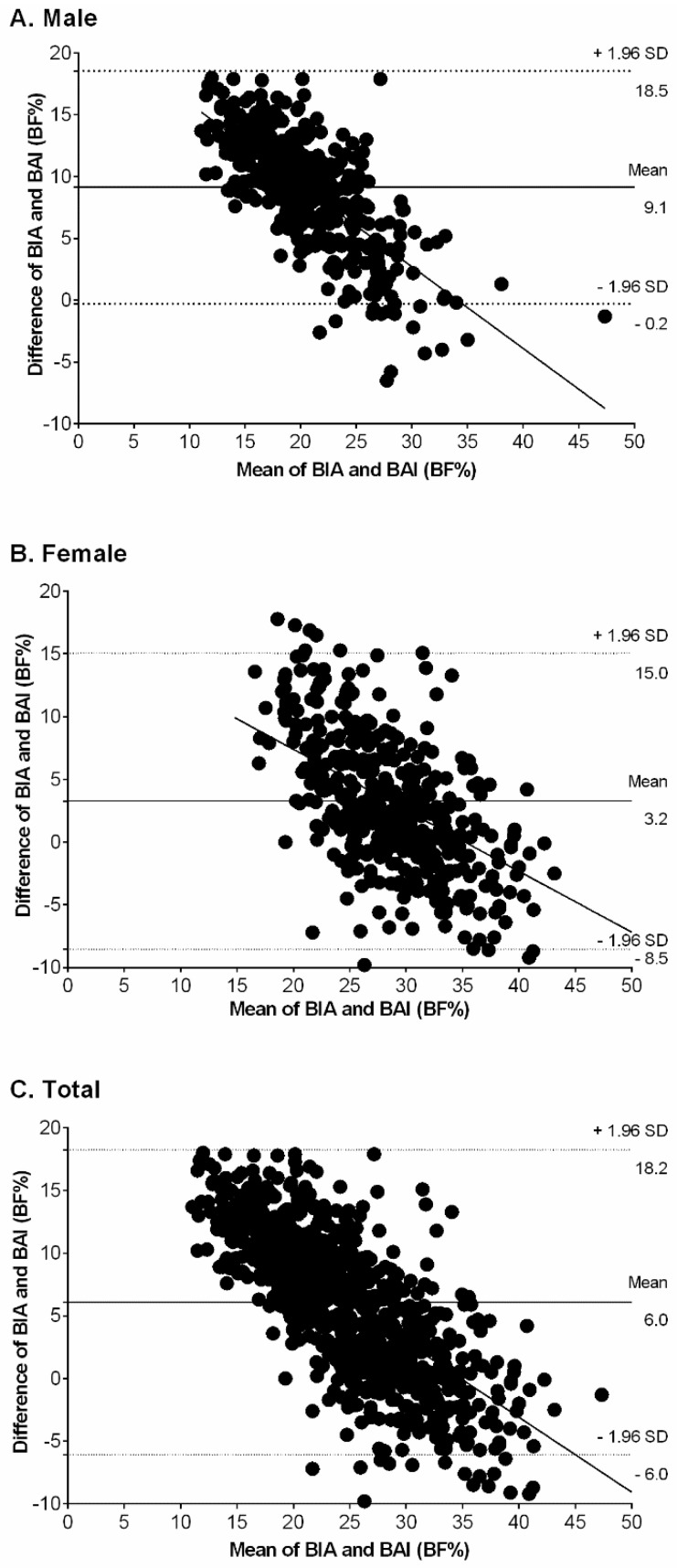
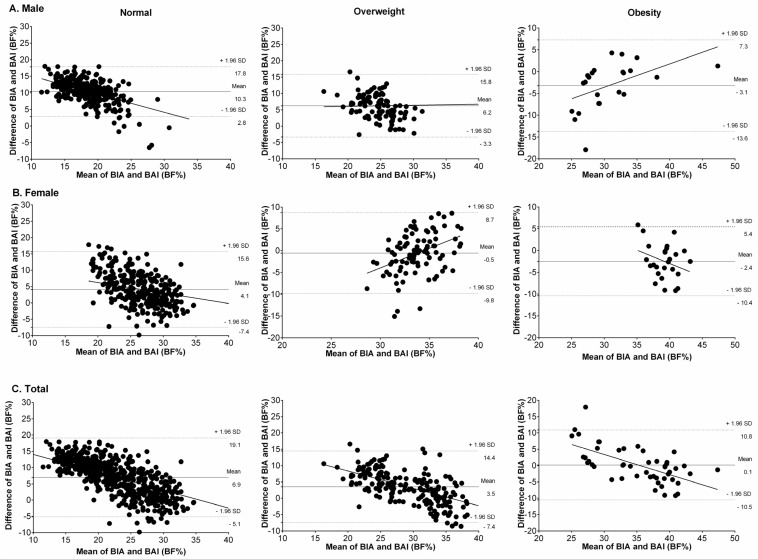
Recently, a body adiposity index (BAI = (hip circumference)/((height)(1.5))-18) was developed and validated in adult populations. The aim of this study was to evaluate the performance of BAI in estimating percentage body fat (BF%) in a sample of Colombian collegiate young adults. The participants were comprised of 903 volunteers (52% females, mean age = 21.4 years ± 3.3). We used the Lin's concordance correlation coefficient, linear regression, Bland-Altman's agreement analysis, concordance correlation coefficient (ρc) and the coefficient of determination (R²) between BAI, and BF%; by bioelectrical impedance analysis (BIA)). The correlation between the two methods of estimating BF% was R² = 0.384, p < 0.001. A paired-sample t-test showed a difference between the methods (BIA BF% = 16.2 ± 3.1, BAI BF% = 30.0 ± 5.4%; p < 0.001). For BIA, bias value was 6.0 ± 6.2 BF% (95% confidence interval (CI) = -6.0 to 18.2), indicating that the BAI method overestimated BF% relative to the reference method. Lin's concordance correlation coefficient was poor (ρc = 0.014, 95% CI = -0.124 to 0.135; p = 0.414). In Colombian college students, there was poor agreement between BAI- and BIA-based estimates of BF%, and so BAI is not accurate in people with low or high body fat percentage levels.
Keywords: body adiposity; body composition; students; validity.
Conflict of interest statement
The authors declare no conflict of interest.
Figures
References
-
- Lam B.C., Koh G.C., Chen C., Wong M.T., Fallows S.J. Comparison of Body Mass Index (BMI), Body AdiposityIndex (BAI), Waist Circumference (WC), Waist-To-Hip Ratio (WHtR) and Waist-To-Height Ratio (WHtR) as predictors of cardiovascular disease risk factors in an adult population in Singapore. PLoS ONE. 2015;10:e0122985. doi: 10.1371/journal.pone.0122985. - DOI - PMC - PubMed
MeSH terms
LinkOut - more resources
Full Text Sources
Other Literature Sources
Miscellaneous
