


Red Fruits: Extraction of Antioxidants, Phenolic Content, and Radical Scavenging Determination: A Review
- PMID: 28106822
- PMCID: PMC5384171
- DOI: 10.3390/antiox6010007
Red Fruits: Extraction of Antioxidants, Phenolic Content, and Radical Scavenging Determination: A Review
Abstract
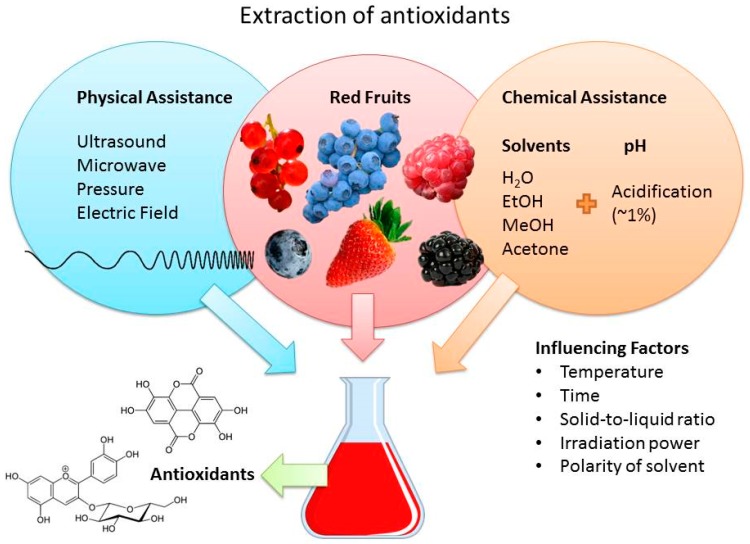
Red fruits, as rich antioxidant foods, have gained over recent years capital importance for consumers and manufacturers. The industrial extraction of the phenolic molecules from this source has been taking place with the conventional solvent extraction method. New non-conventional extraction methods have been devised as environmentally friendly alternatives to the former method, such as ultrasound, microwave, and pressure assisted extractions. The aim of this review is to compile the results of recent studies using different extraction methodologies, identify the red fruits with higher antioxidant activity, and give a global overview of the research trends regarding this topic. As the amount of data available is overwhelming, only results referring to berries are included, leaving aside other plant parts such as roots, stems, or even buds and flowers. Several researchers have drawn attention to the efficacy of non-conventional extraction methods, accomplishing similar or even better results using these new techniques. Some pilot-scale trials have been performed, corroborating the applicability of green alternative methods to the industrial scale. Blueberries (Vaccinium corymbosum L.) and bilberries (Vaccinium myrtillus L.) emerge as the berries with the highest antioxidant content and capacity. However, several new up and coming berries are gaining attention due to global availability and elevated anthocyanin content.
Keywords: antioxidant extraction; berry; phenolic content; red fruit; scavenging assay.
Conflict of interest statement
The authors declare no conflict of interest.
Figures

References
-
- Galván D’Alessandro L., Kriaa K., Nikov I., Dimitrov K. Ultrasound assisted extraction of polyphenols from black chokeberry. Sep. Purif. Technol. 2012;93:42–47. doi: 10.1016/j.seppur.2012.03.024. - DOI
-
- Périno-Issartier S., Abert-Vian M., Chemat F. Solvent Free Microwave-Assisted Extraction of Antioxidants from Sea Buckthorn (Hippophae rhamnoides) Food By-Products. Food Bioprocess Technol. 2011;4:1020–1028. doi: 10.1007/s11947-010-0438-x. - DOI
-
- Paes J., Dotta R., Barbero G.F., Martínez J. Extraction of phenolic compounds and anthocyanins from blueberry (Vaccinium myrtillus L.) residues using supercritical CO2 and pressurized liquids. J. Supercrit. Fluids. 2014;95:8–16. doi: 10.1016/j.supflu.2014.07.025. - DOI
-
- Häkkinen S.H., Törrönen A.R. Content of flavonols and selected phenolic acids in strawberries and Vaccinium species: Influence of cultivar, cultivation site and technique. Food Res. Int. 2000;33:517–524. doi: 10.1016/S0963-9969(00)00086-7. - DOI
-
- Ścibisz I., Mitek M. The changes of antioxidant properties in highbush blueberries (Vaccinium corymbosum L.) During freezing and long-term frozen storage. ACTA Acta Sci. Pol. Technol. Aliment. 2007;6:75–82.
Publication types
LinkOut - more resources
Full Text Sources
Other Literature Sources
Research Materials
