


Evaluation of a Predictive Staging Model for HIV-Associated Kaposi Sarcoma in Uganda
- PMID: 28107226
- PMCID: PMC5340582
- DOI: 10.1097/QAI.0000000000001286
Evaluation of a Predictive Staging Model for HIV-Associated Kaposi Sarcoma in Uganda
Abstract
Background: HIV-associated Kaposi sarcoma (KS) is commonly staged using the AIDS Clinical Trials Group criteria, which classify 3 variables- tumor extent (T), immune status (I), and systemic symptoms (S)-into good risk (0) and poor risk (1). Although validated in the United States and Europe, these criteria have not been systematically evaluated in sub-Saharan Africa, where the burden of KS is greatest.
Methods: We reviewed medical charts of adult patients with HIV-associated KS seen at the Uganda Cancer Institute from 1992 to 2007. Vital status at 2 years after KS diagnosis was determined from the medical chart, or by contacting the patient or next of kin. Survival estimates used Kaplan-Meier methods. Predictors were evaluated for 2 periods: 0-4 months and 4-24 months after diagnosis.
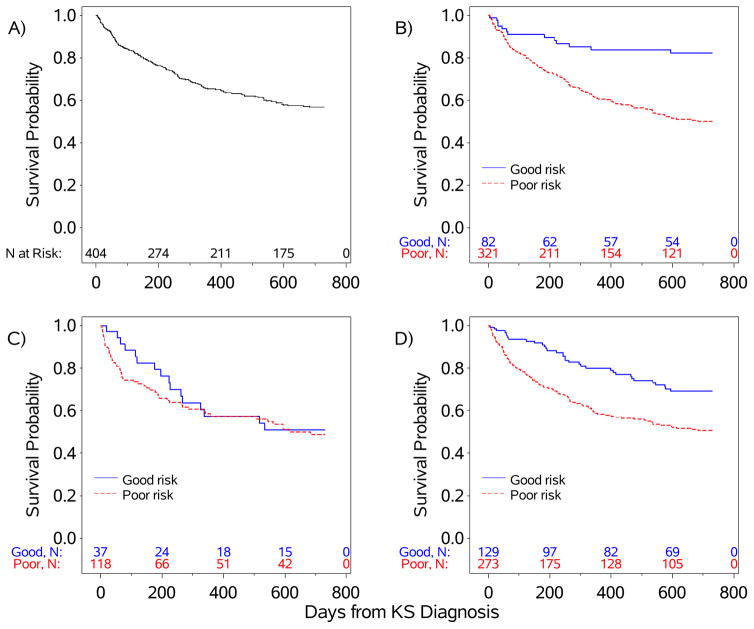
Results: At 2 years after diagnosis, 167 (41%) patients were alive, 156 (39%) had died, and 81 (20%) were lost to follow-up. The Kaplan-Meier estimate of 2-year survival was 57%. S1 was associated with death in months 0-4 [hazard ratio: 6.4, 95% confidence interval: 1.9-21.1], whereas T1 was associated with death in months 4-24 [hazard ratio: 4.0, 95% confidence interval: 1.4 to 11.5]. Immune status was not associated with survival.
Conclusions: Systemic symptoms were strongly associated with death in the early period after KS diagnosis, whereas tumor status was most predictive of death in the 4- to 24-month period. These findings suggest that different processes may influence outcomes in early and late periods following KS diagnosis. Further studies are needed to confirm these observations and to identify better predictors of KS survival in sub-Saharan Africa.
Conflict of interest statement
The authors have no financial or other conflicts of interest to disclose.
Figures
References
-
- Ferlay J, Soerjomataram I, Dikshit R, et al. Cancer incidence and mortality worldwide: sources, methods and major patterns in GLOBOCAN 2012. Int J Cancer. 2015 Mar 1;136(5):E359–386. - PubMed
-
- Wabinga HR, Nambooze S, Amulen PM, Okello C, Mbus L, Parkin DM. Trends in the incidence of cancer in Kampala, Uganda 1991–2010. Int J Cancer. 2014 Jul 15;135(2):432–439. - PubMed
-
- Krown SE, Metroka C, Wernz JC. Kaposi’s sarcoma in the acquired immune deficiency syndrome: a proposal for uniform evaluation, response, and staging criteria. AIDS Clinical Trials Group Oncology Committee. J Clin Oncol. 1989 Sep;7(9):1201–1207. - PubMed
-
- Krown S, Testa M, Huang J. AIDS-related Kaposi’s sarcoma: prospective validation of the AIDS Clinical Trials Group staging classification. AIDS Clinical Trials Group Oncology Committee. J Clin Oncol. 1997 Sep;15(9):3085–3092. - PubMed
-
- Nasti G, Talamini R, Antinori A, et al. AIDS-related Kaposi’s Sarcoma: evaluation of potential new prognostic factors and assessment of the AIDS Clinical Trial Group Staging System in the Haart Era--the Italian Cooperative Group on AIDS and Tumors and the Italian Cohort of Patients Naive From Antiretrovirals. J Clin Oncol. 2003 Aug 1;21(15):2876–2882. - PubMed
Publication types
MeSH terms
Grants and funding
LinkOut - more resources
Full Text Sources
Other Literature Sources
Medical
