. 2017 Mar:88:21-25.
doi: 10.1016/j.jcv.2016.12.011. Epub 2017 Jan 5.

Recent sequence variation in probe binding site affected detection of respiratory syncytial virus group B by real-time RT-PCR

Affiliations

Recent sequence variation in probe binding site affected detection of respiratory syncytial virus group B by real-time RT-PCR

Everlyn Kamau et al. J Clin Virol. 2017 Mar.

Abstract

Background: Direct immuno-fluorescence test (IFAT) and multiplex real-time RT-PCR have been central to RSV diagnosis in Kilifi, Kenya. Recently, these two methods showed discrepancies with an increasing number of PCR undetectable RSV-B viruses.

Objectives: Establish if mismatches in the primer and probe binding sites could have reduced real-time RT-PCR sensitivity.

Study design: Nucleoprotein (N) and glycoprotein (G) genes were sequenced for real-time RT-PCR positive and negative samples. Primer and probe binding regions in N gene were checked for mismatches and phylogenetic analyses done to determine molecular epidemiology of these viruses. New primers and probe were designed and tested on the previously real-time RT-PCR negative samples.

Results: N gene sequences revealed 3 different mismatches in the probe target site of PCR negative, IFAT positive viruses. The primers target sites had no mismatches. Phylogenetic analysis of N and G genes showed that real-time RT-PCR positive and negative samples fell into distinct clades. Newly designed primers-probe pair improved detection and recovered previous PCR undetectable viruses.

Conclusions: An emerging RSV-B variant is undetectable by a quite widely used real-time RT-PCR assay due to polymorphisms that influence probe hybridization affecting PCR accuracy.

Keywords: Mismatches; Primer; Probe; RSV; RT-PCR; Real-time.


Figures

Fig. 1
Fig. 1
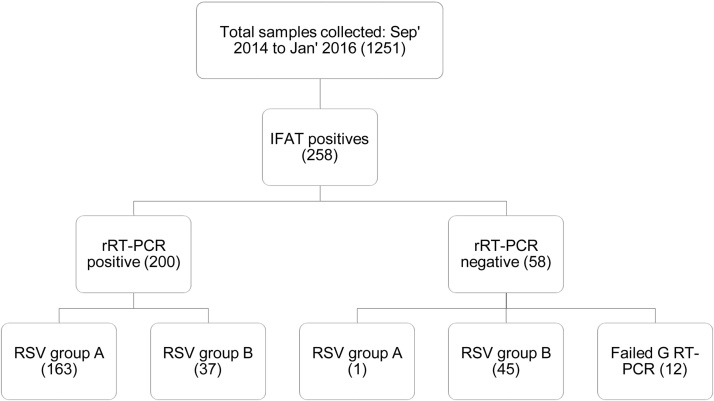
Summary of samples and rRT-PCR sensitivity for two RSV epidemics in Kilifi, Coastal Kenya 2014–2016.
Fig. 2
Fig. 2
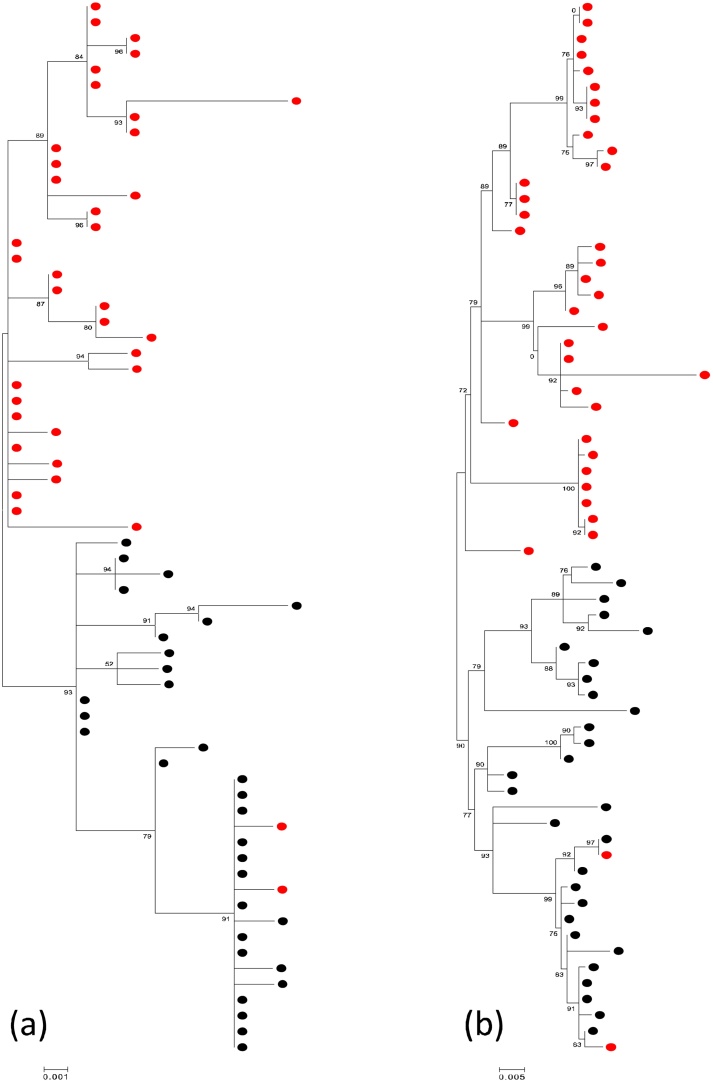
Phylogenetic clustering of nucleotide sequences from viruses undetectable and detectable by multiplex rRT-PCR from Kilifi, Coastal Kenya 2014–16. (a) Maximum likelihood tree of 72 N gene (700 bp) sequences: tips are colored by rRT-PCR outcome, where red is rRT-PCR negative (n = 40) and black is rRT-PCR positive (n = 32). (b) Maximum likelihood tree of 66 G gene (905 bp) sequences. Tips are colored as in (a). Viruses undetected by rRT-PCR formed a cluster separate from the detectable viruses sampled in the same epidemic. N and G gene sequences are derived from the same samples (matching sequences). The two RT-PCR negative strains had an additional polymorphism as described in text.
Fig. 3
Fig. 3
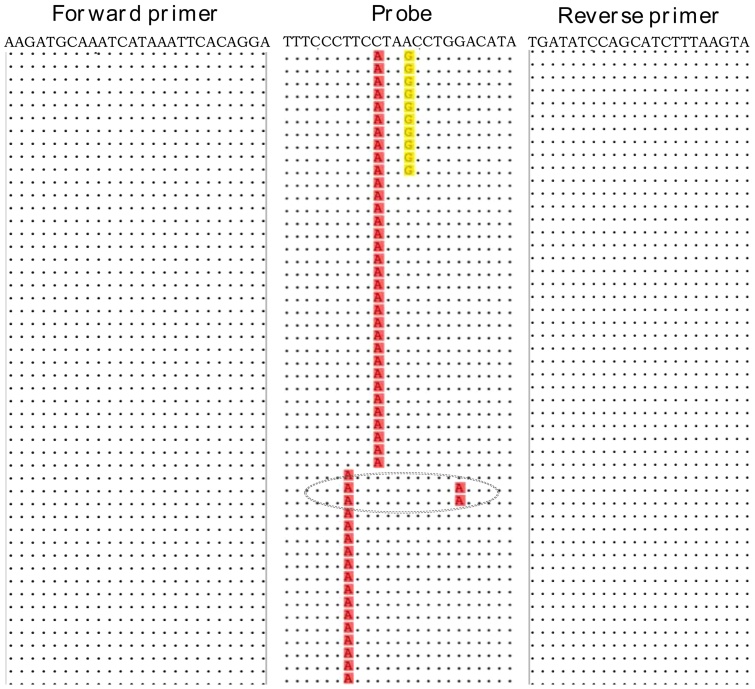
An alignment (5‘ – 3‘) of the primers and probe with a subset of N gene sequences from the rRT-PCR discrepant samples: dots indicate identity with primer or probe sequence. Mismatching nucleotides at positions 11, 14 and 17 of the probe are highlighted. Majority of the rRT-PCR negative RSV-B viruses had nucleotide changes at the 14th base. The grey circle shows the additional polymorphism at the 6th base for two PCR negative strains that clustered with rRT-PCR positive viruses.

References

    1. Berkley J.A., Munywoki P., Ngama M., Kazungu S., Abwao J., Bett A. Viral etiology of severe pneumonia among Kenyan infants and children. JAMA. 2010;303:2051–2057. - PMC - PubMed
    1. Katzov-Eckert H., Botosso V.F., Neto E.A., Zanotto P.M. Phylodynamics and dispersal of HRSV entails its permanence in the general population in between yearly outbreaks in children. PLoS One. 2012;7:e41953. - PMC - PubMed
    1. Nair H., Nokes D.J., Gessner B.D., Dherani M., Madhi S.A., Singleton R.J. Global burden of acute lower respiratory infections due to respiratory syncytial virus in young children: a systematic review and meta-analysis. Lancet (London, England) 2010;375:1545–1555. - PMC - PubMed
    1. Sullender W.M. Respiratory syncytial virus genetic and antigenic diversity. Clin. Microbiol. Rev. 2000;13:1–15. table of contents. - PMC - PubMed
    1. Nokes D.J., Ngama M., Bett A., Abwao J., Munywoki P., English M. Incidence and severity of respiratory syncytial virus pneumonia in rural Kenyan children identified through hospital surveillance. Clin. Infect. Dis. 2009;49:1341–1349. - PMC - PubMed

Publication types

MeSH terms