


Three, six, or twelve months of dual antiplatelet therapy after DES implantation in patients with or without acute coronary syndromes: an individual patient data pairwise and network meta-analysis of six randomized trials and 11 473 patients
- PMID: 28110296
- PMCID: PMC5837418
- DOI: 10.1093/eurheartj/ehw627
Three, six, or twelve months of dual antiplatelet therapy after DES implantation in patients with or without acute coronary syndromes: an individual patient data pairwise and network meta-analysis of six randomized trials and 11 473 patients
Abstract
Aim: We sought to determine whether the optimal dual antiplatelet therapy (DAPT) duration after drug-eluting stent (DES) placement varies according to clinical presentation.
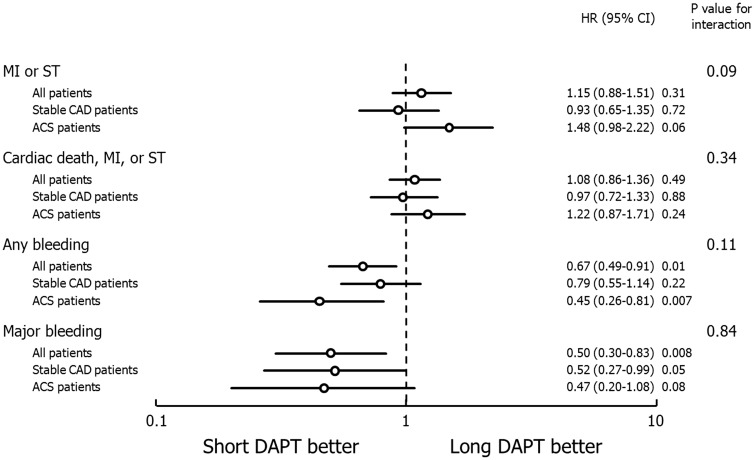
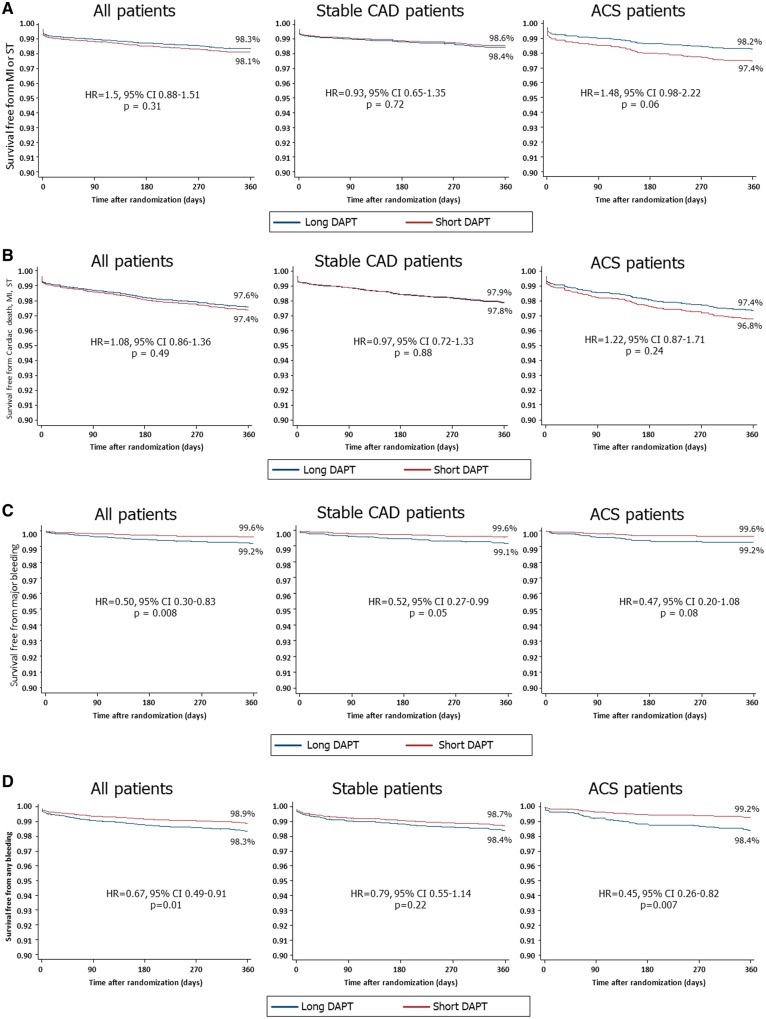
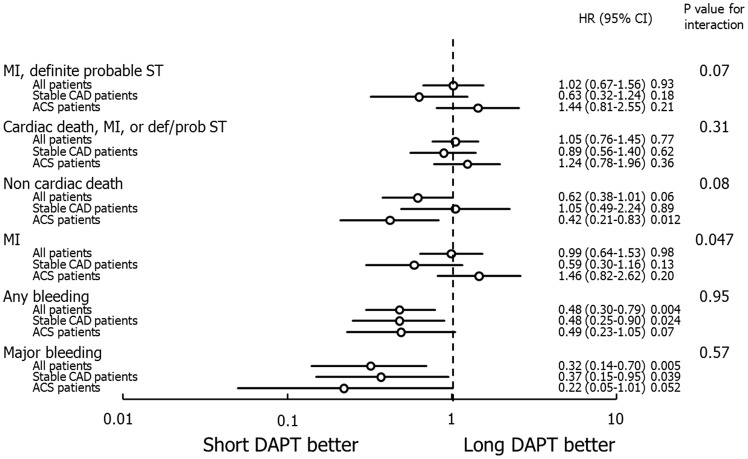
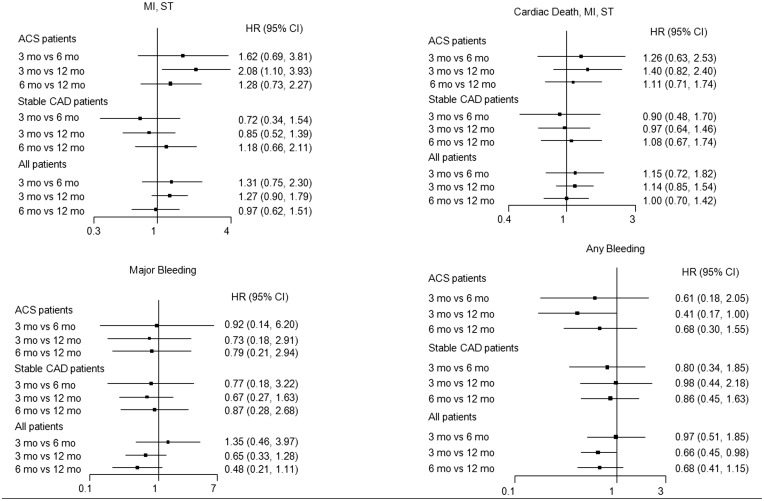
Methods and results: We performed an individual patient data pairwise and network meta-analysis comparing short-term (≤6-months) versus long-term (1-year) DAPT as well as 3-month vs. 6-month vs 1-year DAPT. The primary study outcome was the 1-year composite risk of myocardial infarction (MI) or definite/probable stent thrombosis (ST). Six trials were included in which DAPT after DES consisted of aspirin and clopidogrel. Among 11 473 randomized patients 6714 (58.5%) had stable CAD and 4758 (41.5%) presented with acute coronary syndrome (ACS), the majority of whom (67.0%) had unstable angina. In ACS patients, ≤6-month DAPT was associated with non-significantly higher 1-year rates of MI or ST compared with 1-year DAPT (Hazard Ratio (HR) 1.48, 95% Confidence interval (CI) 0.98-2.22; P = 0.059), whereas in stable patients rates of MI and ST were similar between the two DAPT strategies (HR 0.93, 95%CI 0.65-1.35; P = 0.71; Pinteraction = 0.09). By network meta-analysis, 3-month DAPT, but not 6-month DAPT, was associated with higher rates of MI or ST in ACS, whereas no significant differences were apparent in stable patients. Short DAPT was associated with lower rates of major bleeding compared with 1-year DAPT, irrespective of clinical presentation. All-cause mortality was not significantly different with short vs. long DAPT in both patients with stable CAD and ACS.
Conclusions: Optimal DAPT duration after DES differs according to clinical presentation. In the present meta-analysis, despite the fact that most enrolled ACS patients were relatively low risk, 3-month DAPT was associated with increased ischaemic risk, whereas 3-month DAPT appeared safe in stable CAD. Prolonged DAPT increases bleeding regardless of clinical presentation. Further study is required to identify the optimal duration of DAPT after DES in individual patients based on their relative ischaemic and bleeding risks.
Keywords: Drug-eluting stent; Dual antiplatelet therapy; Stent thrombosis.
Published on behalf of the European Society of Cardiology. All rights reserved. © The Author 2017. For permissions, please email: journals.permissions@oup.com.
Figures
Comment in
-
Duration of antiplatelet therapy after DES implantation: can we trust non-inferiority open-label trials?Eur Heart J. 2017 Apr 7;38(14):1044-1047. doi: 10.1093/eurheartj/ehx110. Eur Heart J. 2017. PMID: 28329323 No abstract available.
-
Review: After coronary DES, ≤ 6 mo and 1 y of dual-antiplatelet therapy do not differ for CV events at 1 y.Ann Intern Med. 2017 May 16;166(10):JC54. doi: 10.7326/ACPJC-2017-166-10-054. Ann Intern Med. 2017. PMID: 28505638 No abstract available.
References
-
- Palmerini T, Stone GW.. Optimal duration of dual antiplatelet therapy after drug-eluting stent implantation: conceptual evolution based on emerging evidence. Eur Heart J 2016;37:353–364. - PubMed
-
- Kukreja N, Onuma Y, Garcia-Garcia HM, Daemen J, van Domburg R, Serruys PW.. The risk of stent thrombosis in patients with acute coronary syndromes treated with bare-metal and drug-eluting stents. JACC Cardiovasc Interv 2009;2:534–541. - PubMed
-
- Stewart LA, Clarke M, Rovers M, Riley RD, Simmonds M, Stewart G, Tierney JF.. Preferred reporting items for systematic review and meta-analyses of individual participant data: the PRISMA-IPD Statement. JAMA 2015;313:1657–1665. - PubMed
-
- Royston P, Lambert P.. Flexible Parametric Survival Analysis Using STATA: Beyond the Cox Model. College Station, Texas: STATA PRESS; 2011.
-
- Klein J, Moeschberger M, Survival Analysis. Techniques for censored and truncated data. 2nd ed. New York: Springer Publishers; 2003.
Publication types
MeSH terms
Substances
Grants and funding
LinkOut - more resources
Full Text Sources
Other Literature Sources
Medical
Miscellaneous
