


Prevention of cardiac surgery-associated AKI by implementing the KDIGO guidelines in high risk patients identified by biomarkers: the PrevAKI randomized controlled trial
- PMID: 28110412
- PMCID: PMC5633630
- DOI: 10.1007/s00134-016-4670-3
Prevention of cardiac surgery-associated AKI by implementing the KDIGO guidelines in high risk patients identified by biomarkers: the PrevAKI randomized controlled trial
Erratum in
-
Erratum to: Prevention of cardiac surgery-associated AKI by implementing the KDIGO guidelines in high risk patients identified by biomarkers: the PrevAKI randomized controlled trial.Intensive Care Med. 2017 Nov;43(11):1749. doi: 10.1007/s00134-017-4735-y. Intensive Care Med. 2017. PMID: 28271319 Free PMC article. No abstract available.
Abstract
Purpose: Care bundles are recommended in patients at high risk for acute kidney injury (AKI), although they have not been proven to improve outcomes. We sought to establish the efficacy of an implementation of the Kidney Disease Improving Global Outcomes (KDIGO) guidelines to prevent cardiac surgery-associated AKI in high risk patients defined by renal biomarkers.
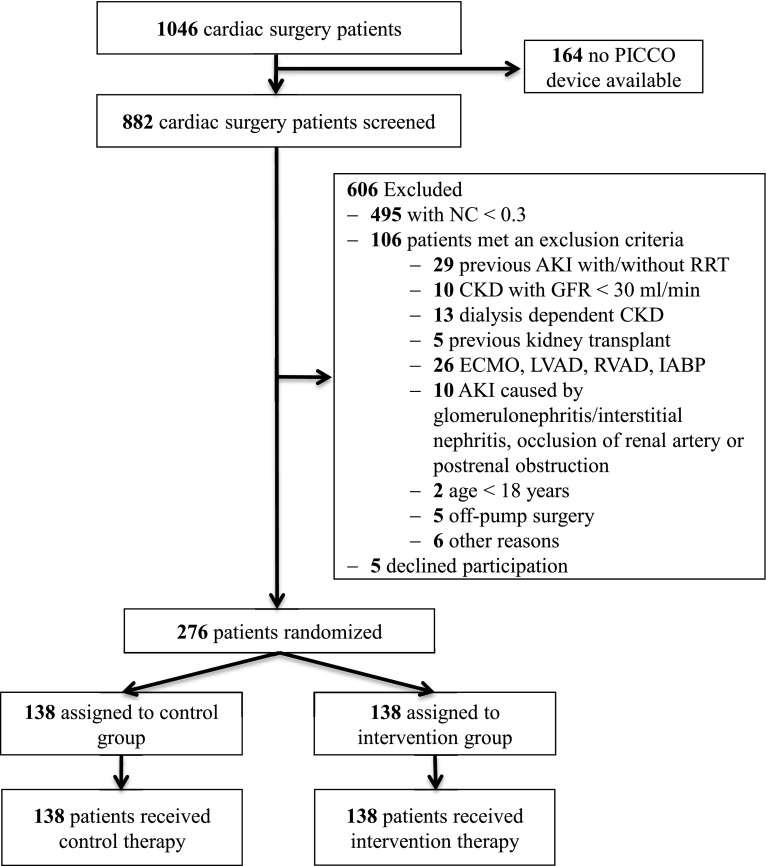
Methods: In this single-center trial, we examined the effect of a "KDIGO bundle" consisting of optimization of volume status and hemodynamics, avoidance of nephrotoxic drugs, and preventing hyperglycemia in high risk patients defined as urinary [TIMP-2]·[IGFBP7] > 0.3 undergoing cardiac surgery. The primary endpoint was the rate of AKI defined by KDIGO criteria within the first 72 h after surgery. Secondary endpoints included AKI severity, need for dialysis, length of stay, and major adverse kidney events (MAKE) at days 30, 60, and 90.
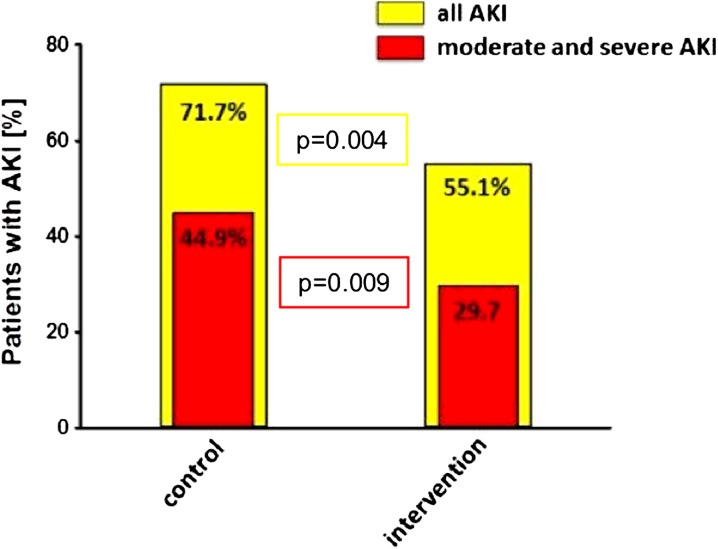
Results: AKI was significantly reduced with the intervention compared to controls [55.1 vs. 71.7%; ARR 16.6% (95 CI 5.5-27.9%); p = 0.004]. The implementation of the bundle resulted in significantly improved hemodynamic parameters at different time points (p < 0.05), less hyperglycemia (p < 0.001) and use of ACEi/ARBs (p < 0.001) compared to controls. Rates of moderate to severe AKI were also significantly reduced by the intervention compared to controls. There were no significant effects on other secondary outcomes.
Conclusion: An implementation of the KDIGO guidelines compared with standard care reduced the frequency and severity of AKI after cardiac surgery in high risk patients. Adequately powered multicenter trials are warranted to examine mortality and long-term renal outcomes.
Keywords: Acute kidney injury; Biomarkers; Cardiac surgery; KDIGO guidelines; Major adverse kidney events; [TIMP-2]·[IGFBP7].
Conflict of interest statement
Conflicts of interest
AZ has received unrestricted grant and lecture fees from Astute Medical as well as lecture fees from Fresenius and Braun. MM has received lecture fees from Astute Medical. The remaining authors declare that they have no conflicts of interest.
Funding/support
The trial is registered at
Figures
Comment in
-
Acute kidney injury: AKI: the myth of inevitability is finally shattered.Nat Rev Nephrol. 2017 Mar;13(3):140-141. doi: 10.1038/nrneph.2017.11. Epub 2017 Feb 6. Nat Rev Nephrol. 2017. PMID: 28163309 No abstract available.
-
Validating benefit of biomarker-directed therapy for acute kidney injury: can you have your cake and eat it?Intensive Care Med. 2017 Apr;43(4):578-580. doi: 10.1007/s00134-017-4710-7. Epub 2017 Feb 16. Intensive Care Med. 2017. PMID: 28210773 No abstract available.
-
Discussion on "Prevention of cardiac surgery-associated AKI by implementing the KDIGO guidelines in high risk patients identified by biomarkers: the PrevAKI randomized controlled trial".Intensive Care Med. 2018 Feb;44(2):273-274. doi: 10.1007/s00134-017-5014-7. Epub 2018 Jan 9. Intensive Care Med. 2018. PMID: 29318325 No abstract available.
References
-
- Landoni G, Bove T, Szekely A, Comis M, Rodseth RN, Pasero D, Ponschab M, Mucchetti M, Bove T, Azzolini ML, Caramelli F, Paternoster G, Pala G, Cabrini L, Amitrano D, Borghi G, Capasso A, Cariello C, Carpanese A, Feltracco P, Gottin L, Lobreglio R, Mattioli L, Monaco F, Morgese F, Musu M, Pasin L, Pisano A, Roasio A, Russo G, Slaviero G, Villari N, Vittorio A, Zucchetti M, Guarracino F, Morelli A, De Santis V, Del Sarto PA, Corcione A, Ranieri M, Finco G, Zangrillo A, Bellomo R. Reducing mortality in acute kidney injury patients: systematic review and international web-based survey. J Cardiothorac Vasc Anesth. 2013;27:1384–1398. doi: 10.1053/j.jvca.2013.06.028. - DOI - PubMed
-
- Bove T, Zangrillo A, Guarracino F, Alvaro G, Persi B, Maglioni E, Galdieri N, Comis M, Caramelli F, Pasero DC, Pala G, Renzini M, Conte M, Paternoster G, Martinez B, Pinelli F, Frontini M, Zucchetti MC, Pappalardo F, Amantea B, Camata A, Pisano A, Verdecchia C, Dal Checco E, Cariello C, Faita L, Baldassarri R, Scandroglio AM, Saleh O, Lembo R, Calabro MG, Bellomo R, Landoni G. Effect of fenoldopam on use of renal replacement therapy among patients with acute kidney injury after cardiac surgery: a randomized clinical trial. JAMA. 2014;312:2244–2253. doi: 10.1001/jama.2014.13573. - DOI - PubMed
-
- KDIGO AKI Work Group (2012) KDIGO clinical practice guideline for acute kidney injury. Kidney Int Suppl 2(1):1–138
Publication types
MeSH terms
Substances
Grants and funding
LinkOut - more resources
Full Text Sources
Other Literature Sources
Medical
Research Materials
Miscellaneous
