. 2017 May;137(5):1025-1032.
doi: 10.1016/j.jid.2016.11.042. Epub 2017 Jan 19.

Abcc6 Knockout Rat Model Highlights the Role of Liver in PPi Homeostasis in Pseudoxanthoma Elasticum

Affiliations

Abcc6 Knockout Rat Model Highlights the Role of Liver in PPi Homeostasis in Pseudoxanthoma Elasticum

Qiaoli Li et al. J Invest Dermatol. 2017 May.

Abstract

Pseudoxanthoma elasticum, a heritable ectopic mineralization disorder, is caused by mutations in the ABCC6 gene primarily expressed in the liver and the kidneys. The fundamental question on pathogenesis of pseudoxanthoma elasticum, whether lack of ABCC6 expression in liver or kidney is the primary site of molecular pathology in peripheral tissues, has not been addressed. We generated a series of Abcc6-/- rats as models of pseudoxanthoma elasticum depicting ectopic mineralization in the skin, eyes, and the arterial blood vessels. Plasma inorganic pyrophosphate (PPi) level was reduced (<30%) in the Abcc6-/- rats leading to a lowered PPi/inorganic phosphate plasma ratio. In situ liver and kidney perfusions were performed to determine the relative contribution of these organs to PPi levels in circulation. PPi levels in the perfusates both in the liver and kidney of Abcc6-/- rats were significantly reduced, but the PPi levels in the liver perfusates of wild-type rats were 10-fold higher than that in the kidney perfusates. These observations suggest a critical role of hepatic ABCC6 in contributing to plasma PPi levels, identifying liver as a target of molecular correction to counteract ectopic mineralization in pseudoxanthoma elasticum.


Conflict of interest statement

DISCLOSURE

Dr. Sundberg has sponsored research with BIOCON which has no relevance to this project. All other authors state no conflict of interest.

Figures
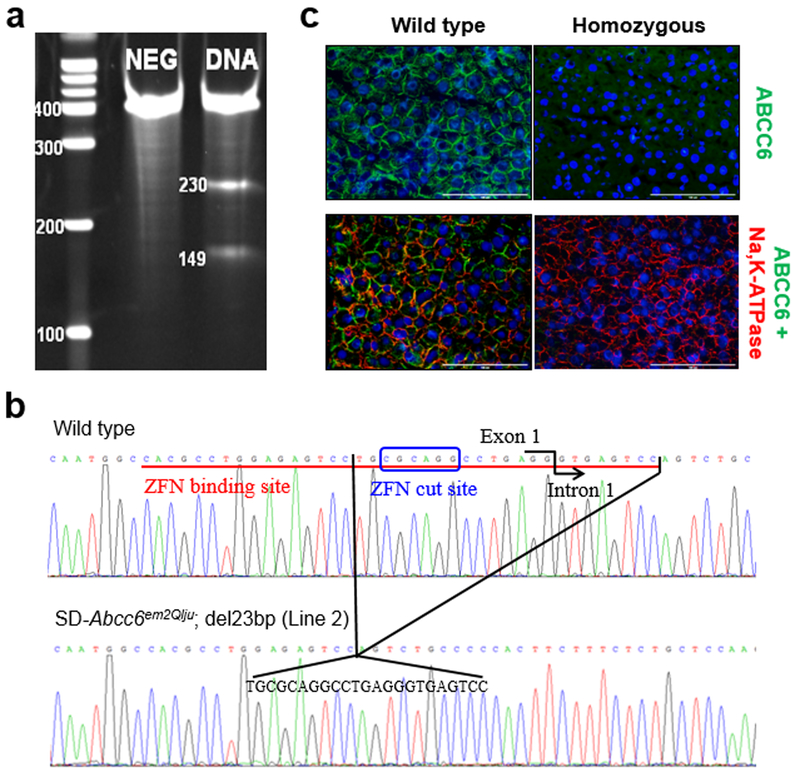
Figure 1.
Figure 1.. Generation and characterization of mutant Abcc6−/− rats.
(a) Surveyor Mutation Detection Assay demonstrates successfully targeted Abcc6 gene editing. Rat C6 cell line was cultured and transfected with ZFN plasmid DNA. Total genomic DNA was extracted from transfected cells (DNA) and from control cells as a negative control (NEG) and subjected to PCR amplification. A CEL-1 digestion assay was performed on the PCR products and resolved on 10% TBE-PAGE. (b) Sequence comparison surrounding the ZFN target site reveals a deletion mutation of 23 bp in mutant line SD-Abcc6em2Qlju (Line 2). The ZFN binding site is underlined, and the ZFN cut site is boxed. (c) The rat ABCC6 K14 antibody labeling in the wild type liver revealed the plasma membrane localization for ABCC6 (green) (1), which showed significant overlap with large areas of co-localization (yellow) with the basolateral plasma membrane marker Na,K-ATPase (red) (2). Complete absence of labeling of the plasma membrane for ABCC6 protein was found in the liver of Abcc6−/− rats (3,4). Scale bar, 100 µm.
Figure 2.
Figure 2.. Characterization of ectopic mineralization in Abcc6−/− rats.
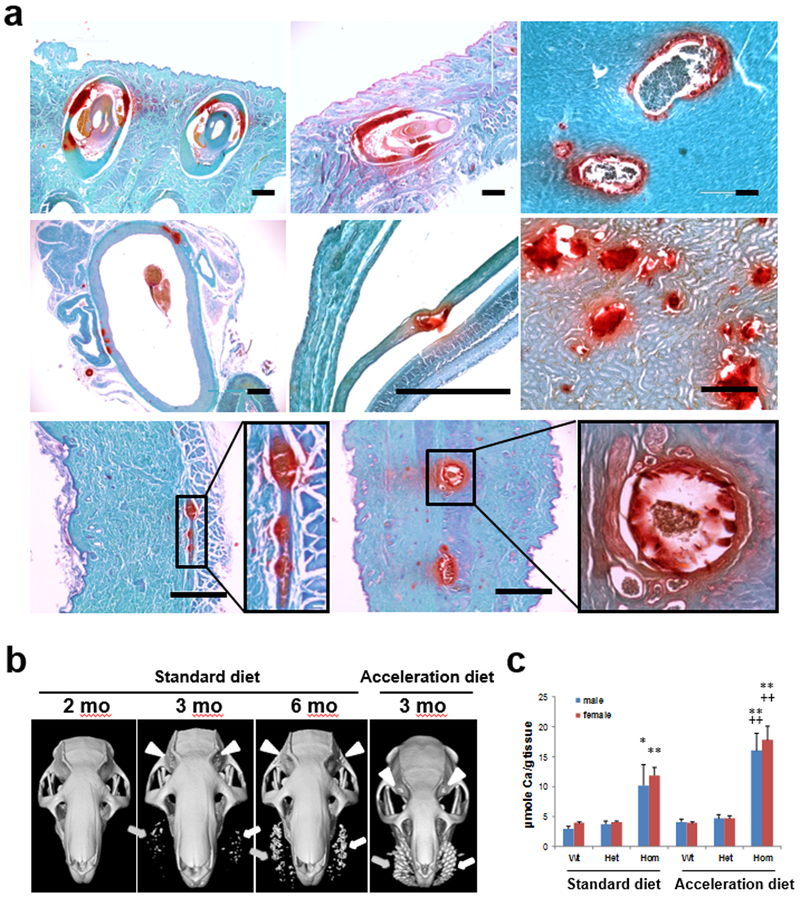
(a) Histological analysis demonstrates ectopic mineralization in a number of tissues of Abcc6−/− rats at 12 weeks of age. Alizarin red staining of tissue sections from knockout rats reveals mineralization in the dermal sheath of vibrissae in muzzle skin (top row left panel), the dermal sheath of vibrissae in the eyelids (top row middle panel), arterial blood vessels in the heart (top row right panel), aorta (middle row left panel), Bruch’s membrane of the eye (middle row middle panel), kidney (middle row right panel), ventral skin (bottom row left panel), and dorsal skin (bottom row right panel). Ectopic mineralization was not noted in heterozygous or wild type rats except in the kidneys. Scale bars in the figure, 400 μm. (b) Computed tomography demonstrates mineralization of dermal sheath of vibrissae in Abcc6−/− rats. When Abcc6−/− rats were maintained on standard rodent diet (left three panels), mineralization of dermal sheath of vibrissae in both muzzle skin (indicated by arrows) and eyelids (indicated by arrowheads) was clearly detectable at 3 months of age and progressing at 6 months of age. No mineralization was present at 2 months of age (the left panel). The Abcc6−/− rats develop significantly more mineralization when placed on “acceleration diet”, as shown at 3 months of age (right panel; compare with the rat at 3 months of age on standard diet). (c) Quantitation of mineralization by chemical assay of calcium in muzzle skin containing the dermal sheath of vibrissae of rats at 12 weeks of age kept on either standard diet or acceleration diet. Marked increase in mineralization is noted in the vibrissae of homozygous rats in comparison with wild type or heterozygous animals. The homozygous rats mineralize more when placed on acceleration diet. The values are mean ± S.E., n = 5 – 9 rats per sex in each group. Wt, wild type; Het, heterozygous; Hom, homozygous. Statistical significance: * P < 0.05, ** P < 0.01 versus wild type rats on the same diet; ++ P < 0.01 versus homozygous rats on the standard diet.
Figure 3.
Figure 3.. Quantification of PPi levels in liver and kidney perfusates of wild type and Abcc6−/− rats.
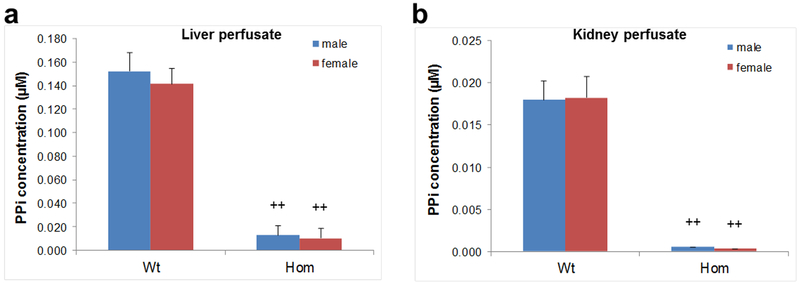
The PPi levels in the perfusates of Abcc6−/− rats were significantly lower as compared to that in the wild type rats. (a) liver perfusate; (b) kidney perfusate. Note the differences in the scale of the vertical axis demonstrating that PPi levels in the liver perfusate were ~10-fold higher than in kidney perfusate of wild type rats. Wt, wild type; Het, heterozygous; Hom, homozygous. Five males and 5 females in each group were analyzed; mean ± S.E.; ++, P < 0.001.

References

    1. Belinsky MG, Kruh GD. MOAT-E (ARA) is a full-length MRP/cMOAT subfamily transporter expressed in kidney and liver. Br J Cancer 1999;80:1342–9. - PMC - PubMed
    1. Bergen AA, Plomp AS, Schuurman EJ, Terry S, Breuning M, Dauwerse H, et al. Mutations in ABCC6 cause pseudoxanthoma elasticum. Nat Genet 2000;25:228–31. - PubMed
    1. Berndt A, Li Q, Potter CS, Liang Y, Silva KA, Kennedy V, et al. A single-nucleotide polymorphism in the Abcc6 gene associates with connective tissue mineralization in mice similar to targeted models for pseudoxanthoma elasticum. J Invest Dermatol 2013;133:833–6. - PMC - PubMed
    1. Dahl G ATP release through pannexon channels. Philos Trans R Soc Lond B Biol Sci 2015;370. - PMC - PubMed
    1. El-Sheikh AA, Koenderink JB, Wouterse AC, van den Broek PH, Verweij VG, Masereeuw R, et al. Renal glucuronidation and multidrug resistance protein 2-/ multidrug resistance protein 4-mediated efflux of mycophenolic acid: interaction with cyclosporine and tacrolimus. Transl Res 2014;164:46–56. - PubMed