


(En)gendering Racial Disparities in Health Trajectories: A Life Course and Intersectional Analysis
- PMID: 28111630
- PMCID: PMC5240637
- DOI: 10.1016/j.ssmph.2016.04.011
(En)gendering Racial Disparities in Health Trajectories: A Life Course and Intersectional Analysis
Abstract
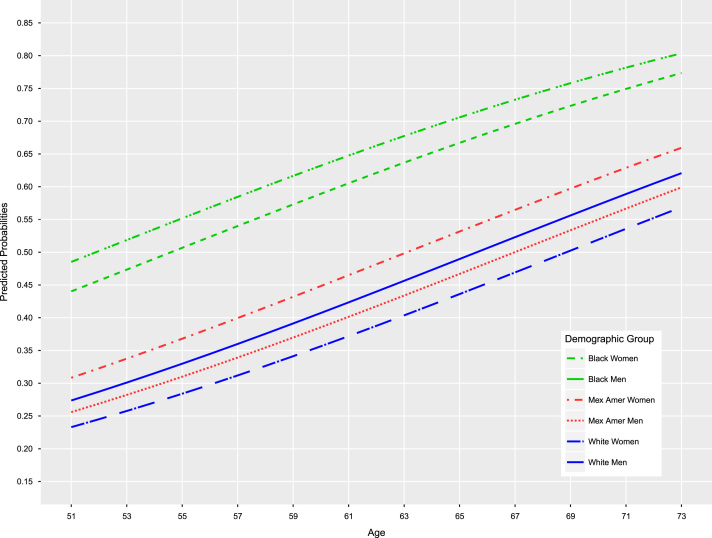
Historically, intersectionality has been an underutilized framework in sociological research on racial/ethnic and gender inequalities in health. To demonstrate its utility and importance, we conduct an intersectional analysis of the social stratification of health using the exemplar of hypertension-a health condition in which racial/ethnic and gender differences have been well-documented. Previous research has tended to examine these differences separately and ignore how the interaction of social status dimensions may influence health over time. Using seven waves of data from the Health and Retirement Study and multilevel logistic regression models, we found a multiplicative effect of race/ethnicity and gender on hypertension risk trajectories, consistent with both an intersectionality perspective and persistent inequality hypothesis. Group differences in past and contemporaneous socioeconomic and behavioral factors did not explain this effect.
Keywords: Gender; Health Inequalities; Intersectionality; Life Course; Race.
Figures
References
-
- Alon S. Overlapping disadvantages and the racial/ethnic graduation gap among students attending selective institutions. Social Science Research. 2007;36(4):1475–1499.
-
- Angel J.L., Whitfield K.E. Springer; New York: 2007. The health of aging hispanics: The Mexican-origin population.
-
- Bates, D. (2011). Linear mixed model implementation in lme4. 〈http://cran.r-project.org/web/packages/lme4/vignettes/Implementation.pdf〉.
-
- Bates D., DebRoy S. Linear mixed models and penalized least squares. Journal of Multivariate Analysis. 2004;91(1):1–17.
Grants and funding
LinkOut - more resources
Full Text Sources
Other Literature Sources
Research Materials
Miscellaneous