Review
. 2017 Jan 24;15(1):15.
doi: 10.1186/s12916-017-0795-7.

Procalcitonin-guided diagnosis and antibiotic stewardship revisited

Affiliations
Review

Procalcitonin-guided diagnosis and antibiotic stewardship revisited

Ramon Sager et al. BMC Med. .

Abstract

Several controlled clinical studies have evaluated the potential of the infection biomarker procalcitonin (PCT) to improve the diagnostic work-up of patients with bacterial infections and its influence on decisions regarding antibiotic therapy. Most research has focused on lower respiratory tract infections and critically ill sepsis patients. A clinical utility for PCT has also been found for patients with urinary tract infections, postoperative infections, meningitis, and patients with acute heart failure with possible superinfection (i.e., pneumonia). In these indications, PCT levels measured on hospital admission were found to substantially reduce the initiation of antibiotic treatment in low-risk situations (i.e., bronchitis, chronic obstructive pulmonary disease exacerbation). For more severe infections (i.e., pneumonia, sepsis), antibiotic stewardship by monitoring of PCT kinetics resulted in shorter antibiotic treatment durations with early cessation of therapy. Importantly, these strategies appear to be safe without increasing the risk for mortality, recurrent infections, or treatment failures. PCT kinetics also proved to have prognostic value correlating with disease severity (i.e., pancreatitis, abdominal infection) and resolution of illness (i.e., sepsis). Although promising findings have been published in these different types of infections, there are a number of limitations regarding PCT, including suboptimal sensitivity and/or specificity, which makes a careful interpretation of PCT in the clinical context mandatory. This narrative review aims to update clinicians on the strengths and limitations of PCT for patient management, focusing on research conducted within the last 4 years.

Keywords: Antibiotic stewardship; Pneumonia; Procalcitonin; Respiratory tract infection; Sepsis.


Figures
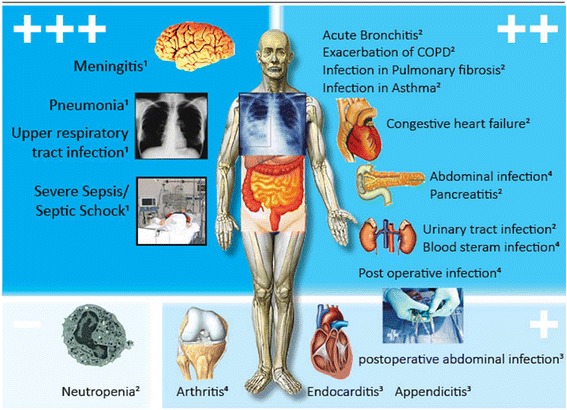
Fig. 1
Fig. 1
Summary of evidence regarding procalcitonin (PCT) for diagnosis and antibiotic stewardship in organ-related infections. While for some infections, intervention studies have investigated benefit and harm of using PCT for diagnosis and antibiotic stewardship (left side), for other infections only results from diagnostic (observation) studies are available (right side). +: moderate evidence in favor of PCT; ++: good evidence in favor of PCT; +++: strong evidence in favor of PCT; – no evidence in favor of PCT
Fig. 2
Fig. 2
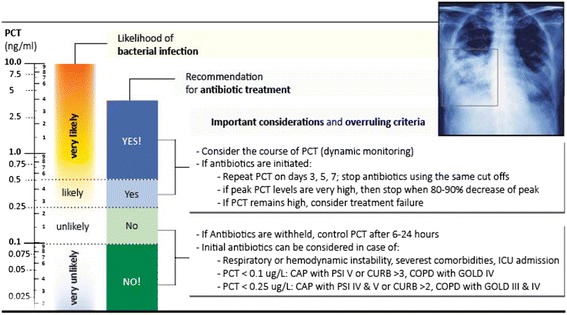
Procalcitonin (PCT) algorithm in patients with respiratory tract infections in the emergency department. The clinical algorithm for antibiotic stewardship in patients with respiratory tract infections in the emergency department encourages (>0.5 ng/ml or >0.25 ng/ml) or discourages (<0.1 ng/ml or <0.25 ng/ml) initiation or continuation of antibiotic therapy more or less based on specific PCT cut-off ranges. Abbreviations: AB antibiotic, LRTI lower respiratory tract infection, ICU intensive care unit, PSI pneumonia severity score
Fig. 3
Fig. 3
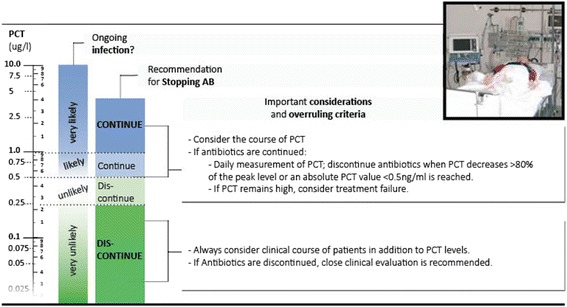
Procalcitonin (PCT) algorithm in patients with sepsis in the intensive care unit (ICU). In critically ill patients in the ICU, cut-offs are higher and initial empiric antibiotic therapy should be encouraged in all patients with suspicion of sepsis. PCT cut-offs are helpful in the subsequent days after admission to shorten the course of antibiotic therapy in patients with clinical improvement

References

    1. Mitsuma SF, Mansour MK, Dekker JP, Kim J, Rahman MZ, Tweed-Kent A, Schuetz P. Promising new assays and technologies for the diagnosis and management of infectious diseases. Clin Infectious Dis. 2013;56(7):996–1002. doi: 10.1093/cid/cis1014. - DOI - PMC - PubMed
    1. Schuetz P, Albrich W, Mueller B. Procalcitonin for diagnosis of infection and guide to antibiotic decisions: past, present and future. BMC Med. 2011;9:107. doi: 10.1186/1741-7015-9-107. - DOI - PMC - PubMed
    1. Musher DM, Thorner AR. Community-acquired pneumonia. New Engl J Med. 2014;371(17):1619–1628. doi: 10.1056/NEJMra1312885. - DOI - PubMed
    1. Fiumefreddo R, Zaborsky R, Haeuptle J, Christ-Crain M, Trampuz A, Steffen I, Frei R, Muller B, Schuetz P. Clinical predictors for Legionella in patients presenting with community-acquired pneumonia to the emergency department. BMC Pulm Med. 2009;9:4. doi: 10.1186/1471-2466-9-4. - DOI - PMC - PubMed
    1. Haubitz S, Hitz F, Graedel L, Batschwaroff M, Wiemken TL, Peyrani P, Ramirez JA, Fux CA, Mueller B, Schuetz P. Ruling out Legionella in community-acquired pneumonia. Am J Med. 2014;127(10):1010. doi: 10.1016/j.amjmed.2014.03.042. - DOI - PubMed

MeSH terms