


Non-high-density lipoprotein cholesterol predicts nonfatal recurrent myocardial infarction in patients with ST segment elevation myocardial infarction
- PMID: 28114933
- PMCID: PMC5260128
- DOI: 10.1186/s12944-017-0418-5
Non-high-density lipoprotein cholesterol predicts nonfatal recurrent myocardial infarction in patients with ST segment elevation myocardial infarction
Abstract
Background: Lipids, which are associated with atherogenesis, clotting, and the fibrinolytic pathway, may be important prognostic indicators of recurrent myocardial infarction. The aim of this study was to determine the predictive value of baseline lipid fractions for nonfatal recurrent myocardial infarction in patients with ST segment elevation myocardial infarction 2 years after primary percutaneous coronary intervention in China.
Methods: Cox proportional-hazards models were used to evaluate the association between potential risk factors, including lipid fractions, and the occurrence of nonfatal recurrent myocardial infarction in 2402 consecutive patients who underwent primary percutaneous coronary intervention for ST segment elevation myocardial infarction.
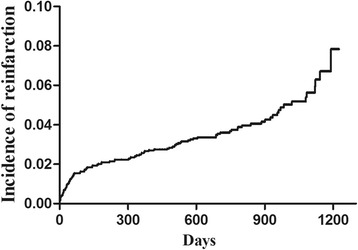
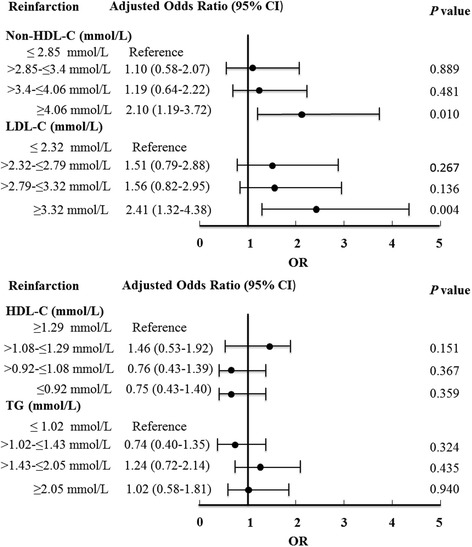
Results: The cumulative incidence of recurrent myocardial infarction was 2.7% at 1 year, 3.8% at 2 years, and 5.8% at 3 years after percutaneous coronary intervention. The effects of collinearity of lipids were investigated. In concerning the principal components analysis, composing factor 1 (scoring factors were 0.689 for non-HDL, 0.702 for LDL, 0.182 for HDL) which had eigenvalues of 1.86 and explained 62% of the variability among lipid cholesterols was significantly associated with recurrent MI in the final adjusted analysis of the lipid cholesterols principal components. Non-high-density lipoprotein cholesterol was the strongest independent predictor of nonfatal recurrent myocardial infarction. The adjusted hazards ratios for nonfatal recurrent myocardial infarction were 1.26 (95% confidence interval (CI): 1.05-1.51) for non-high-density lipoprotein cholesterol, 1.17 (95% CI: 0.99-1.39) for low-density lipoprotein and 1.15 (95% CI: 0.95-1.40) for HDL. After adjusting for gender and age, the odds ratio for patients in the highest non-high-density lipoprotein cholesterol quartile was 2.10 (95% CI: 1.19-3.72).
Conclusions: Non-high-density lipoprotein cholesterol value is a stronger predictor of nonfatal recurrent myocardial infarction than other lipid risk factors in patients with ST segment elevation myocardial infarction. Moreover, the occurrence of reinfarction after percutaneous coronary intervention was highest for patients in the highest non-high-density lipoprotein cholesterol quartile.
Trial registration: http://www.chictr.org.cn/edit.aspx?pid=13583&htm=4 , registration number: ChiCTR-EPC-16008199, date of registration:2013.01.01.
Keywords: Lipid; Primary percutaneous coronary intervention; Recurrent myocardial infarction; ST segment elevation myocardial infarction; Serum transaminase.
Figures
References
-
- Sabatine MS, Cannon CP, Gibson CM, Lopez-Sendon JL, Montalescot G, Theroux P, Lewis BS, Murphy SA, McCabe CH, Braunwald E. Clopidogrel as adjunctive reperfusion therapy -thrombolysis in myocardial infarction I. Effect of clopidogrel pretreatment before percutaneous coronary intervention in patients with ST-elevation myocardial infarction treated with fibrinolytics: the PCI-CLARITY study. Jama. 2005;294:1224–1232. doi: 10.1001/jama.294.10.1224. - DOI - PubMed
-
- Van’t Hof AW, Ten Berg J, Heestermans T, Dill T, Funck RC, van Werkum W, Dambrink JH, Suryapranata H, van Houwelingen G, Ottervanger JP, Stella P, Giannitsis E, Hamm C. Ongoing Tirofiban in myocardial infarction evaluation 2 study g. Prehospital initiation of Tirofiban in patients with ST-elevation myocardial infarction undergoing primary angioplasty (on-TIME 2): a multicentre, double-blind, randomised controlled trial. Lancet. 2008;372:537–546. doi: 10.1016/S0140-6736(08)61235-0. - DOI - PubMed
-
- Dutta P, Courties G, Wei Y, Leuschner F, Gorbatov R, Robbins CS, Iwamoto Y, Thompson B, Carlson AL, Heidt T, Majmudar MD, Lasitschka F, Etzrodt M, Waterman P, Waring MT, Chicoine AT, van der Laan AM, Niessen HW, Piek JJ, Rubin BB, Butany J, Stone JR, Katus HA, Murphy SA, Morrow DA, Sabatine MS, Vinegoni C, Moskowitz MA, Pittet MJ, Libby P, Lin CP, Swirski FK, Weissleder R, Nahrendorf M. Myocardial infarction accelerates atherosclerosis. Nature. 2012;487:325–329. doi: 10.1038/nature11260. - DOI - PMC - PubMed
-
- Vlaar PJ, Svilaas T, van der Horst IC, Diercks GF, Fokkema ML, de Smet BJ, van den Heuvel AF, Anthonio RL, Jessurun GA, Tan ES, Suurmeijer AJ, Zijlstra F. Cardiac death and reinfarction after 1 year in the thrombus aspiration during percutaneous coronary intervention in acute myocardial infarction study (TAPAS): a 1-year follow-up study. Lancet. 2008;371:1915–1920. doi: 10.1016/S0140-6736(08)60833-8. - DOI - PubMed
MeSH terms
Substances
LinkOut - more resources
Full Text Sources
Other Literature Sources
Medical
