


Allogeneic Hematopoietic Cell Transplantation for Adult Chronic Myelomonocytic Leukemia
- PMID: 28115276
- PMCID: PMC5590102
- DOI: 10.1016/j.bbmt.2017.01.078
Allogeneic Hematopoietic Cell Transplantation for Adult Chronic Myelomonocytic Leukemia
Abstract
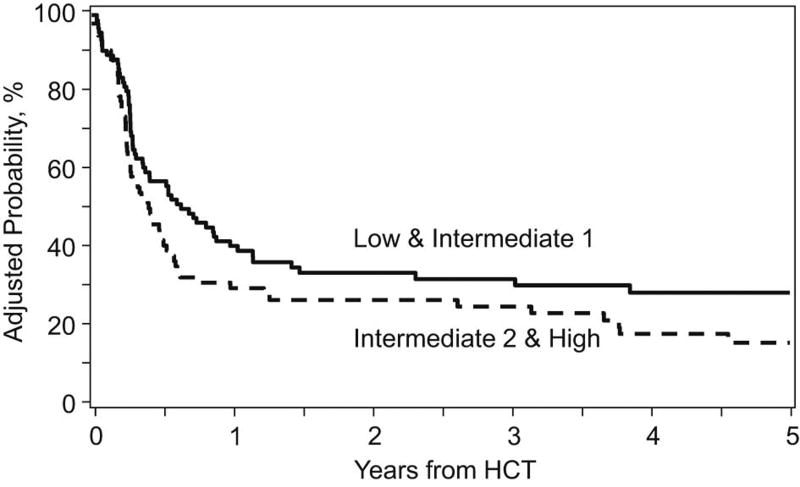
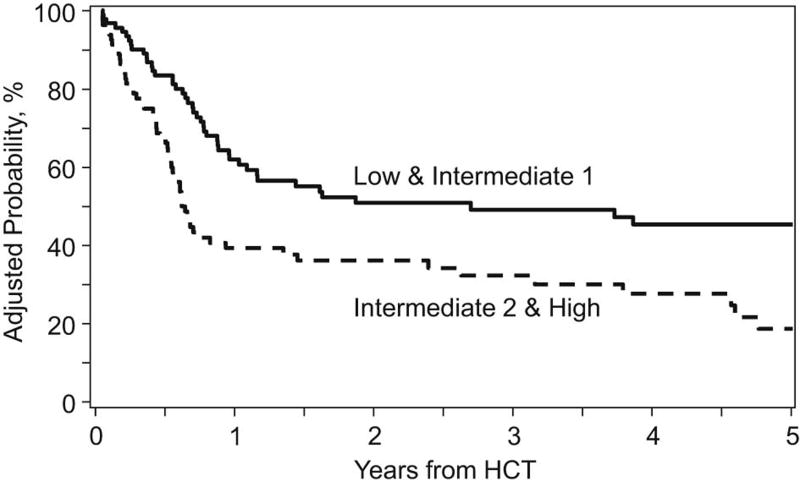
Allogeneic hematopoietic cell transplantation (HCT) is potentially curative for patients with chronic myelomonocytic leukemia (CMML); however, few data exist regarding prognostic factors and transplantation outcomes. We performed this retrospective study to identify prognostic factors for post-transplantation outcomes. The CMML-specific prognostic scoring system (CPSS) has been validated in subjects receiving nontransplantation therapy and was included in our study. From 2001 to 2012, 209 adult subjects who received HCT for CMML were reported to the Center for International Blood and Marrow Transplant Research. The median age at transplantation was 57 years (range, 23 to 74). Median follow-up was 51 months (range, 3 to 122). On multivariate analyses, CPSS scores, Karnofsky performance status (KPS), and graft source were significant predictors of survival (P = .004, P = .01, P = .01, respectively). Higher CPSS scores were not associated with disease-free survival, relapse, or transplantation-related mortality. In a restricted analysis of subjects with relapse after HCT, those with intermediate-2/high risk had a nearly 2-fold increased risk of death after relapse compared to those with low/intermediate-1 CPSS scores. Respective 1-year, 3-year, and 5-year survival rates for low/intermediate-1 risk subjects were 61% (95% confidence interval [CI], 52% to 72%), 48% (95% CI, 37% to 59%), and 44% (95% CI, 33% to 55%), and for intermediate-2/high risk subjects were 38% (95% CI, 28% to 49%), 32% (95% CI, 21% to 42%), and 19% (95% CI, 8% to 29%). We conclude that higher CPSS score at time of transplantation, lower KPS, and a bone marrow graft are associated with inferior survival after HCT. Further investigation of CMML disease-related biology may provide insights into other risk factors predictive of post-transplantation outcomes.
Keywords: Allogeneic hematopoietic cell transplantation; Chronic myelomonocytic leukemia; Transplantation outcomes.
Copyright © 2017 The American Society for Blood and Marrow Transplantation. Published by Elsevier Inc. All rights reserved.
Figures
Comment in
-
A Lot to Learn about Allogeneic Hematopoietic Cell Transplantation for Chronic Myelomonocytic Leukemia.Biol Blood Marrow Transplant. 2017 May;23(5):713-714. doi: 10.1016/j.bbmt.2017.03.011. Epub 2017 Mar 9. Biol Blood Marrow Transplant. 2017. PMID: 28286197 No abstract available.
References
-
- Vardiman JW, Pierre R, Bain B, et al. Chronic myelomonocytic leukaemia. In: Jaffe ES, Harris NL, Stein H, Vardiman JW, editors. World Health Organization Classification of Tumours: Pathology and Genetics of Tumours of Haematopoietic and Lymphoid Tissues. Lyon, France: IARC Press; 2001. pp. 49–51.
-
- Orazi A, Bennett JM, Germing U, et al. Chronic myelomonocytic leukaemia. In: Swerdlow S, Campos E, Lee Harris N, et al., editors. World Health Organization Classification of tumours of haematopoietic and lymphoid tissues. Lyon, France: IARC press, World Health Organization; 2008. pp. 76–81.
-
- Emanuel PD. Juvenile myelomonocytic leukemia and chronic myelomonocytic leukemia. Leukemia. 2008;22:1335–1342. - PubMed
-
- Vardiman JW, Harris NL, Brunning RD, et al. The World Health Organization (WHO) classification of the myeloid neoplasms. Blood. 2002;100:2292–2302. - PubMed
-
- Onida F, Kantarjian HM, Smith TL, et al. Prognostic factors and scoring systems in chronic myelomonocytic leukemia: a retrospective analysis of 213 patients. Blood. 2002;99:840–849. - PubMed
MeSH terms
Grants and funding
LinkOut - more resources
Full Text Sources
Other Literature Sources
