. 2017 Mar 24;61(4):e02173-16.
doi: 10.1128/AAC.02173-16. Print 2017 Apr.

Subinhibitory Concentrations of Bacteriostatic Antibiotics Induce relA-Dependent and relA-Independent Tolerance to β-Lactams

Affiliations

Subinhibitory Concentrations of Bacteriostatic Antibiotics Induce relA-Dependent and relA-Independent Tolerance to β-Lactams

Pavel Kudrin et al. Antimicrob Agents Chemother. .

Abstract

The nucleotide (p)ppGpp is a key regulator of bacterial metabolism, growth, stress tolerance, and virulence. During amino acid starvation, the Escherichia coli (p)ppGpp synthetase RelA is activated by deacylated tRNA in the ribosomal A-site. An increase in (p)ppGpp is believed to drive the formation of antibiotic-tolerant persister cells, prompting the development of strategies to inhibit (p)ppGpp synthesis. We show that in a biochemical system from purified E. coli components, the antibiotic thiostrepton efficiently inhibits RelA activation by the A-site tRNA. In bacterial cultures, the ribosomal inhibitors thiostrepton, chloramphenicol, and tetracycline all efficiently abolish accumulation of (p)ppGpp induced by the Ile-tRNA synthetase inhibitor mupirocin. This abolishment, however, does not reduce the persister level. In contrast, the combination of dihydrofolate reductase inhibitor trimethoprim with mupirocin, tetracycline, or chloramphenicol leads to ampicillin tolerance. The effect is independent of RelA functionality, specific to β-lactams, and not observed with the fluoroquinolone norfloxacin. These results refine our understanding of (p)ppGpp's role in antibiotic tolerance and persistence and demonstrate unexpected drug interactions that lead to tolerance to bactericidal antibiotics.

Keywords: RelA; antibiotics; mupirocin; persistence; ppGpp; ribosomes; thiostrepton; tolerance; trimethoprim; β-lactam.


Figures

FIG 1
FIG 1
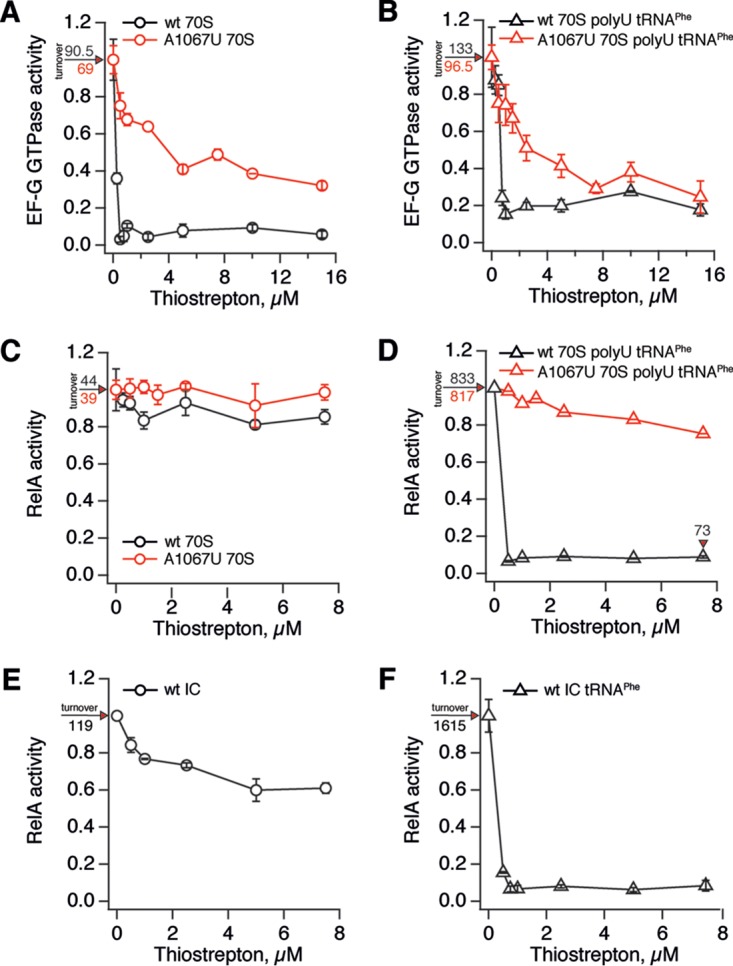
Thiostrepton specifically inhibits RelA activation by deacylated A-site tRNA. EF-G GTPase is efficiently inhibited by thiostrepton in the presence of vacant wild-type 70S ribosomes (A) or starved ribosomal complexes (B). A1067U rRNA mutation protected EF-G from thiostrepton in both cases (A and B). RelA activated by either vacant wild-type or A1067U 70S ribosomes (C) or initiation complexes (E) is insensitive to thiostrepton. RelA activated by 70S ribosomes programmed with 2 μM poly(U) mRNA and 2 μM deacylated tRNAPhe is efficiently inhibited by thiostrepton, and rRNA mutation A1067U protects from antibiotic (D). Similarly, efficient inhibition is observed when RelA is activated by ribosomal initiation complexes in the presence of 2 μM deacylated A-site tRNAPhe (F). The enzymatic activities of 100 nM elongation factor EF-G (GTP hydrolysis) and 100 nM stringent factor RelA were assayed in the presence of 0.5 μM 70S or wild-type initiation complexes (black traces) or thiostrepton-resistant A1067U rRNA mutant ribosomes (red traces). Enzymatic activities (turnovers, GTP per EF-G per minute and ppGpp per RelA per minute) were normalized to that of the corresponding system in the absence of thiostrepton, and uninhibited turnover values corresponding to 1.0 activity are provided on individual panels. Error bars represent the standard deviations of the turnover estimates as determined by linear regression. Each experiment was performed at least three times.
FIG 2
FIG 2
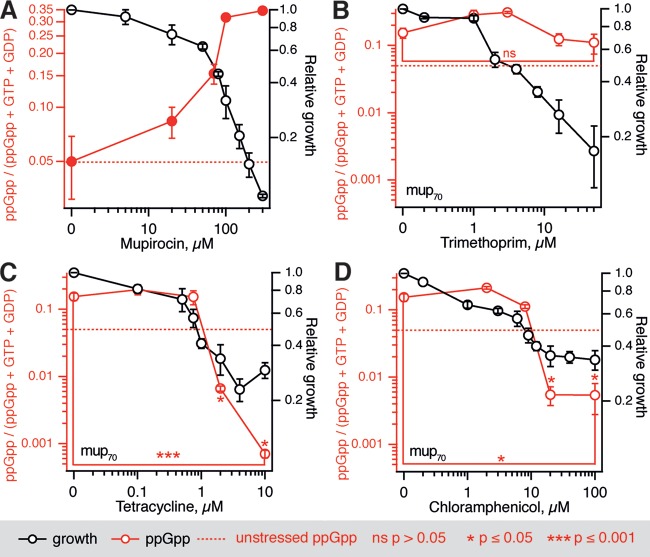
Concurrent inhibition of E. coli growth and ppGpp production by antibiotics targeting translation. (A) A stringent response was induced by the addition of increasing concentrations of mupirocin, followed by 30 min of incubation and HPLC analysis. (B to D) Cell cultures were treated for 30 min with increasing concentrations of trimethoprim (B), tetracycline (C), or chloramphenicol (D) combined with 70 μM mupirocin (mup70), samples were collected, and nucleotide levels were determined by HPLC. Experiments were performed with BW25113 E. coli wild-type strain grown at 37°C in MOPS medium supplemented with 0.4% glucose and a full set of 20 amino acids at 25 μg/ml. Growth inhibition was calculated as an increase in the OD600 after 1 h of antibiotic treatment compared to the untreated control. The ppGpp levels are calculated as a ppGpp fraction of a combined GTP, GTP, and ppGpp nucleotide pool; the dashed red trace indicates the level in unstressed cells. Error bars indicate the standard errors of the mean (three to five biological replicates). The P values were calculated using a two-tailed Welch's t test either relative to the unstressed ppGpp levels or, where indicated by brackets, within the titration series.
FIG 3
FIG 3
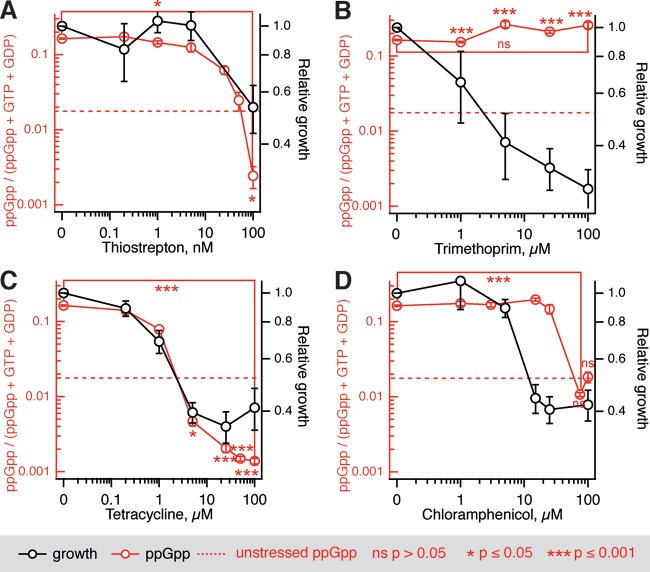
Inhibition of growth of B. subtilis artificially starved for isoleucine by antibiotics targeting translation is mirrored by a drop in ppGpp levels. Artificial starvation for isoleucine induced by addition of 70 nM mupirocin (mup70) was countered by increasing concentrations of thiostrepton (A), trimethoprim (B), tetracycline (C), or chloramphenicol (D). At 30 min after the addition of antibiotics, samples were collected, and the nucleotide levels were determined by HPLC. Experiments were performed with BSB1 B. subtilis wild-type strain grown at 37°C in MOPS medium supplemented with 0.4% glucose and a full set of 20 amino acids at 25 μg/ml. The ppGpp levels were calculated as a ppGpp fraction of a combined GTP, GTP, and ppGpp nucleotide pool; the dashed red trace indicates the level in unstressed cells. Error bars indicate the standard errors of the mean (three to five biological replicates). The P values were calculated using a two-tailed Welch's t test either relative to the unstressed ppGpp levels or, where indicated by brackets, within the titration series.
FIG 4
FIG 4
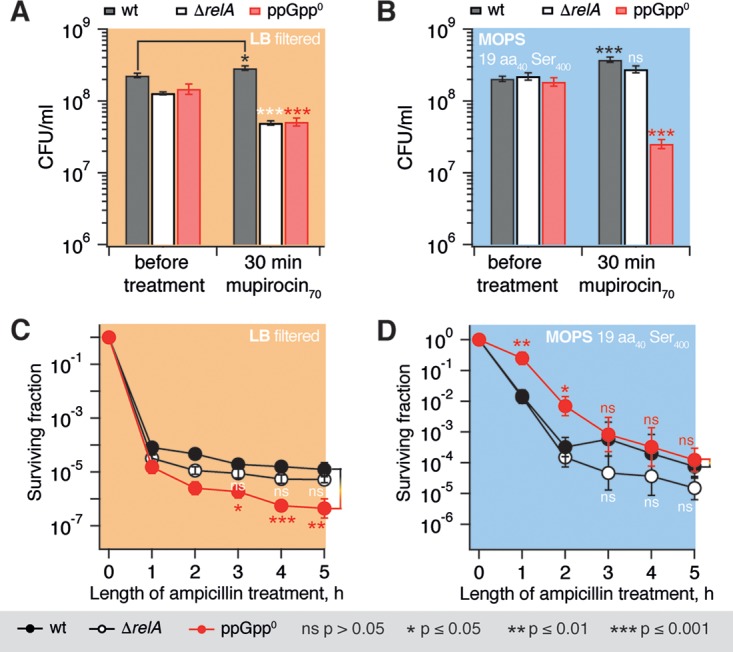
Medium composition modulates the effects of mupirocin and ampicillin treatment on wild-type, relaxed, and ppGpp0 BW25113 E. coli. Experiments were performed using either filtered LB (A and C; beige shading) or MOPS medium supplemented with 0.4% glucose and a full set amino acids at 400 μg/ml (for serine) or 25 μg/ml (for the remaining 19 amino acids) (B and D; blue shading). The colony count (i.e., the CFU) was determined either as a function of a 30-min treatment with either 70 μM mupirocin compared to mock treatment (A and B) or as a function of time after the addition of ampicillin to a final concentration of 200 μg/ml (C and D). Error bars indicate the standard errors of the mean (three to five biological replicates). Where indicated by brackets, the P values were calculated using a two-tailed Welch's t test either between wild-type and mutant strains (A and B) or relative to the killing time course of an untreated culture (C and D).
FIG 5
FIG 5
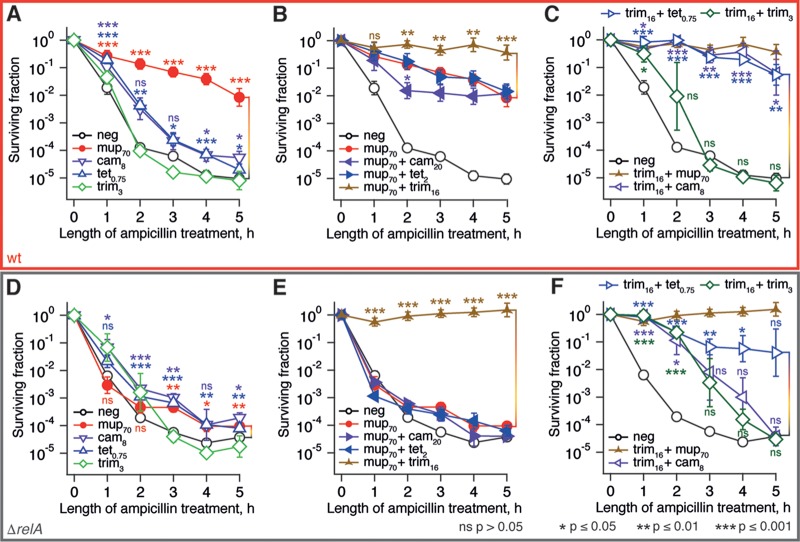
Antibiotic pretreatment induces both relA-dependent and relA-independent ampicillin tolerance of BW25113 E. coli. The antibiotic pretreatment was performed for 30 min at 37°C in MOPS medium supplemented with 0.4% glucose and amino acids at 25 μg/ml using BW25113 E. coli wild-type strain (A to C) and an isogenic relA knockout (ΔrelA; D to F), followed by the addition of ampicillin to a final concentration of 200 μg/ml. The surviving fraction was determined by LB plating and colony counting. The bacteriostatic antibiotics were used at concentrations reducing the growth rate by half, and concentrations are indicated in μM on the figures, e.g., mup70 indicates pretreatment with 70 μM mupirocin. Error bars indicate the standard errors of the mean (three to five biological replicates). Where indicated by brackets, the P values were calculated by using a two-tailed Welch's t test relative to the killing time course of an untreated culture.
FIG 6
FIG 6
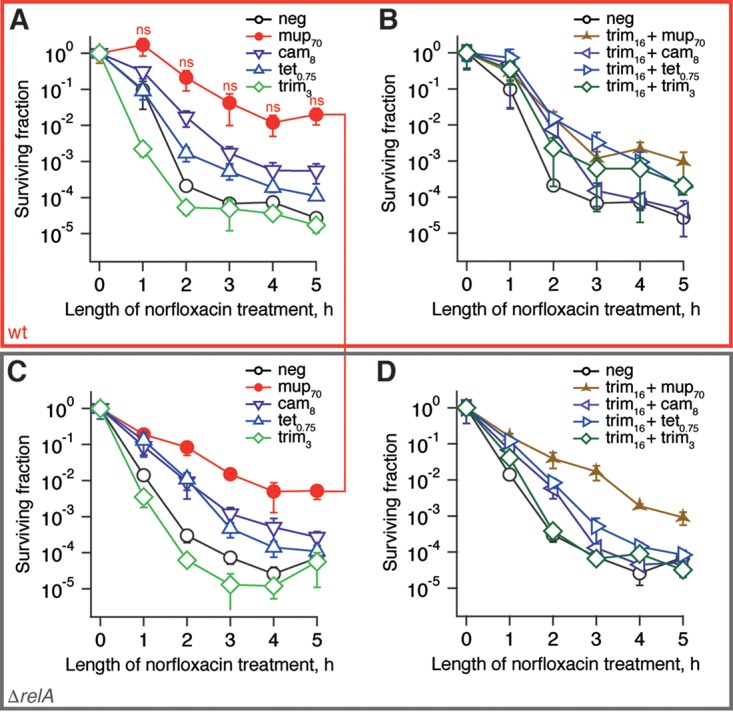
RelA functionality does not determine the norfloxacin tolerance of BW25113 E. coli induced by antibiotic pretreatment. The antibiotic pretreatment was performed for 30 min at 37°C in MOPS media supplemented with 0.4% glucose and amino acids at 25 μg/ml using BW25113 E. coli wild-type strain (A and B) and an isogenic relA knockout (ΔrelA; C and D), followed by the addition of norfloxacin to a final concentration of 5 μg/ml, and the surviving fraction was determined by LB plating and colony counting. Bacteriostatic antibiotics were used at concentrations reducing the growth rate by half, and concentrations are indicated in μM on the figures, e.g., mup70 indicates pretreatment with 70 μM mupirocin. Error bars indicate the standard errors of the mean (three to five biological replicates). P values were calculated using a two-tailed Welch's t test between wild-type and relaxed strains.

References

    1. Hauryliuk V, Atkinson GC, Murakami KS, Tenson T, Gerdes K. 2015. Recent functional insights into the role of (p)ppGpp in bacterial physiology. Nat Rev Microbiol 13:298–309. doi: 10.1038/nrmicro3448. - DOI - PMC - PubMed
    1. Dalebroux ZD, Swanson MS. 2012. ppGpp: magic beyond RNA polymerase. Nat Rev Microbiol 10:203–212. doi: 10.1038/nrmicro2720. - DOI - PubMed
    1. Rodionov DG, Ishiguro EE. 1995. Direct correlation between overproduction of guanosine 3′,5′-bispyrophosphate (ppGpp) and penicillin tolerance in Escherichia coli. J Bacteriol 177:4224–4229. doi: 10.1128/jb.177.15.4224-4229.1995. - DOI - PMC - PubMed
    1. Bernier SP, Lebeaux D, DeFrancesco AS, Valomon A, Soubigou G, Coppee JY, Ghigo JM, Beloin C. 2013. Starvation, together with the SOS response, mediates high biofilm-specific tolerance to the fluoroquinolone ofloxacin. PLoS Genet 9:e1003144. doi: 10.1371/journal.pgen.1003144. - DOI - PMC - PubMed
    1. Gerdes K, Maisonneuve E. 2012. Bacterial persistence and toxin-antitoxin loci. Annu Rev Microbiol 66:103–123. doi: 10.1146/annurev-micro-092611-150159. - DOI - PubMed

MeSH terms

LinkOut - more resources