


How Does Incarcerating Young People Affect Their Adult Health Outcomes?
- PMID: 28115536
- PMCID: PMC5260153
- DOI: 10.1542/peds.2016-2624
How Does Incarcerating Young People Affect Their Adult Health Outcomes?
Abstract
Background and objectives: Despite the widespread epidemic of mass incarceration in the US, relatively little literature exists examining the longitudinal relationship between youth incarceration and adult health outcomes. We sought to quantify the association of youth incarceration with subsequent adult health outcomes.
Methods: We analyzed data from 14 344 adult participants in the National Longitudinal Study of Adolescent to Adult Health. We used weighted multivariate logistic regressions to investigate the relationship between cumulative incarceration duration (none, <1 month, 1-12 months, and >1 year) before Wave IV (ages 24-34 years) and subsequent adult health outcomes (general health, functional limitations, depressive symptoms, and suicidal thoughts). Models controlled for Wave I (grades 7-12) baseline health, sociodemographics, and covariates associated with incarceration and health.
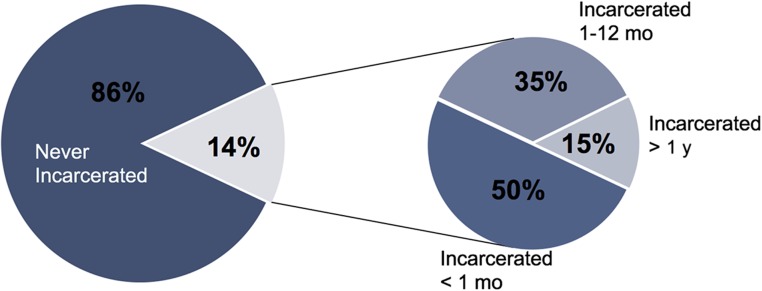
Results: A total of 14.0% of adults reported being incarcerated between Waves I and IV. Of these, 50.3% reported a cumulative incarceration duration of <1 month, 34.8% reported 1 to 12 months, and 15.0% reported >1 year. Compared with no incarceration, incarceration duration of < 1 month predicted subsequent adult depressive symptoms (odds ratio [OR] = 1.41; 95% confidence interval [CI], 1.11-1.80; P = .005). A duration of 1 to 12 months predicted worse subsequent adult general health (OR = 1.48; 95% CI, 1.12-1.96; P = .007). A duration of >1 year predicted subsequent adult functional limitations (OR = 2.92; 95% CI, 1.51-5.64; P = .002), adult depressive symptoms (OR = 4.18; 95% CI, 2.48-7.06; P < .001), and adult suicidal thoughts (OR = 2.34; 95% CI, 1.09-5.01; P = .029).
Conclusions: Cumulative incarceration duration during adolescence and early adulthood is independently associated with worse physical and mental health later in adulthood. Potential mechanisms merit exploration.
Copyright © 2017 by the American Academy of Pediatrics.
Conflict of interest statement
POTENTIAL CONFLICT OF INTEREST: The authors have indicated they have no potential conflicts of interest to disclose.
Figures
Comment in
-
Changing Risk Trajectories and Health Outcomes for Vulnerable Adolescents: Reclaiming the Future.Pediatrics. 2017 Feb;139(2):e20163557. doi: 10.1542/peds.2016-3557. Pediatrics. 2017. PMID: 28115543 Free PMC article. No abstract available.
References
-
- Schnittker J, John A. Enduring stigma: the long-term effects of incarceration on health. J Health Soc Behav. 2007;48(2):115–130 - PubMed
-
- Massoglia M. Incarceration as exposure: the prison, infectious disease, and other stress-related illnesses. J Health Soc Behav. 2008;49(1):56–71 - PubMed
-
- Hazel N. Cross-national Comparison of Youth Justice. Salford, UK: University of Salford; 2008
-
- Puzzanchera C. Office of Juvenile Justice and Delinquency Prevention. Juvenile arrests 2012. Available at: www.ojjdp.gov/pubs/248513.pdf. Accessed January 26, 2016
-
- Mendel R. No Place for Kids: The Case for Reducing Juvenile Incarceration. Baltimore, MD: The Annie E Casey Foundation; 2011
MeSH terms
Grants and funding
LinkOut - more resources
Full Text Sources
Other Literature Sources
