


E-cigarettes and National Adolescent Cigarette Use: 2004-2014
- PMID: 28115540
- PMCID: PMC5260150
- DOI: 10.1542/peds.2016-2450
E-cigarettes and National Adolescent Cigarette Use: 2004-2014
Abstract
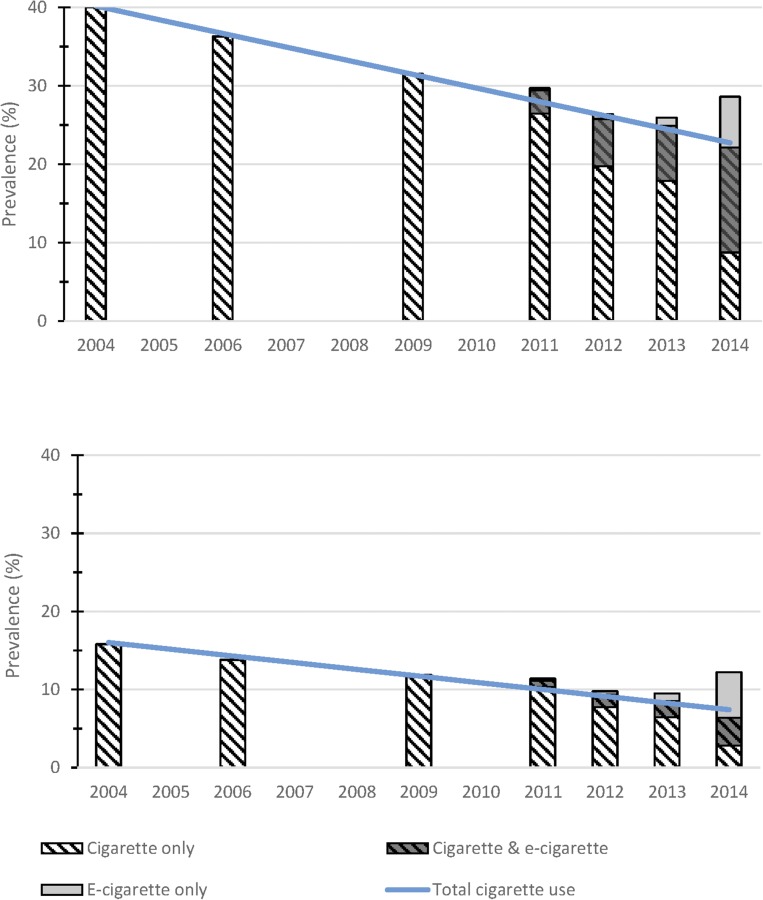
Background: E-cigarette use is rapidly increasing among adolescents in the United States, with some suggesting that e-cigarettes are the cause of declining youth cigarette smoking. We hypothesized that the decline in youth smoking changed after e-cigarettes arrived on the US market in 2007.
Methods: Data were collected by using cross-sectional, nationally representative school-based samples of sixth- through 12th-graders from 2004-2014 National Youth Tobacco Surveys (samples ranged from 16 614 in 2013 to 25 324 in 2004). Analyses were conducted by using interrupted time series of ever (≥1 puff) and current (last 30 days) cigarette smoking. Logistic regression was used to identify psychosocial risk factors associated with cigarette smoking in the 2004-2009 samples; this model was then applied to estimate the probability of cigarette smoking among cigarette smokers and e-cigarette users in the 2011-2014 samples.
Results: Youth cigarette smoking decreased linearly between 2004 and 2014 (P = .009 for ever smoking and P = .05 for current smoking), with no significant change in this trend after 2009 (P = .57 and .23). Based on the psychosocial model of smoking, including demographic characteristics, willingness to wear clothing with a tobacco logo, living with a smoker, likelihood of smoking in the next year, likelihood of smoking cigarettes from a friend, and use of tobacco products other than cigarettes or e-cigarettes, the model categorized <25% of current e-cigarette-only users (between 11.0% in 2012 and 23.1% in 2013) as current smokers.
Conclusions: The introduction of e-cigarettes was not associated with a change in the linear decline in cigarette smoking among youth. E-cigarette-only users would be unlikely to have initiated tobacco product use with cigarettes.
Copyright © 2017 by the American Academy of Pediatrics.
Conflict of interest statement
POTENTIAL CONFLICT OF INTEREST: The authors have indicated they have no potential conflicts of interest to disclose.
Figures
Comment in
-
The Importance of Contextual and Temporal Accuracy When Studying Novel Tobacco Products.Pediatrics. 2017 May;139(5):e20170455A. doi: 10.1542/peds.2017-0455A. Pediatrics. 2017. PMID: 28557767 No abstract available.
References
-
- Johnston LD, O’Malley PM, Miech RA, Bachman JG, Schulenberg JE Monitoring the Future National Survey results on drug use, 1975-2015: overview, key findings on adolescent drug use. Published 2016. Available at: www.monitoringthefuture.org/pubs/monographs/mtf-overview2015.pdf. Accessed March 6, 2016
-
- Hamilton HA, Ferrence R, Boak A, et al. Ever use of nicotine and nonnicotine electronic cigarettes among high school students in Ontario, Canada. Nicotine Tob Res. 2015;17(10):1212–1218 - PubMed
-
- National Institute on Drug Abuse Monitoring the Future Survey, overview of findings 2015. Published 2015. Updated December 2015. Available at: https://www.drugabuse.gov/related-topics/trends-statistics/monitoring-fu.... Accessed March 20, 2016
-
- Goniewicz ML, Kuma T, Gawron M, Knysak J, Kosmider L. Nicotine levels in electronic cigarettes. Nicotine Tob Res. 2013;15(1):158–166 - PubMed
MeSH terms
Grants and funding
LinkOut - more resources
Full Text Sources
Other Literature Sources
Medical
