


Genome-wide association study of therapeutic opioid dosing identifies a novel locus upstream of OPRM1
- PMID: 28115739
- PMCID: PMC5407902
- DOI: 10.1038/mp.2016.257
Genome-wide association study of therapeutic opioid dosing identifies a novel locus upstream of OPRM1
Abstract
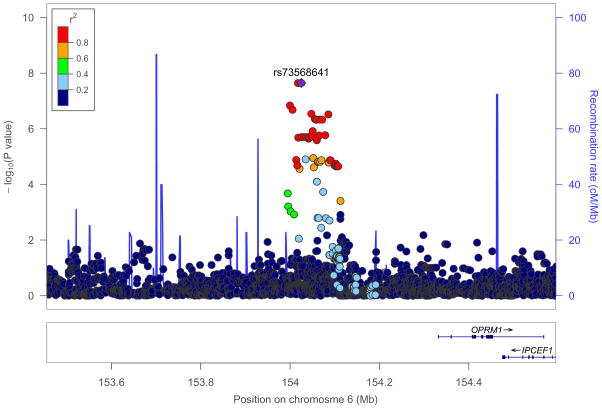
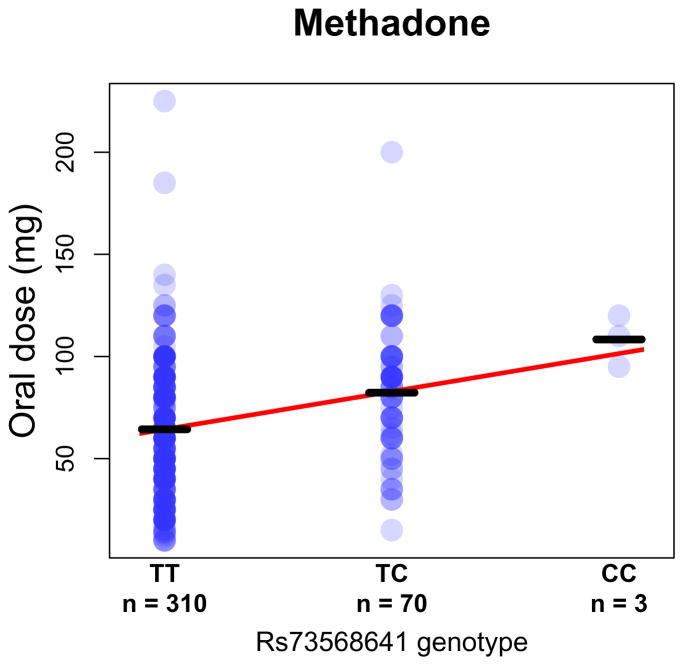
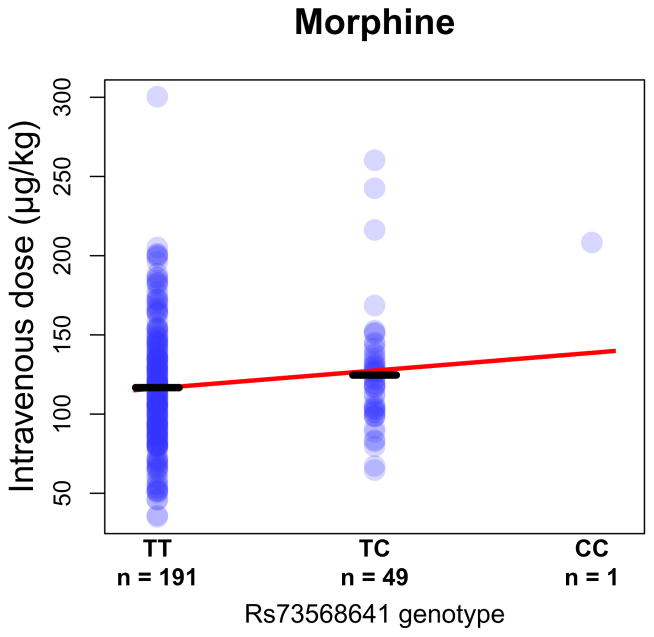
Opioids are very effective analgesics, but they are also highly addictive. Methadone is used to treat opioid dependence (OD), acting as a selective agonist at the μ-opioid receptor encoded by the gene OPRM1. Determining the optimal methadone maintenance dose is time consuming; currently, no biomarkers are available to guide treatment. In methadone-treated OD subjects drawn from a case and control sample, we conducted a genome-wide association study of usual daily methadone dose. In African-American (AA) OD subjects (n=383), we identified a genome-wide significant association between therapeutic methadone dose (mean=68.0 mg, s.d.=30.1 mg) and rs73568641 (P=2.8 × 10⁻⁸), the nearest gene (306 kilobases) being OPRM1. Each minor (C) allele corresponded to an additional ~20 mg day-1 of oral methadone, an effect specific to AAs. In European-Americans (EAs) (n=1027), no genome-wide significant associations with methadone dose (mean=77.8 mg, s.d.=33.9 mg) were observed. In an independent set of opioid-naive AA children being treated for surgical pain, rs73568641-C was associated with a higher required dose of morphine (n=241, P=3.9 × 10⁻²). Similarly, independent genomic loci previously shown to associate with higher opioid analgesic dose were associated with higher methadone dose in the OD sample (AA and EA: n=1410, genetic score P=1.3 × 10⁻³). The present results in AAs indicate that genetic variants influencing opioid sensitivity across different clinical settings could contribute to precision pharmacotherapy for pain and addiction.
Conflict of interest statement
Dr. Kranzler reports being a consultant, continuing medical education (CME) speaker, or advisory board member for Alkermes, Indivior, Lundbeck, and Otsuka, and a member of the American Society of Clinical Psychopharmacology’s Alcohol Clinical Trials Initiative, which was supported in the last three years by AbbVie, Alkermes, Ethypharm, Indivior, Lilly, Lundbeck, Otsuka, Pfizer, and XenoPort. No other disclosures are reported.
Figures
References
-
- Okie S. A flood of opioids, a rising tide of deaths. N Engl J Med. 2010;363(21):1981–1985. - PubMed
-
- Volkow ND, Frieden TR, Hyde PS, Cha SS. Medication-assisted therapies--tackling the opioid-overdose epidemic. N Engl J Med. 2014;370(22):2063–2066. - PubMed
-
- Dole VP. Implications of methadone maintenance for theories of narcotic addiction. JAMA. 1988;260(20):3025–3029. - PubMed
-
- Dole VP, Nyswander M. A medical treatment for diacetylmorphine (heroin) addiction. A clinical trial with methadone hydrochloride. JAMA. 1965;193:646–650. - PubMed
MeSH terms
Substances
Grants and funding
LinkOut - more resources
Full Text Sources
Other Literature Sources
Medical
Research Materials
