. 2018 Apr;23(4):923-931.
doi: 10.1038/mp.2016.263. Epub 2017 Jan 24.

Bipolar mood cycles and lunar tidal cycles

Affiliations

Bipolar mood cycles and lunar tidal cycles

T A Wehr. Mol Psychiatry. 2018 Apr.

Abstract

In 17 patients with rapid cycling bipolar disorder, time-series analyses detected synchronies between mood cycles and three lunar cycles that modulate the amplitude of the moon's semi-diurnal gravimetric tides: the 14.8-day spring-neap cycle, the 13.7-day declination cycle and the 206-day cycle of perigee-syzygies ('supermoons'). The analyses also revealed shifts among 1:2, 1:3, 2:3 and other modes of coupling of mood cycles to the two bi-weekly lunar cycles. These shifts appear to be responses to the conflicting demands of the mood cycles' being entrained simultaneously to two different bi-weekly lunar cycles with slightly different periods. Measurements of circadian rhythms in body temperature suggest a biological mechanism through which transits of one of the moon's semi-diurnal gravimetric tides might have driven the patients' bipolar cycles, by periodically entraining the circadian pacemaker to its 24.84-h rhythm and altering the pacemaker's phase-relationship to sleep in a manner that is known to cause switches from depression to mania.


Conflict of interest statement

The authors declare no conflict of interest.

Figures
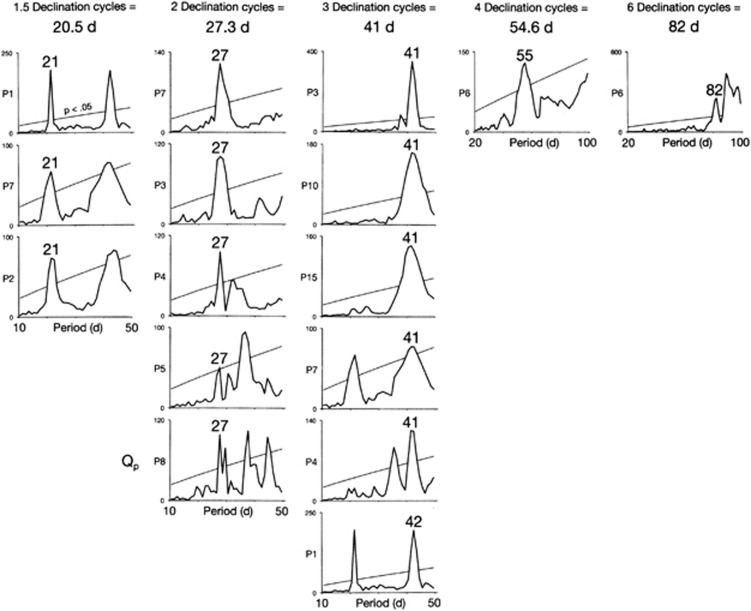
Figure 1
Figure 1
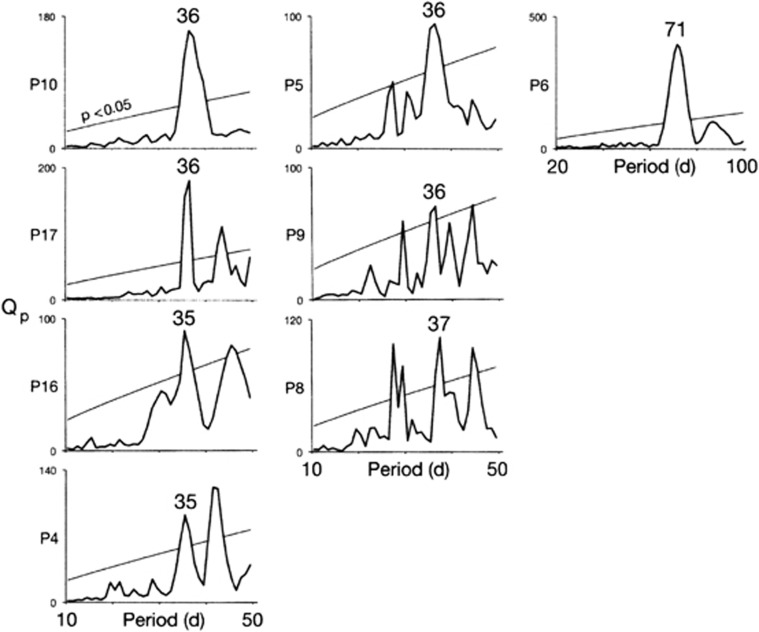
Periodicities in 10 rapid cycling bipolar patients’ mood cycles were synchronous with every second, third, fourth, fifth or sixth oscillation of the moon’s 13.7-day declination tidal cycle. Figure shows results of χ2 periodogram analyses of longitudinal observations of the patients’ courses of illness. Statistically significant periodicities that correspond to each of the multiples of the declination cycle are labeled. A number of patients exhibited more than one type of synchrony during their courses of illness.
Figure 2
Figure 2
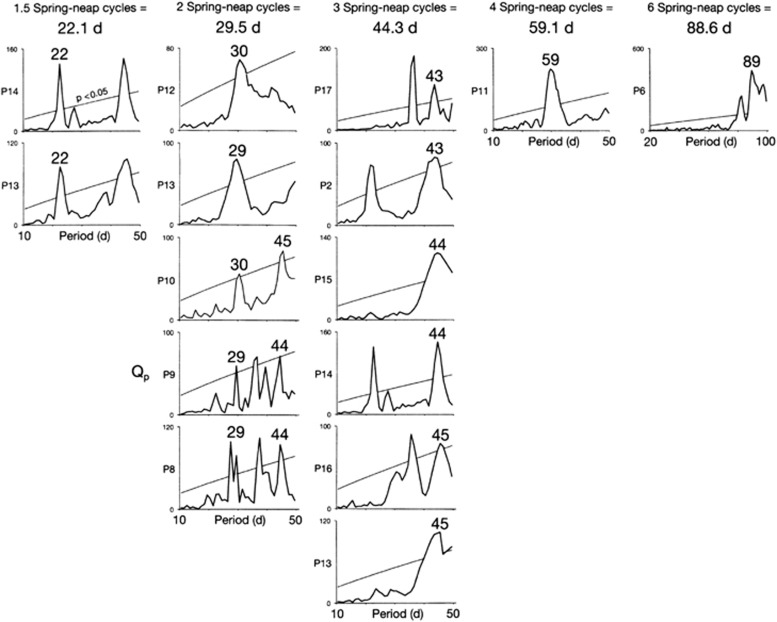
Periodicities in twelve rapid cycling bipolar patients’ mood cycles were synchronous with every second, third, fourth, fifth or sixth oscillation of the moon’s 14.8-day spring–neap tidal cycle. Statistically significant periodicities in the χ2 periodograms that correspond to each of the multiples of the spring–neap cycle are labeled. A number of patients exhibited more than one type of synchrony during their courses of illness.
Figure 3
Figure 3
Nearly half of seventeen rapid cycling bipolar patients’ mood cycles exhibited a circa 35.5-day periodicity. Statistically significant periodicities in the χ2 periodograms that correspond to this interval are labeled.
Figure 4
Figure 4
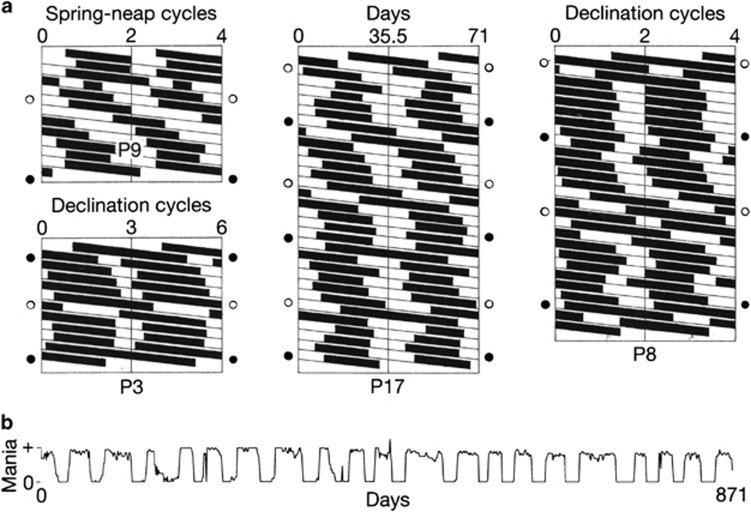
Bipolar mood cycles exhibited a synchrony with every second or every third bi-weekly lunar cycle that was periodically interrupted by 360° or 720° phase-displacements that coincided with lunar perigee-syzygies (supermoons). Raster double plots (a) show manic episodes as black bars and depressive episodes as white bars. Open circles and closed circles adjacent to raster plots show times of 206-day recurrences of perigee-syzygies in their full-moon and new-moon phases, respectively. Patient identities are shown beneath raster plots. Vertical alignment of manic episodes indicates that they had become synchronous with every second or every third bi-weekly lunar cycle, as confirmed by χ2 periodogram analyses (Figures 1 and 2). Periodically, the course of manic episodes deviated diagonally to the right, leading to 360° or 720° phase-displacements of the bipolar cycles. These displacements regularly coincided with recurrences of perigee-syzygies. Each phase-displacement was followed by re-establishment of the bipolar cycles’ previous phase-relationship to the lunar cycles. For comparison with the raster plots, a linear plot of the time-series of Patient 17’s daily self-ratings of mania is shown (b). For further analyses of the relationships of Patients 8 and 17’s mood cycles to lunar cycles, see Figure 5, Supplementary Figures S5 and 6.
Figure 5
Figure 5
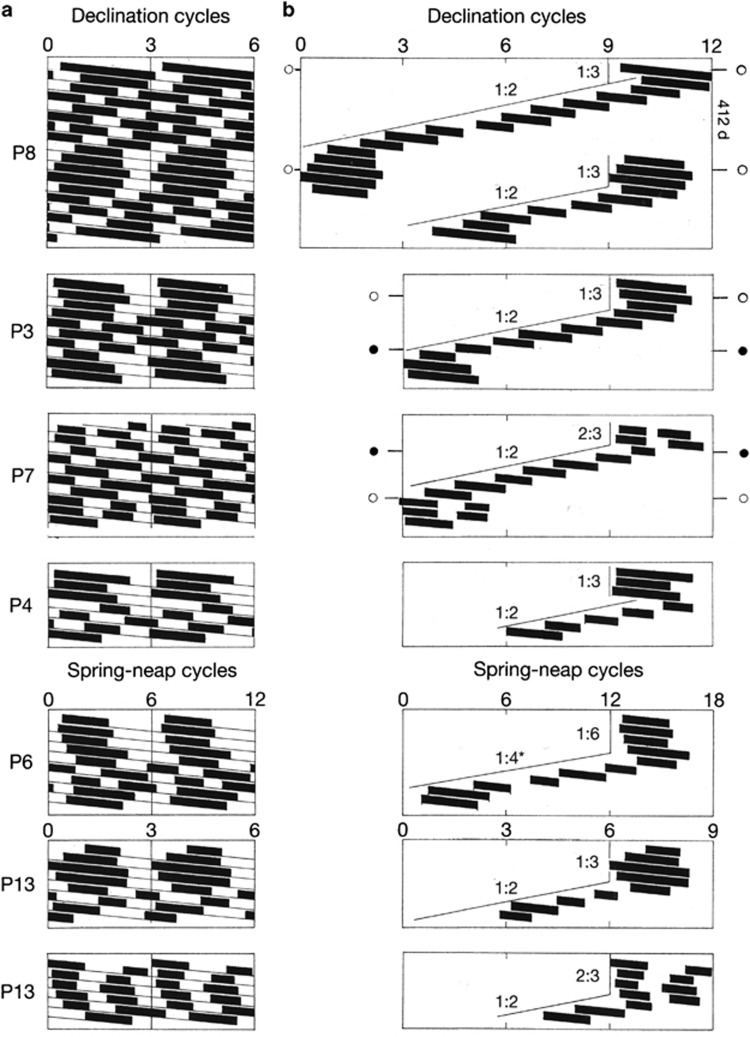
Eleven instances of shifts between 1:2 and 1:3 (or 2:3) modes of synchrony of mood cycles with bi-weekly lunar cycles. Double raster plots (a), as described for Figure 4. The courses of successive manic episodes across the plotting space (b) are shown together with numbers indicating their apparent mode of synchrony with bi-weekly lunar cycles. The numbers 1:2, 1:3 and 2:3 indicate, respectively, that every mood cycle had become synchronous with every second or third lunar cycle, or that every second mood cycle had become synchronous with every third lunar cycle. Uniquely, Patient 6’s mood cycles shifted from 1:6 resonance with spring–neap cycles to 1:4 resonance with declination cycles, as indicated by an asterisk (*).
Figure 6
Figure 6
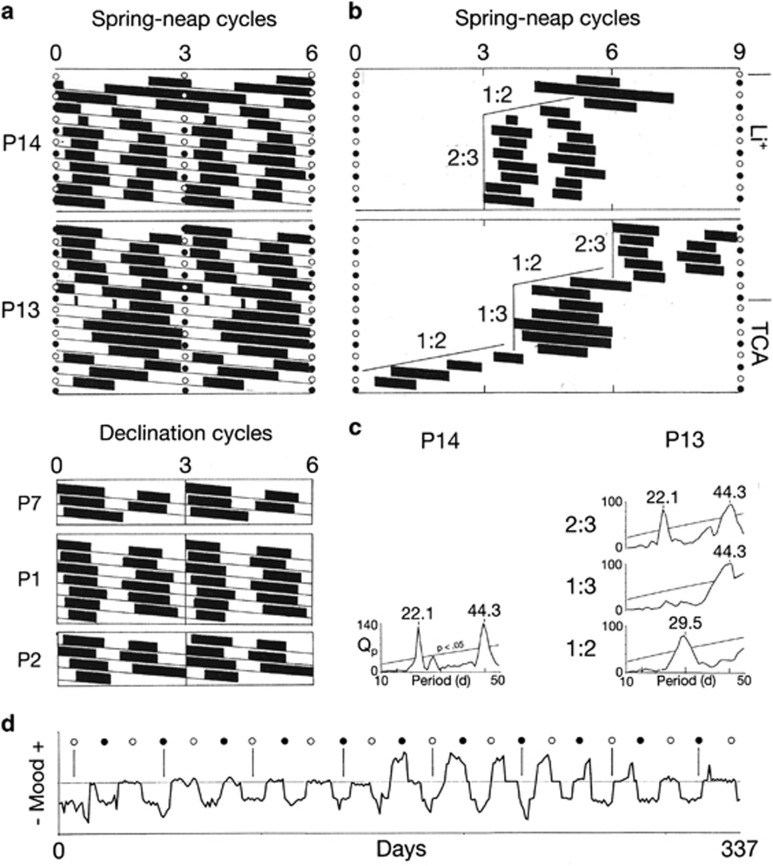
Five instances of synchrony of every second mood cycle with every third bi-weekly lunar cycle. Raster double plots of bipolar cycles (a) and courses of manic episodes across the plotting space (b), are shown as described for Figures 4 and 5. The occurrence of 2:3 synchrony of mood cycles with lunar cycles in Patients 13 and 14 is confirmed by χ2 periodogram analyses (c). As a reference, the duration of 1.5, 2 and 3 spring–neap cycles (22.1, 29.5 and 44.3 days, respectively) are shown above the periodograms. At different times, Patient 13’s mood cycles exhibited all three modes of synchrony with the lunar cycle (b, c). Patient 14’s periodogram and the first of Patient 13’s three periodograms show the first harmonic at circa 22.1 days, which is the fundamental period of the mood cycle, together with the second harmonic at circa 44.3 days, which is the period of recurrence of every third bi-weekly lunar cycle. Synchrony of every second mood cycle with every third lunar spring–neap cycle is evident in a linear plot of the time-series of Patient 14’s daily self-ratings of mood, in which times of full and new moons are indicated by open and closed circles, respectively (d).
Figure 7
Figure 7
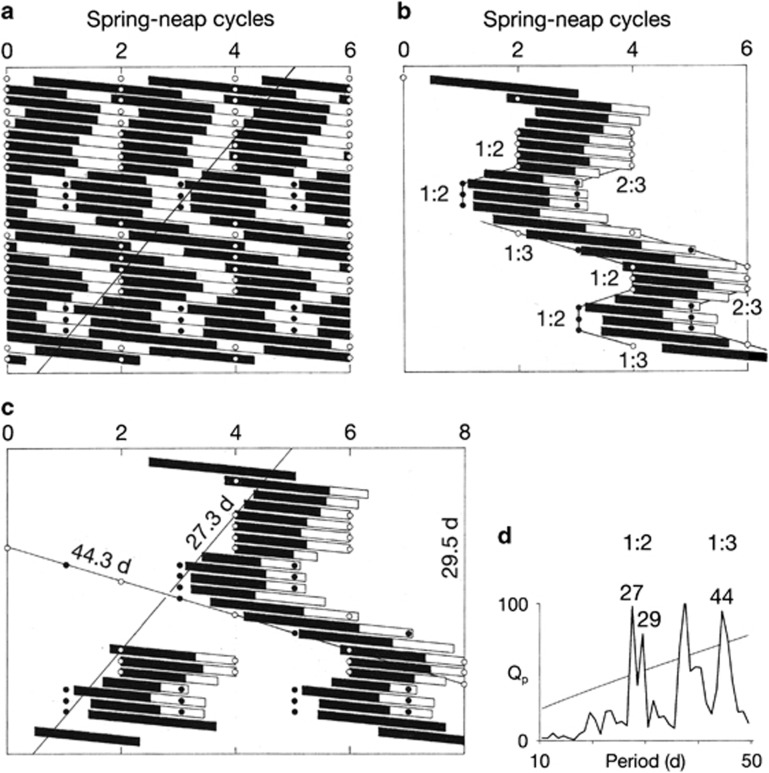
Bipolar mood cycles entrained simultaneously to both the declination cycle and the spring–neap cycle. Raster triple-plot of Patient 8’s mood cycles constructed with plotting intervals equal to two 14.8-day spring–neap cycles (a). Open and closed circles indicate selected times of occurrence of full-moon and new-moon peaks of the 14.8-day spring–neap cycle. Diagonal line indicates the transits across the plotting space of 27.3-day recurrences of every second peak of the 13.7-day declination cycle. Sequences in which mood cycles are vertically aligned indicate that they had become synchronous with every second spring–neap cycle. A sequence of successive individual manic-depressive cycles (b) extracted from the raster-plot (a) shows the path of their course across the plotting space. As they progress, the mood cycles shift among different modes of coupling with the spring–neap cycle. The sequence 1:2–2:3-1:2–1:3, which occurs over the course of one lunar year, is repeated exactly over the course of the subsequent lunar year. With these shifts, the mood cycles maintain relatively consistent phase-relationships with each of the bi-weekly lunar cycles, as shown by lines and circles (c). The 27.3-day line indicates times of recurrence of peaks of every second declination cycle. The 44.3-day line indicates times of recurrence of peaks of every third spring–neap cycle. The 29.5-day sequences of circles indicate times of recurrence of peaks of every second spring–neap cycle. The presence of all three periodicities in the course of the mood cycles is confirmed by χ2 periodogram analysis (d).

References

    1. Owens M, McGowan IW. Madness and the moon: the lunar cycle and psychopathology. Ger J Psychiatry 2006; 9: 123–127.
    1. Foster RG, Roenneberg T. Human responses to the geophysical daily, annual and lunar cycles. Curr Biol 2008; 18: R784–R794. - PubMed
    1. Raison CL, Klein HM, Steckler M. The moon and madness reconsidered. J Affect Disord 1999; 53: 99–106. - PubMed
    1. Kronfeld-Schor N, Dominoni D, de la Iglesia H, Levy O, Herzog ED, Dayan T, Helfrich-Forster C. Chronobiology by moonlight. Proc R Soc B 2013; 280: 20123088. - PMC - PubMed
    1. Nash LT. Moonlight and behavior in nocturnal and cathemeral primates, especially Lepilemur leucopus: Illuminating possible anti-predator efforts. In: Gursky SL, Nekaris KAI. (eds). Developments in Primatology: Progress and Prospects. Springer: Berlin, 2007. pp 173–187.

Publication types