. 2017:2017:3864340.
doi: 10.1155/2017/3864340. Epub 2017 Jan 1.

Dietary Supplementation of Hericium erinaceus Increases Mossy Fiber-CA3 Hippocampal Neurotransmission and Recognition Memory in Wild-Type Mice

Affiliations

Dietary Supplementation of Hericium erinaceus Increases Mossy Fiber-CA3 Hippocampal Neurotransmission and Recognition Memory in Wild-Type Mice

Federico Brandalise et al. Evid Based Complement Alternat Med. 2017.

Abstract

Hericium erinaceus (Bull.) Pers. is a medicinal mushroom capable of inducing a large number of modulatory effects on human physiology ranging from the strengthening of the immune system to the improvement of cognitive functions. In mice, dietary supplementation with H. erinaceus prevents the impairment of spatial short-term and visual recognition memory in an Alzheimer model. Intriguingly other neurobiological effects have recently been reported like the effect on neurite outgrowth and differentiation in PC12 cells. Until now no investigations have been conducted to assess the impact of this dietary supplementation on brain function in healthy subjects. Therefore, we have faced the problem by considering the effect on cognitive skills and on hippocampal neurotransmission in wild-type mice. In wild-type mice the oral supplementation with H. erinaceus induces, in behaviour test, a significant improvement in the recognition memory and, in hippocampal slices, an increase in spontaneous and evoked excitatory synaptic current in mossy fiber-CA3 synapse. In conclusion, we have produced a series of findings in support of the concept that H. erinaceus induces a boost effect onto neuronal functions also in nonpathological conditions.


Conflict of interest statement

The authors have declared that no competing interests exist.

Figures
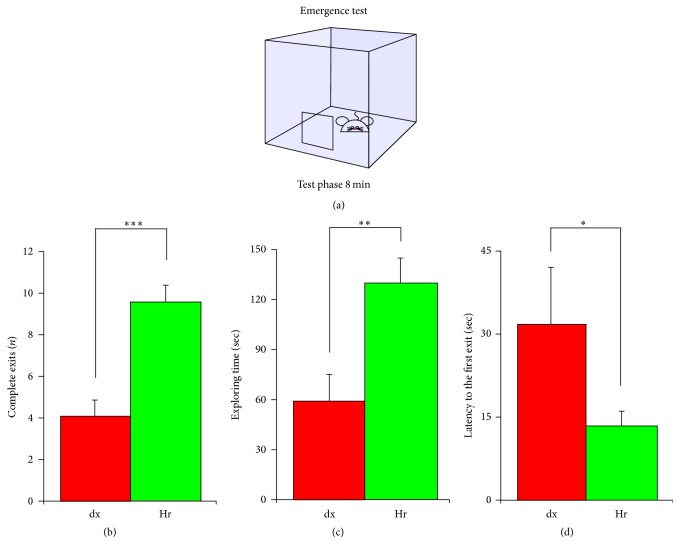
Figure 1
Figure 1
H. erinaceus increases novelty exploration behaviour. Emergence test in dx (n = 12) and Hr-dietary supplemented mice (n = 22) during an 8 min session. (a) Schematic of the experimental set-up and procedure used. Histograms show (b) the number of complete exits; (c) duration of exploring time; and (d) the latency of the first exit.
Figure 2
Figure 2
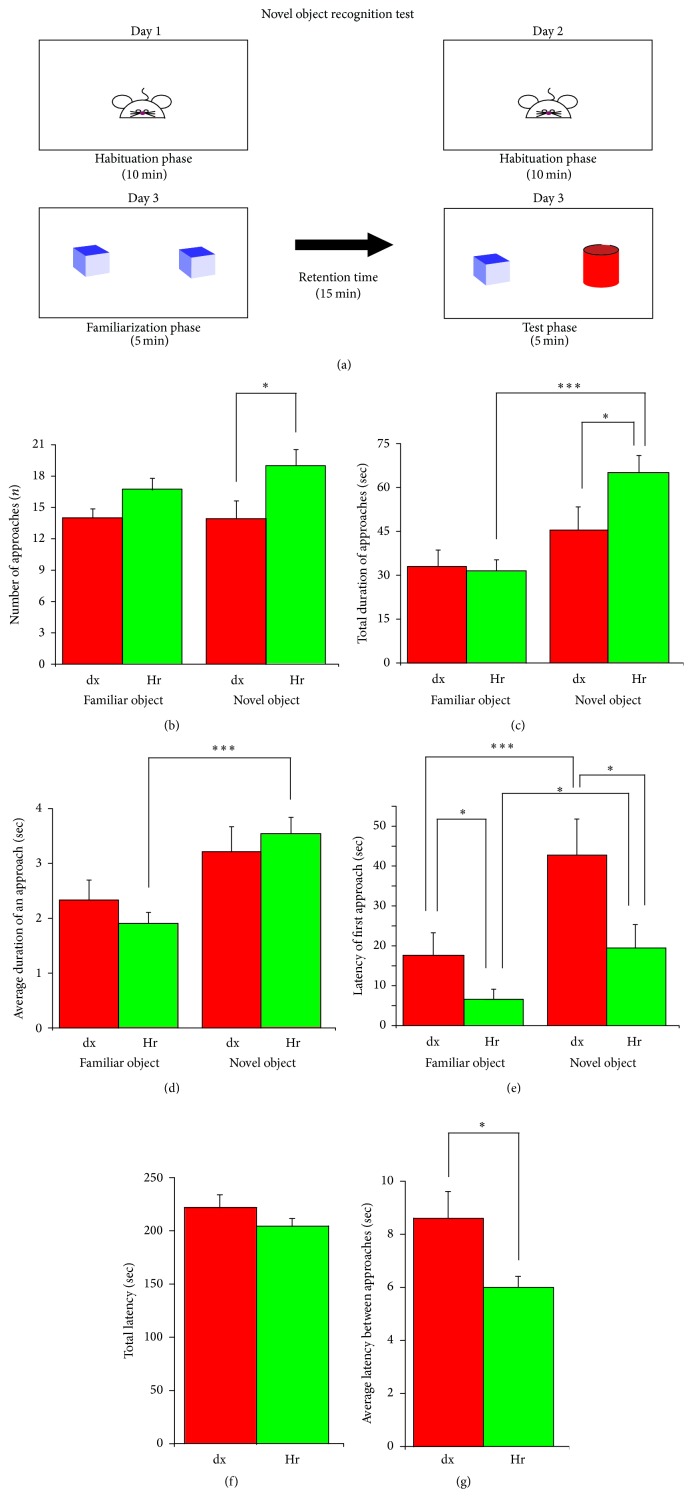
H. erinaceus increases recognition memory. Novel object recognition test (NOR) in dx (n = 10) and Hr-dietary supplemented mice (n = 15) during a 10 min session. (a) Schematic of the experimental set-up and procedure used. Histograms show (b) the number of approaches to the familiar and novel objects; (c) the total duration of approaches; (d) the average duration of an approach; (e) the latency to the first approach; (f) total latency; and (g) average latency between approaches.
Figure 3
Figure 3
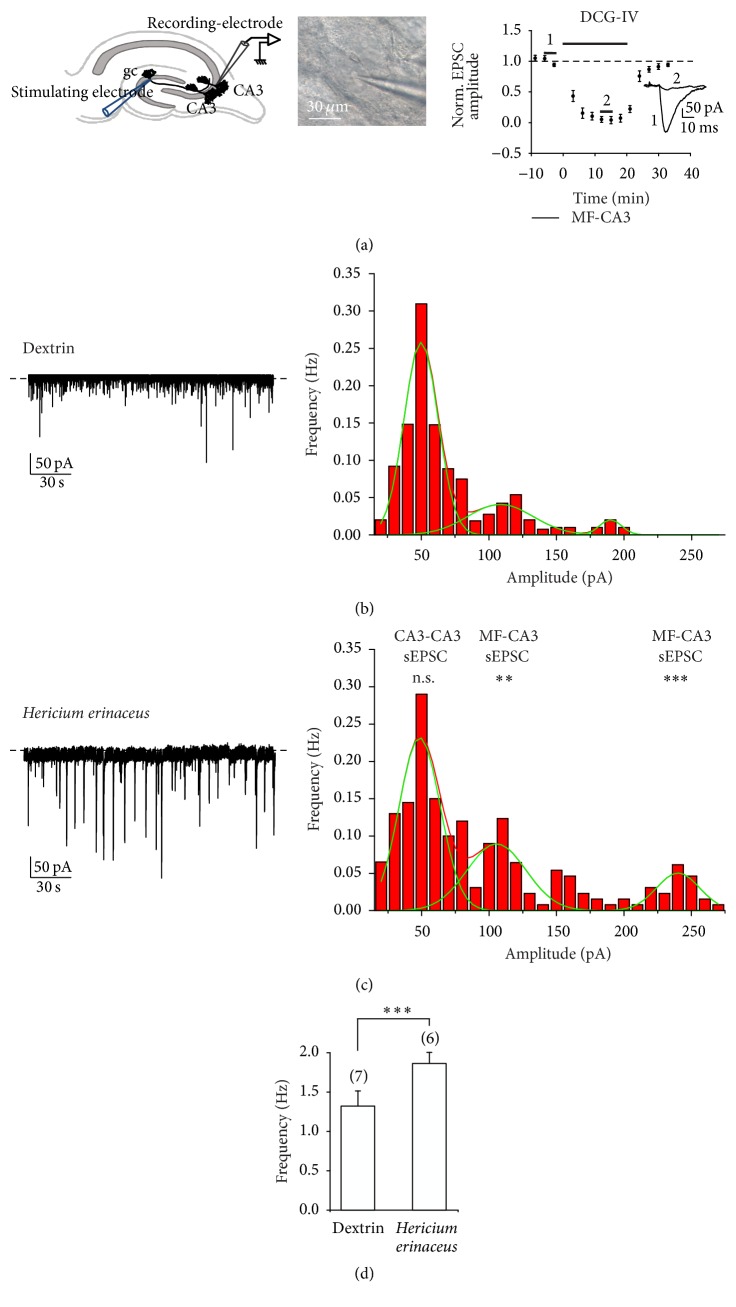
Spontaneous synaptic excitatory currents (sEPSCs) recorded from CA3 pyramidal cells. (a) Left, schematic drawing of experimental set-up. gc: granule cell, CA3 pyramidal cell. Middle, patch-pipette in a CA3 neuron. Right, bath-application of 2 μM DCG-IV, a receptor agonist of Group II metabotropic glutamate that blocks glutamate release from mossy fibers terminals, selectively decreases mossy fiber response (see inset). ((b) and (c)) Excitatory currents (sEPSCs) and (d) frequency histogram of spontaneous activity recorded from CA3 pyramidal cells in dextrin treated mice (Dextrin, n = 6) and in Hericium supplemented mice (Hericium erinaceus, n = 5).
Figure 4
Figure 4
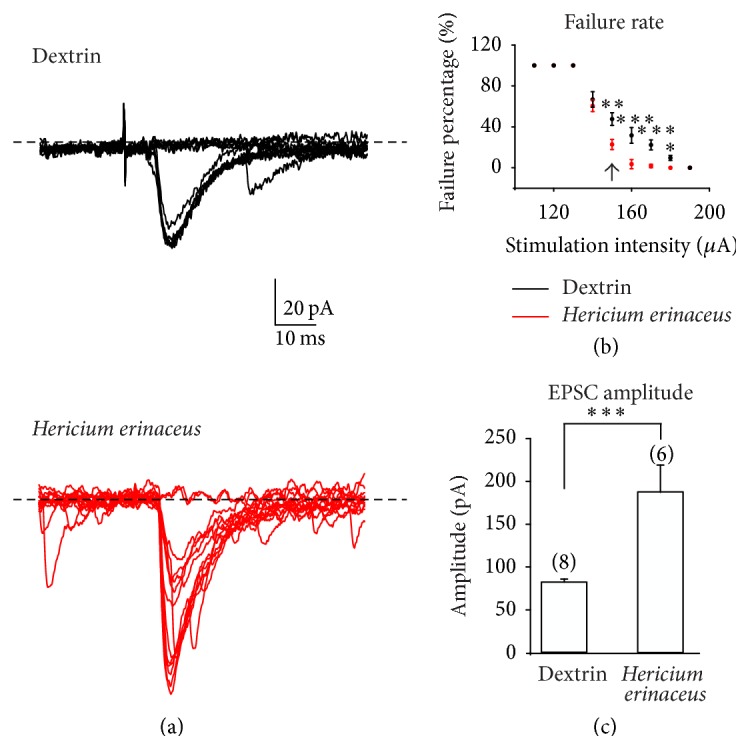
Mossy fiber-CA3 synapse evoked synaptic excitatory current (EPSCs) recorded after minimal stimulation at low frequency (0.1 Hz). (a) Experimental traces of evoked synaptic excitatory currents recorded in CA3 pyramidal cells for dextrin treated mice (top, Dextrin n = 8) and H. erinaceus oral supplemented mice (bottom, Hericium erinaceus n = 6). (b) Experimental design: mossy fibers were stimulated at different intensities (15 stimulations for each point) and the percentage of failure was calculated as the number of sweeps where no EPSC was evoked over the total number of stimulations per intensity point. The arrow inside the plot indicates the intensity point at which the representative traces in (a) are taken. (c) EPSCs amplitude histogram in dextrin treated mice (Dextrin) and in H. erinaceus oral supplemented mice (Hericium erinaceus).
Figure 5
Figure 5
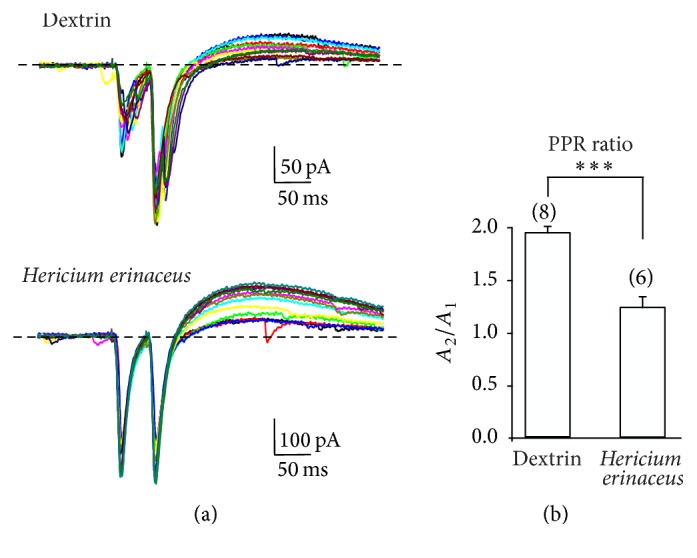
Paired-pulse stimulation: mossy fiber-CA3 synapse was stimulated by two pulses (interpulse interval 50 ms). (a) Experimental traces recorded in paired-pulse protocol for dextrin treated mouse (Dextrin, n = 8) and H. erinaceus supplemented mouse (Hericium erinaceus, n = 6). (b) Histograms of peak amplitude of the ratio between the second peak (A2) and the first peak (A1) for dextrin and Hr mice.

References

    1. Chang S. T., Wasser S. P. The role of culinary-medicinal mushrooms on human welfare with a pyramid model for human health. International Journal of Medicinal Mushrooms. 2012;14(2):95–134. doi: 10.1615/IntJMedMushr.v14.i2.10. - DOI - PubMed
    1. Mori K., Obara Y., Moriya T., Inatomi S., Nakahata N. Effects of Hericium erinaceus on amyloid β(25–35) peptide-induced learning and memory deficits in mice. Biomedical Research. 2011;32(1):67–72. doi: 10.2220/biomedres.32.67. - DOI - PubMed
    1. Hazekawa M., Kataoka A., Hayakawa K., et al. Neuroprotective effect of repeated treatment with Hericium erinaceum in mice subjected to middle cerebral artery occlusion. Journal of Health Science. 2010;56(3):296–303. doi: 10.1248/jhs.56.296. - DOI
    1. Mori K., Inatomi S., Ouchi K., Azumi Y., Tuchida T. Improving effects of the mushroom Yamabushitake (Hericium erinaceus) on mild cognitive impairment: a double-blind placebo-controlled clinical trial. Phytotherapy Research. 2009;23(3):367–372. doi: 10.1002/ptr.2634. - DOI - PubMed
    1. Nagano M., Shimizu K., Kondo R., et al. Reduction of depression and anxiety by 4 weeks Hericium erinaceus intake. Biomedical Research. 2010;31(4):231–237. doi: 10.2220/biomedres.31.231. - DOI - PubMed