


The use of amino acid PET and conventional MRI for monitoring of brain tumor therapy
- PMID: 28116231
- PMCID: PMC5226808
- DOI: 10.1016/j.nicl.2016.12.020
The use of amino acid PET and conventional MRI for monitoring of brain tumor therapy
Abstract
Routine diagnostics and treatment monitoring of brain tumors is usually based on contrast-enhanced MRI. However, the capacity of conventional MRI to differentiate tumor tissue from posttherapeutic effects following neurosurgical resection, chemoradiation, alkylating chemotherapy, radiosurgery, and/or immunotherapy may be limited. Metabolic imaging using PET can provide relevant additional information on tumor metabolism, which allows for more accurate diagnostics especially in clinically equivocal situations. This review article focuses predominantly on the amino acid PET tracers 11C-methyl-l-methionine (MET), O-(2-[18F]fluoroethyl)-l-tyrosine (FET) and 3,4-dihydroxy-6-[18F]-fluoro-l-phenylalanine (FDOPA) and summarizes investigations regarding monitoring of brain tumor therapy.
Keywords: Bevacizumab; Checkpoint inhibitors; FDOPA; FET; Glioma; Immunotherapy; MET; PET; Pseudoprogression; Pseudoresponse; Temozolomide.
Figures
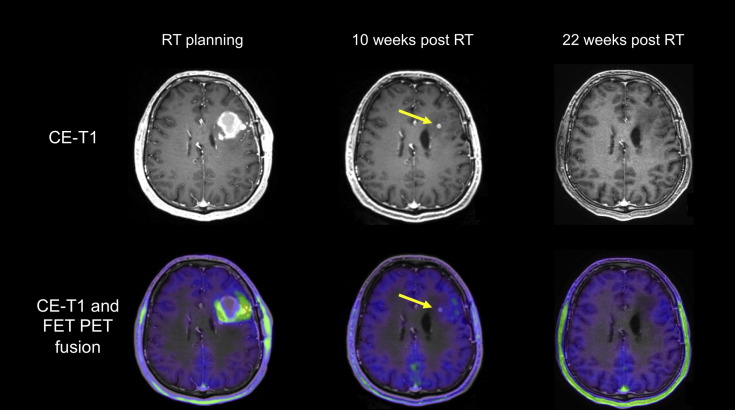
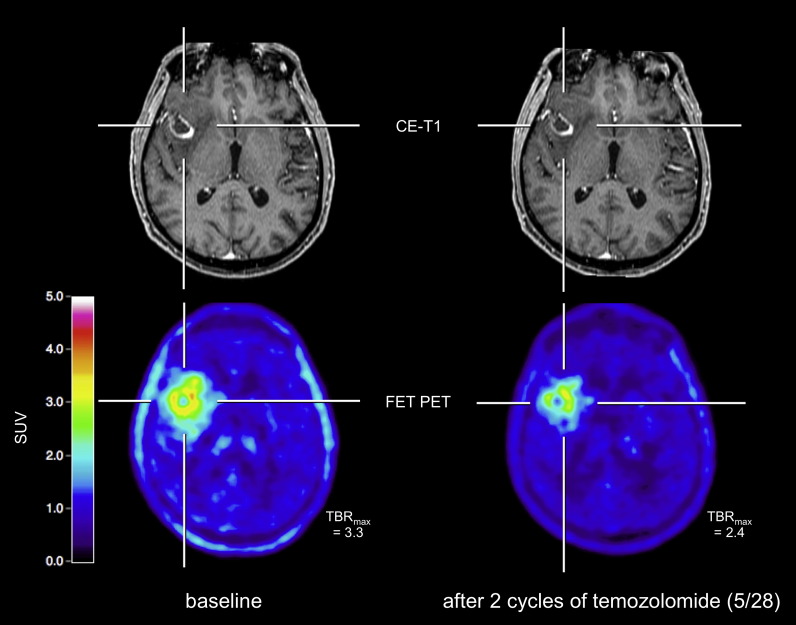
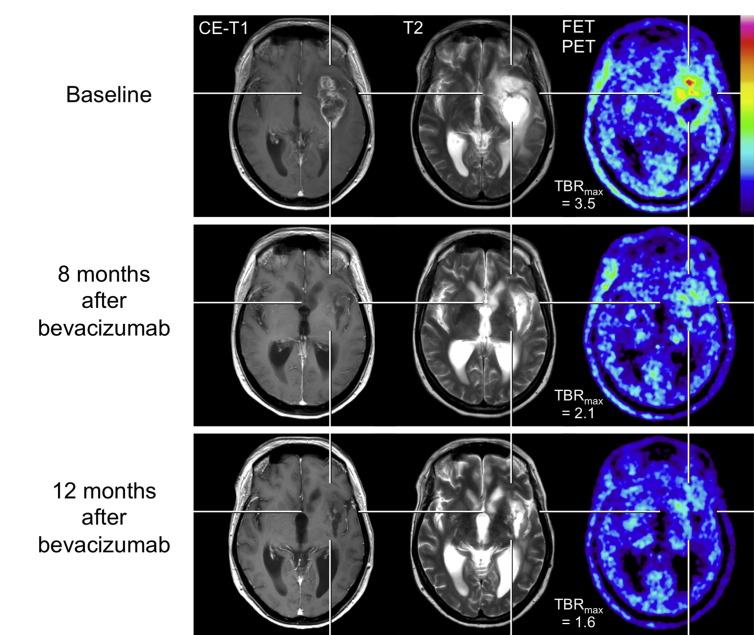
References
-
- Ahluwalia M.S., Wen P.Y. Antiangiogenic therapy for patients with glioblastoma: current challenges in imaging and future directions. Expert. Rev. Anticancer. Ther. 2011;11:653–656. - PubMed
-
- Albert F.K., Forsting M., Sartor K., Adams H.P., Kunze S. Early postoperative magnetic resonance imaging after resection of malignant glioma: objective evaluation of residual tumor and its influence on regrowth and prognosis. Neurosurgery. 1994;34:45–60. - PubMed
-
- Albert N.L., Weller M., Suchorska B., Galldiks N., Soffietti R., Kim M.M., la Fougere C., Pope W., Law I., Arbizu J., Chamberlain M.C., Vogelbaum M., Ellingson B.M., Tonn J.C. Response assessment in Neuro-Oncology working group and European Association for Neuro-Oncology recommendations for the clinical use of PET imaging in gliomas. Neuro-Oncology. 2016;18:1199–1208. - PMC - PubMed
-
- Albert N.L., Winkelmann I., Suchorska B., Wenter V., Schmid-Tannwald C., Mille E., Todica A., Brendel M., Tonn J.C., Bartenstein P., la Fougere C. Early static (18)F-FET-PET scans have a higher accuracy for glioma grading than the standard 20–40 min scans. Eur. J. Nucl. Med. Mol. Imaging. 2016;43:1105–1114. - PubMed
Publication types
MeSH terms
Substances
LinkOut - more resources
Full Text Sources
Other Literature Sources
Medical
Miscellaneous
