


Brain networks associated with cognitive and hedonic responses to a meal
- PMID: 28116817
- PMCID: PMC6615895
- DOI: 10.1111/nmo.13031
Brain networks associated with cognitive and hedonic responses to a meal
Abstract
Background: We recently reported interrelated digestive, cognitive, and hedonic responses to a meal. The aim of this study was to identify brain networks related to the hedonic response to eating.
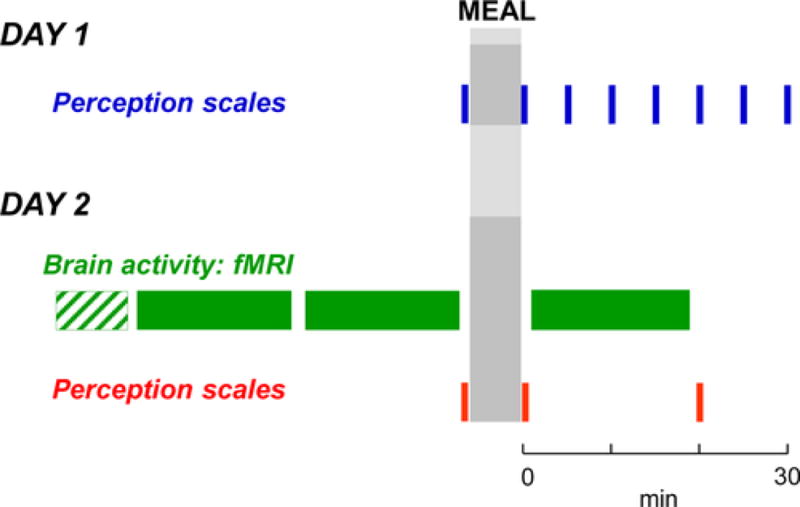
Methods: Thirty-eight healthy subjects (20-38 age range) were evaluated after a 5-hour fast and after ingestion of a test meal (juice and warm ham and cheese sandwich, 300 mL, 425 kcal). Perceptual and affective responses (satiety, abdominal fullness, digestive well-being, and positive mood), and resting scans of the brain using functional MRI (3T Trio, Siemens, Germany) were evaluated immediately before and after the test meal. A high-order group independent component analysis was performed to investigate ingestion-related changes in the intrinsic connectivity of brain networks, with a focus on thalamic and insular networks.
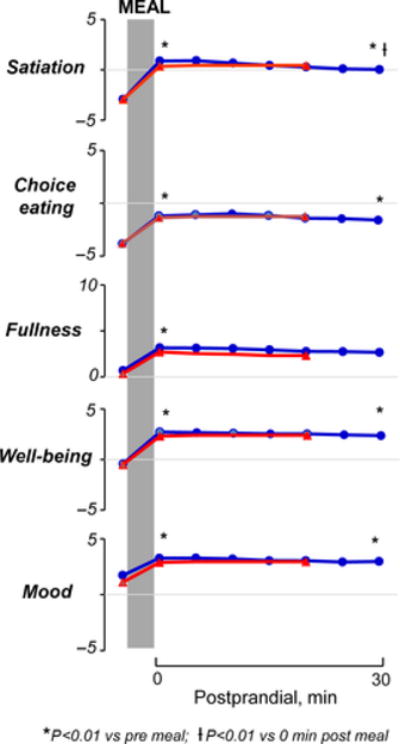
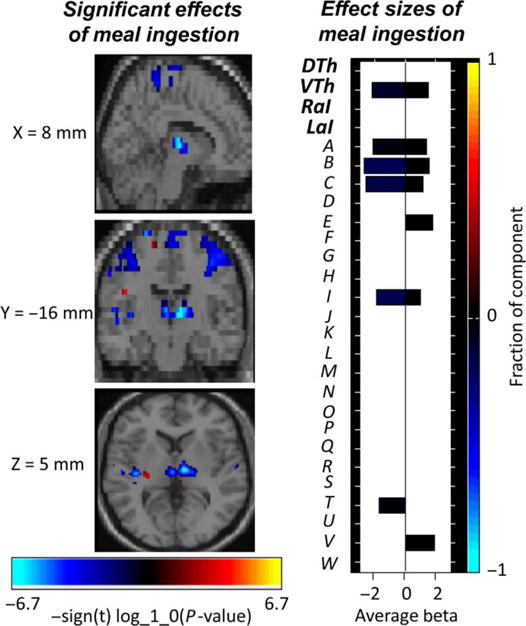
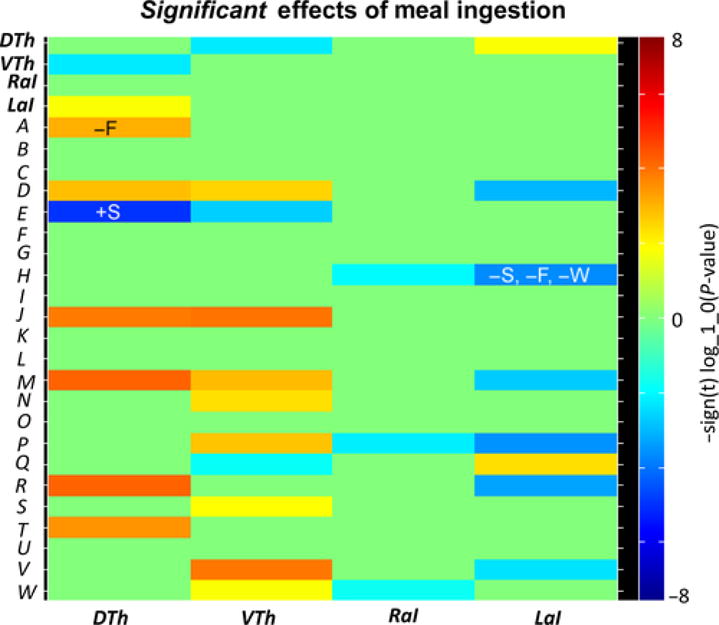
Key results: Ingestion induced satiation (3.3±0.4 score increase; P<.001) and abdominal fullness (2.4±0.3 score increase; P<.001). These sensations included an affective dimension involving digestive well-being (2.8±0.3 score increase; P<.001) and positive mood (1.8±0.2 score increase; P<.001). In general, thalamo-cortical connectivity increased with meal ingestion while insular-cortical connectivity mainly decreased. Furthermore, larger meal-induced changes (increase/decrease) in specific thalamic connections were associated with smaller changes in satiety/fullness. In contrast, a larger meal-induced decrease in insular-anterior cingulate cortex connectivity was associated with increased satiety, fullness, and digestive well-being.
Conclusions and inferences: Perceptual and emotional responses to food intake are related to brain connectivity in defined functional networks. Brain imaging may provide objective biomarkers of subjective effects of meal ingestion.
Keywords: brain imaging; hedonic response; meal ingestion; postprandial sensations.
© 2017 John Wiley & Sons Ltd.
Conflict of interest statement
No competing interests declared by all investigators.
Figures
References
-
- Azpiroz F, Bouin M, Camilleri M, et al. Mechanisms of hypersensitivity in IBS and functional disorders. Neurogastroenterol Mot. 2007;19:62–88. - PubMed
-
- Kellow JE, Azpiroz F, Delvaux M, et al. Applied principles of neurogastroenterology: physiology/motility sensation. Gastroenterology. 2006;130:1412–1420. - PubMed
-
- Azpiroz F, Feinle C, Grundy D, Tack J. Gastric sensitivirty and reflexes: basic mechanism underlying clinical problems. J Gastroenterol. 2014;49:206–218. - PubMed
-
- Feinle C, Azpiroz F. Dietary and life-style factors in funcional dyspepsia. Nat Rev Gastroenterol Hepatol. 2013;10:150–157. - PubMed
MeSH terms
Grants and funding
LinkOut - more resources
Full Text Sources
Other Literature Sources
