. 2017 Jan 24:7:41292.
doi: 10.1038/srep41292.

Advanced Materials From Fungal Mycelium: Fabrication and Tuning of Physical Properties

Affiliations

Advanced Materials From Fungal Mycelium: Fabrication and Tuning of Physical Properties

Muhammad Haneef et al. Sci Rep. .

Abstract

In this work is presented a new category of self-growing, fibrous, natural composite materials with controlled physical properties that can be produced in large quantities and over wide areas, based on mycelium, the main body of fungi. Mycelia from two types of edible, medicinal fungi, Ganoderma lucidum and Pleurotus ostreatus, have been carefully cultivated, being fed by two bio-substrates: cellulose and cellulose/potato-dextrose, the second being easier to digest by mycelium due to presence of simple sugars in its composition. After specific growing times the mycelia have been processed in order to cease their growth. Depending on their feeding substrate, the final fibrous structures showed different relative concentrations in polysaccharides, lipids, proteins and chitin. Such differences are reflected as alterations in morphology and mechanical properties. The materials grown on cellulose contained more chitin and showed higher Young's modulus and lower elongation than those grown on dextrose-containing substrates, indicating that the mycelium materials get stiffer when their feeding substrate is harder to digest. All the developed fibrous materials were hydrophobic with water contact angles higher than 120°. The possibility of tailoring mycelium materials' properties by properly choosing their nutrient substrates paves the way for their use in various scale applications.


Figures
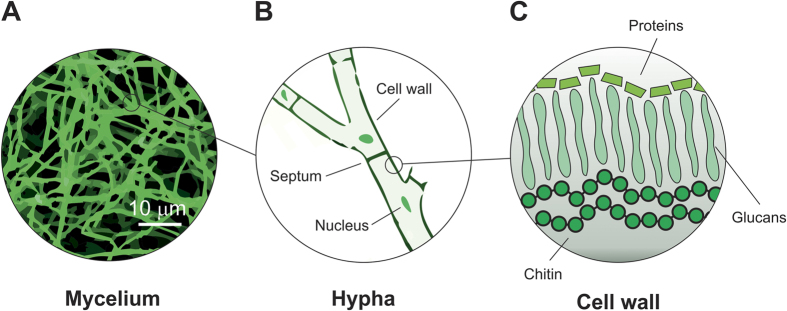
Figure 1
Figure 1. Schematic representation of mycelium physiology at different scales.
(A) Optical microscopy image of a mycelium film showing a branched network of micro-filaments (hyphae). (B) Schematic representation of a hypha that is formed by cells separated by cross walls (septa), all enclosed within a cell wall. (C) Schematic representation of the cell wall that is composed of a layer of chitin on the cell membrane, a layer of glucans (whose composition varies between species) and a layer of proteins on the surface (adapted from ref. 36).
Figure 2
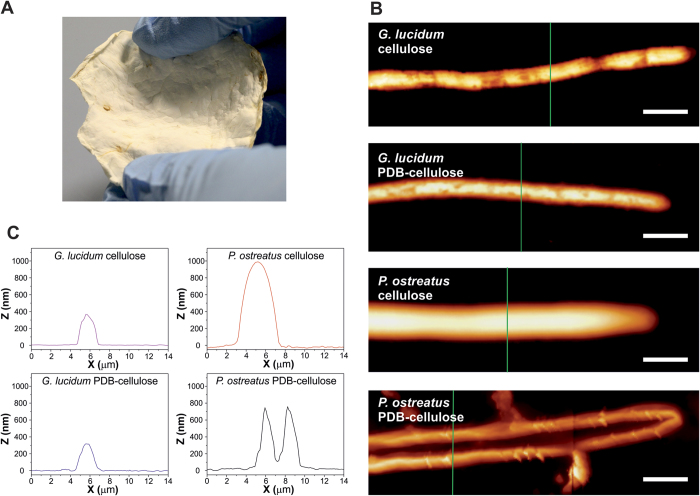
Figure 2. Topographic characterization.
(A) photograph of a film of P. ostreatus fed with amorphous cellulose for 20 days. (B) topographic AFM images of fungal hyphae at early stage of development (2 days old) on cellulose and PDB-cellulose substrates. Scale bar: 5 μm. (C) height profiles of filaments corresponding to the green lines in “B”.
Figure 3
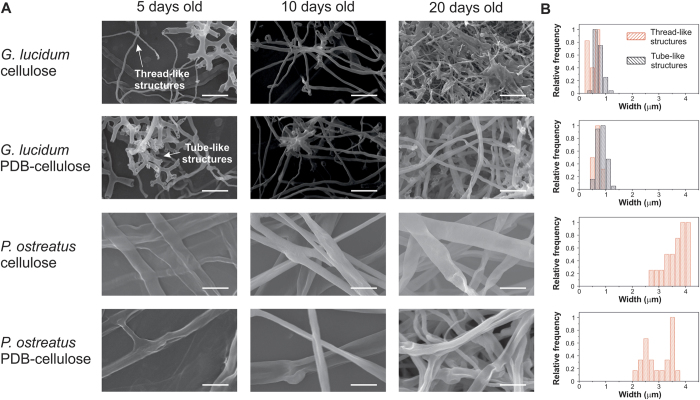
Figure 3. Morphological characterization.
(A) SEM micrographs of G. lucidum and P. ostreatus on cellulose and PDB-cellulose substrates at 5, 10 and 20 days of growth. Scale bar: 5 μm. (B) histograms of widths of hyphae growth after 20 days.
Figure 4
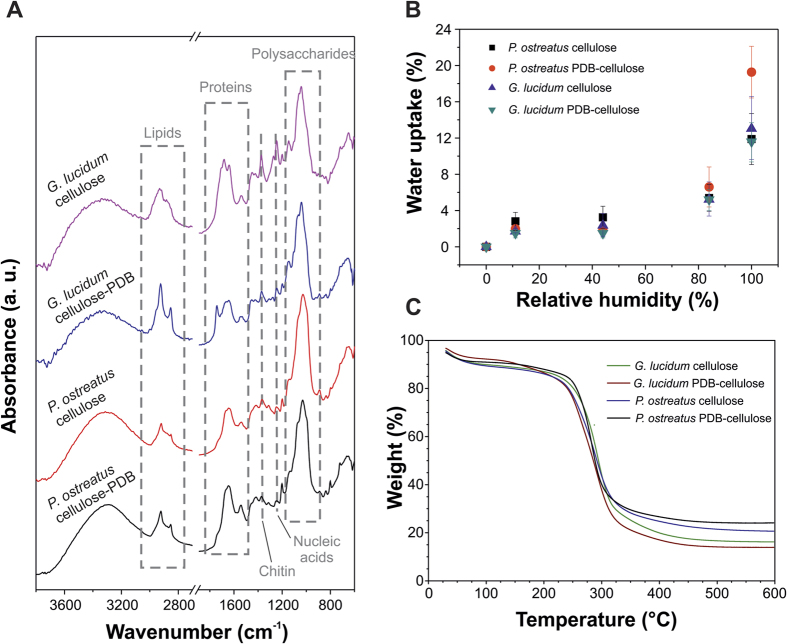
Figure 4. Chemical, thermal and water uptake characterization.
(A) ATR-FTIR spectra of 20 days old samples in the range 3800–600 cm−1. Main absorptions associated with lipids, proteins, chitin, nucleic acids and polysaccharides have been highlighted. (B) water uptake of the different samples, 20 days old. (C) thermogravimetric analysis of 20 days old samples.
Figure 5
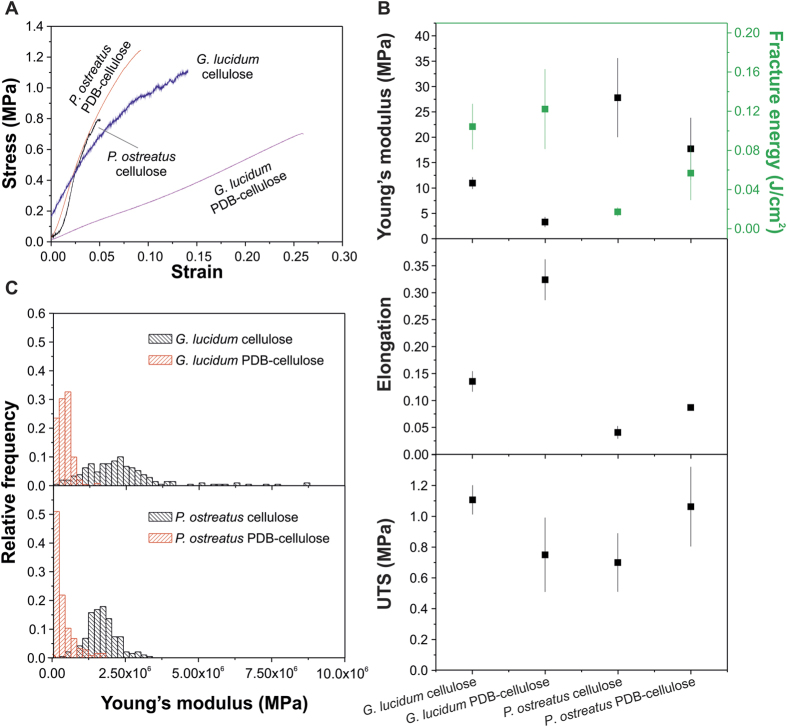
Figure 5. Mechanical characterization.
(A) typical stress-strain curves of 20-days old mycelium films. (B) Young’s modulus, elongation and strength of the different samples. (C) Histograms of measurements of Young’s modulus calculated by AFM indentation on 2-days old samples.

References

    1. Gutmanis I. Probability of the Nanotechnology Manufacturing Processes in the Industrial Nations in 2015-2025 time period. (Report of Hobe Corporation, 1999).
    1. Cingolani R., Athanassiou A. & Pompa P. P. Modulating antibacterial properties using nanotechnology. Nanomedicine 6, 1483–1485, doi: 10.2217/nnm.11.133 (2011). - DOI - PubMed
    1. Sarikaya M., Tamerler C., Jen A. K. Y., Schulten K. & Baneyx F. Molecular biomimetics: nanotechnology through biology. Nature Materials 2, 577–585, doi: 10.1038/nmat964 (2003). - DOI - PubMed
    1. Ariga K., Ji Q., Hill J. P., Bando Y. & Aono M. Forming nanomaterials as layered functional structures toward materials nanoarchitectonics. NPG Asia Materials 4, 17 (2012).
    1. Niemeyer C. M. Nanoparticles, proteins, and nucleic acids: Biotechnology meets materials science. Angewandte Chemie-International Edition 40, 4128–4158, doi: 10.1002/1521-3773(20011119)40:22<4128::aid-anie4128>3.0.co;2-s (2001). - DOI - PubMed