


Allogeneic transplantation for advanced acute myeloid leukemia: The value of complete remission
- PMID: 28117884
- PMCID: PMC5445001
- DOI: 10.1002/cncr.30536
Allogeneic transplantation for advanced acute myeloid leukemia: The value of complete remission
Abstract
Background: Patients with acute myeloid leukemia (AML) without complete remission (CR) or in first relapse (Rel1) can have extended leukemia control and survival after allogeneic hematopoietic cell transplantation (HCT). For patients in Rel1 or primary induction failure (PIF), transplantation versus treatment to achieve a second CR (CR2) and subsequent HCT might yield similar outcomes, but available comparative data are scarce.
Methods: Survival was analyzed in 4682 HCT recipients according to disease status: PIF (N = 1440), Rel1 (failing ≥1 reinduction; N = 1256), and CR2 (N = 1986).
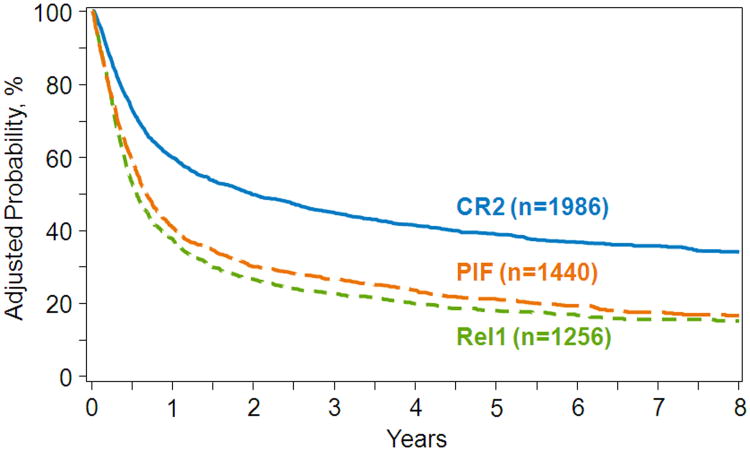
Results: Patient, disease, and transplantation characteristics were similar, except that patients in CR2 more often had performance scores of 90% to 100%, de novo AML, and longer CR1 duration. Adverse cytogenetics were more common in patients who experienced PIF. The 5-year survival rate adjusted for performance score, cytogenetic risk, and donor type for CR2 was 39% (95% confidence interval [CI], 37%-41%) compared with 18% (95% CI, 16%-20%) for HCT in Rel1 and 21% (95% CI, 19%-23%) in PIF (P < .0001).
Conclusions: Although survival is superior for patients who undergo HCT in CR2, transplantation for selected patients in Rel1 or PIF may still be valuable. These data can guide decision making about additional salvage therapy versus prompt HCT for patients not in CR, but they also highlight that AML is intrinsically more treatable in patients who have favorable-risk cytogenetics, those with longer CR1 duration, and younger patients with better performance status. Cancer 2017;123:2025-2034. © 2017 American Cancer Society.
Keywords: acute myeloid leukemia; allogeneic transplantation; complete remission; primary induction failure; relapse.
© 2017 American Cancer Society.
Conflict of interest statement
All others report no conflicts of interest in the study design or analysis.
Figures
References
-
- Cornelissen JJ, Blaise D. Hematopoietic stem cell transplantation for patients with AML in first complete remission. Blood. 2016;127(1):62–70. Epub 2015 Dec 10. - PubMed
-
- Forman SJ, Schmidt GM, Nademanee AP, Amylon MD, Chao NJ, Fahey JL, et al. Allogeneic bone marrow transplantation as therapy for primary induction failure for patients with acute leukemia. J of Clin Oncol. 1991;9(9):1570–1574. - PubMed
-
- Mehta J, Powles R, Horton C, Milan S, Treleaven J, Tait D, et al. Bone marrow transplantation for primary refractory acute leukaemia. Bone Marrow Transplant. 1994;14(3):415–418. - PubMed
-
- Estey EH. Treatment of relapsed and refractory acute myelogenous leukemia. Leukemia. 2000;14(3):476–479. - PubMed
Publication types
MeSH terms
Grants and funding
LinkOut - more resources
Full Text Sources
Other Literature Sources
Medical
