


Role of adjuvant radiotherapy for localized extrahepatic bile duct cancer
- PMID: 28118028
- PMCID: PMC5601530
- DOI: 10.1259/bjr.20160807
Role of adjuvant radiotherapy for localized extrahepatic bile duct cancer
Abstract
Objective: To evaluate the benefit of adjuvant radiotherapy (RT) after surgical resection for extrahepatic bile duct (EHBD) cancer.
Methods: From 1997 to 2015, 59 patients with EHBD cancer were the subject of this study; 36 patients not undergoing adjuvant treatment after surgery (observation group) and 23 patients receiving adjuvant RT (RT group) were compared. Microscopic residual disease (R1) was in 9 (25%) patients and 5 (22%) patients, and macroscopic residual disease (R2) was in 2 (6%) patients and 6 (26%) patients in the observation and RT groups, respectively. Adjuvant RT was delivered to the tumour bed and regional lymph nodes up to 50.4 Gy (range, 45-61 Gy).
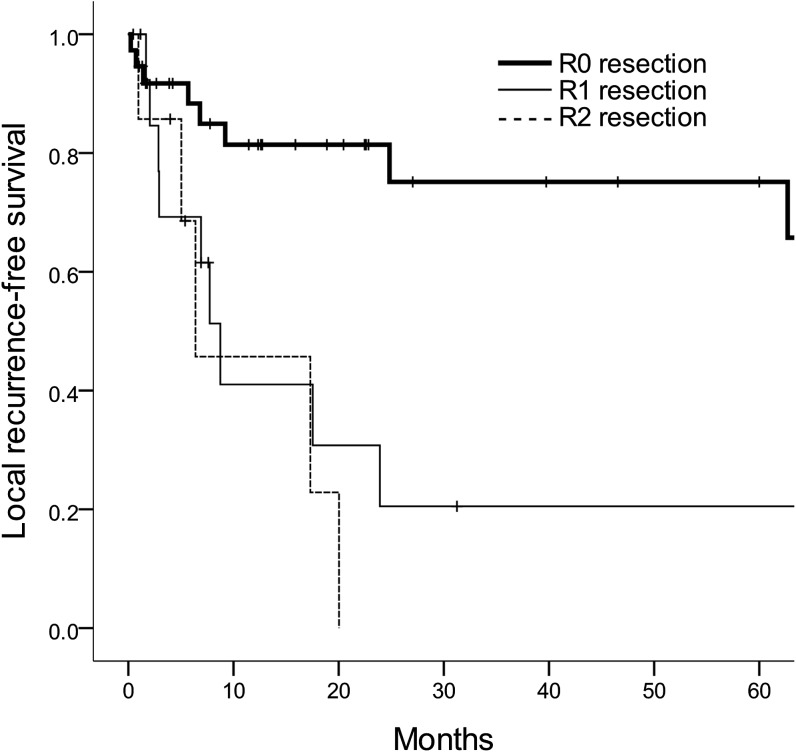
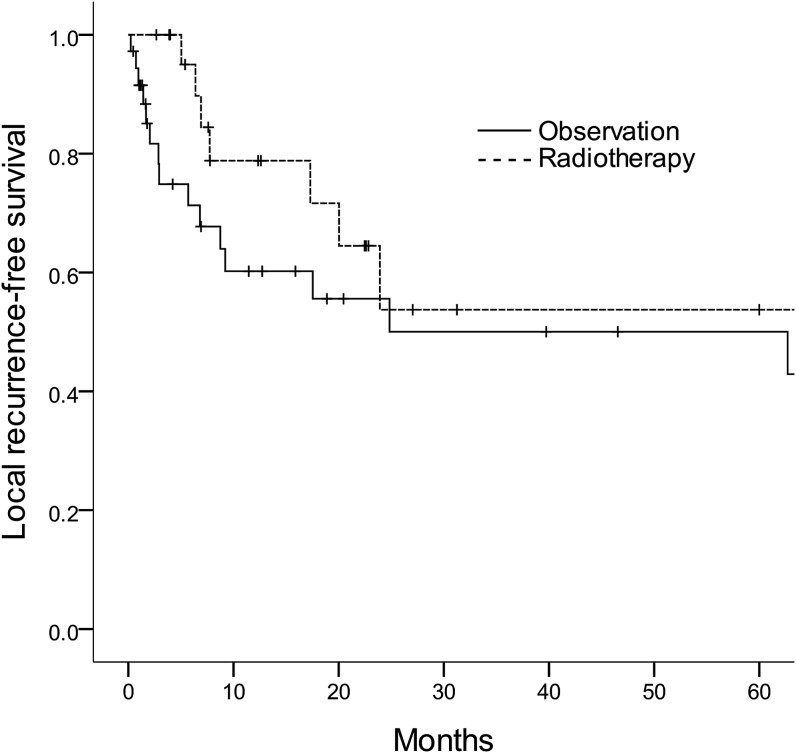
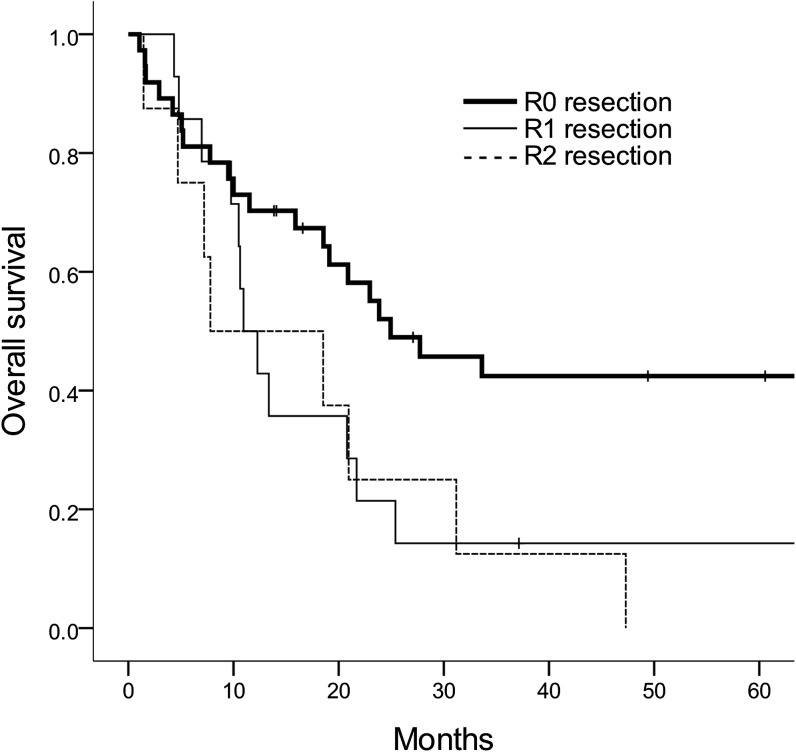
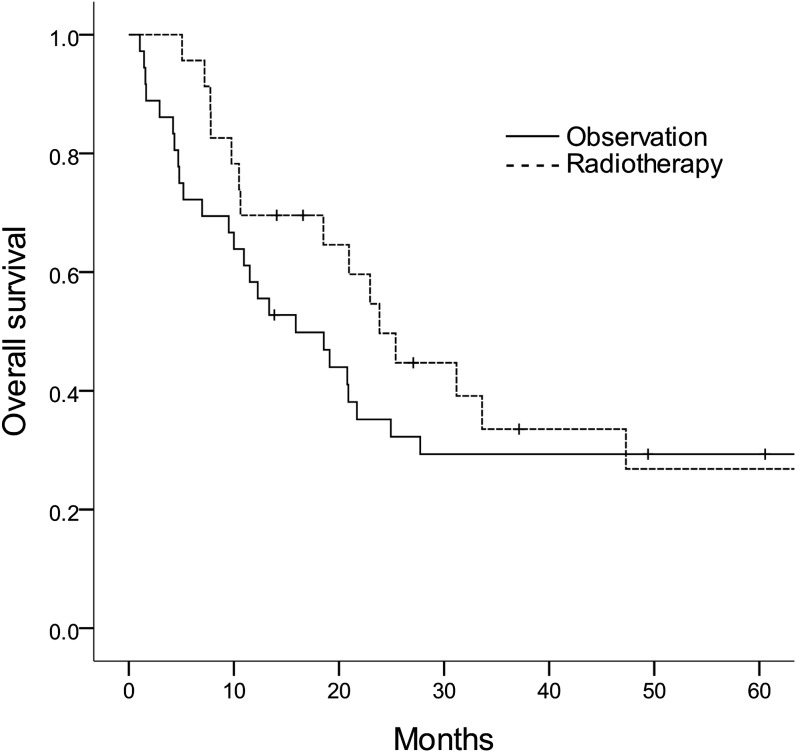
Results: With a median follow-up of 19 months, local recurrence was observed in 10 (28%) patients and 2 (9%) patients in the observation and RT groups, respectively. On univariate analysis, the 5-year local recurrence-free survival (LRFS) rates were 50% in the observation group and 54% in the RT group (p = 0.401). The 5-year overall survival (OS) rates were 29.3% in the observation group and 26.3% in the RT group (p = 0.602). On multivariable analysis, however, adjuvant RT significantly improved LRFS [hazard ratio (HR), 0.310; 95% confidence interval (CI), 0.100-0.963; p = 0.043] and had a trend towards increased OS (HR, 0.491; 95% CI, 0.219-1.102; p = 0.085). Resection margin (RM) status was also correlated with LRFS (HR for R1 6.134, 95% CI 2.051-18.344; and HR for R2 18.551, 95% CI 3.680-93.520; p < 0.001) and OS (HR for R1 1.816, 95% CI 0.853-3.867; and HR for R2 3.564, 95% CI 1.175-10.809; p = 0.054).
Conclusion: RM status was a significant prognosticator of EHBD cancer, and adjuvant RT improved local control rate; thereby, survival rate might be increased. Advances in knowledge: The benefit of adjuvant RT in EHBD cancer was demonstrated via comparison with observation group.
Figures
References
-
- Jung KW, Won YJ, Oh CM, Kong HJ, Cho H, Lee JK, et al. . Prediction of cancer incidence and mortality in Korea, 2016. Cancer Res Treat 2016; 48: 451–7. doi: https://doi.org/10.4143/crt.2016.092 - DOI - PMC - PubMed
-
- Vern-Gross TZ, Shivnani AT, Chen K, Lee CM, Tward JD, MacDonald OK, et al. . Survival outcomes in resected extrahepatic cholangiocarcinoma: effect of adjuvant radiotherapy in a surveillance, epidemiology, and end results analysis. Int J Radiat Oncol Biol Phys 2011; 81: 189–98. doi: https://doi.org/10.1016/j.ijrobp.2010.05.001 - DOI - PubMed
-
- Nakeeb A, Pitt HA, Sohn TA, Coleman J, Abrams RA, Piantadosi S, et al. . Cholangiocarcinoma. A spectrum of intrahepatic, perihilar, and distal tumors. Ann Surg 1996; 224: 463. doi: https://doi.org/10.1097/00000658-199610000-00005 - DOI - PMC - PubMed
-
- Tsao JI, Nimura Y, Kamiya J, Hayakawa N, Kondo S, Nagino M, et al. . Management of hilar cholangiocarcinoma: comparison of an American and a Japanese experience. Ann Surg 2000; 232: 166–74. doi: https://doi.org/10.1097/00000658-200008000-00003 - DOI - PMC - PubMed
-
- Nagorney DM, Donohue JH, Farnell MB, Schleck CD, Ilstrup DM. Outcomes after curative resections of cholangiocarcinoma. Arch Surg 1993; 128: 871–8. doi: https://doi.org/10.1001/archsurg.1993.01420200045008 - DOI - PubMed
MeSH terms
LinkOut - more resources
Full Text Sources
Other Literature Sources
Medical
