


Brief Report: Treatment of Tumor Necrosis Factor-Transgenic Mice With Anti-Tumor Necrosis Factor Restores Lymphatic Contractions, Repairs Lymphatic Vessels, and May Increase Monocyte/Macrophage Egress
- PMID: 28118521
- PMCID: PMC5449211
- DOI: 10.1002/art.40047
Brief Report: Treatment of Tumor Necrosis Factor-Transgenic Mice With Anti-Tumor Necrosis Factor Restores Lymphatic Contractions, Repairs Lymphatic Vessels, and May Increase Monocyte/Macrophage Egress
Abstract
Objective: Recent studies have demonstrated that there is an inverse relationship between lymphatic egress and inflammatory arthritis in affected joints. As a model, tumor necrosis factor (TNF)-transgenic mice develop advanced arthritis following draining lymph node (LN) collapse, and loss of lymphatic contractions downstream of inflamed joints. It is unknown if these lymphatic deficits are reversible. This study was undertaken to test the hypothesis that anti-TNF therapy reduces advanced erosive inflammatory arthritis, associated with restoration of lymphatic contractions, repair of damaged lymphatic vessels, and evidence of increased monocyte egress.
Methods: TNF-transgenic mice with advanced arthritis and collapsed popliteal LNs were treated with anti-TNF monoclonal antibody (10 mg/kg weekly) or placebo for 6 weeks, and effects on knee synovitis, lymphatic vessel ultrastructure and function, and popliteal LN cellularity were assessed by ultrasound, histology, transmission electron microscopy (TEM), near-infrared indocyanine green imaging, and flow cytometry.
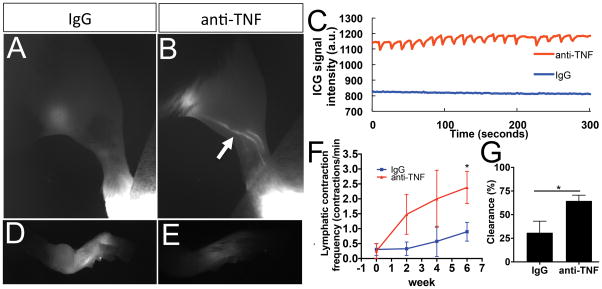
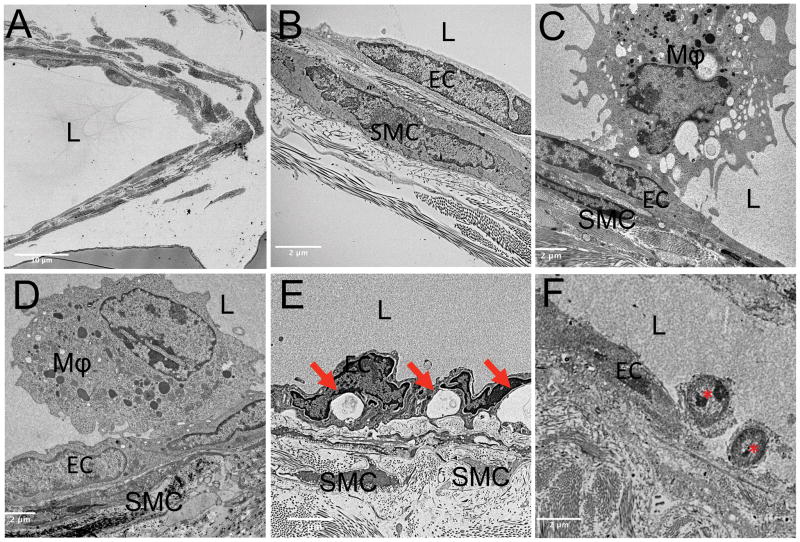
Results: Anti-TNF therapy significantly decreased synovitis (∼5-fold; P < 0.05 versus placebo), restored lymphatic contractions, and significantly increased the number of popliteal LN monocyte/macrophages (∼2-fold; P < 0.05 versus placebo). TEM demonstrated large activated macrophages attached to damaged lymphatic endothelium in mice with early arthritis, extensively damaged lymphatic vessels in placebo-treated mice with advanced arthritis, and rolling leukocytes in repaired lymphatic vessels in mice responsive to anti-TNF therapy.
Conclusion: These findings support the concept that anti-TNF therapy ameliorates erosive inflammatory arthritis, in part via restoration of lymphatic vessel contractions and potential enhancement of inflammatory cell egress.
© 2017, American College of Rheumatology.
Figures
References
-
- Smeets TJ, Kraan MC, van Loon ME, Tak PP. Tumor necrosis factor alpha blockade reduces the synovial cell infiltrate early after initiation of treatment, but apparently not by induction of apoptosis in synovial tissue. Arthritis Rheum. 2003;48(8):2155–62. - PubMed
-
- Wijbrandts CA, Remans PH, Klarenbeek PL, Wouters D, van den Bergh Weerman MA, Smeets TJ, et al. Analysis of apoptosis in peripheral blood and synovial tissue very early after initiation of infliximab treatment in rheumatoid arthritis patients. Arthritis Rheum. 2008;58(11):3330–9. - PubMed
-
- Polzer K, Baeten D, Soleiman A, Distler J, Gerlag DM, Tak PP, et al. Tumour necrosis factor blockade increases lymphangiogenesis in murine and human arthritic joints. Ann Rheum Dis. 2008;67(11):1610–6. - PubMed
Publication types
MeSH terms
Substances
Grants and funding
LinkOut - more resources
Full Text Sources
Other Literature Sources
Medical
Research Materials
