. 2017 Jan 24;12(1):10.
doi: 10.1186/s13024-017-0149-0.

The SH-SY5Y cell line in Parkinson's disease research: a systematic review

Affiliations

The SH-SY5Y cell line in Parkinson's disease research: a systematic review

Helena Xicoy et al. Mol Neurodegener. .

Abstract

Parkinson's disease (PD) is a devastating and highly prevalent neurodegenerative disease for which only symptomatic treatment is available. In order to develop a truly effective disease-modifying therapy, improvement of our current understanding of the molecular and cellular mechanisms underlying PD pathogenesis and progression is crucial. For this purpose, standardization of research protocols and disease models is necessary. As human dopaminergic neurons, the cells mainly affected in PD, are difficult to obtain and maintain as primary cells, current PD research is mostly performed with permanently established neuronal cell models, in particular the neuroblastoma SH-SY5Y lineage. This cell line is frequently chosen because of its human origin, catecholaminergic (though not strictly dopaminergic) neuronal properties, and ease of maintenance. However, there is no consensus on many fundamental aspects that are associated with its use, such as the effects of culture media composition and of variations in differentiation protocols. Here we present the outcome of a systematic review of scientific articles that have used SH-SY5Y cells to explore PD. We describe the cell source, culture conditions, differentiation protocols, methods/approaches used to mimic PD and the preclinical validation of the SH-SY5Y findings by employing alternative cellular and animal models. Thus, this overview may help to standardize the use of the SH-SY5Y cell line in PD research and serve as a future user's guide.

Keywords: Cell culture conditions; Cellular differentiation; Cellular model; Dopaminergic neuron; Neuroblastoma; Parkinson’s disease; SH-SY5Y cell line.


Figures
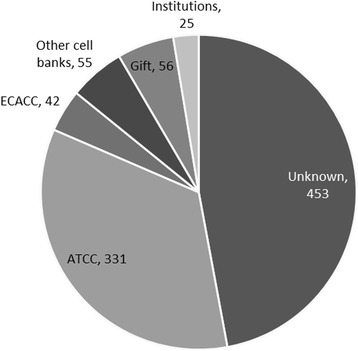
Fig. 1
Fig. 1
Sources from which researchers obtained the SH-SY5Y cell line. Number of articles using a particular source is indicated. ATCC: American Type Culture Collection; EACC: European Collection of Authenticated Cell Cultures; other cell banks includes all of them, except for ATCC and ECACC
Fig. 2
Fig. 2
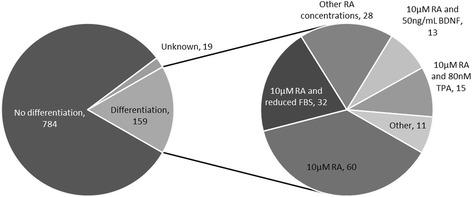
Papers reporting the differentiation of the SH-SY5Y cell line for PD-research. Left: Proportion of studies that do not use differentiation protocols (no differentiation), those that do not specify the differentiation status (unknown) and those that include a differentiation regime (differentiation). Among the papers in which differentiated cells were used, the main differentiation treatments used are depicted in the right chart, including 10 μM retinoic acid (RA), 10 μM RA and reduced fetal bovine serum (FBS), other concentrations of RA, 10 μM RA and 50 ng/ml brain-derived neurotrophic factor (BDNF) and 10 μM RA and 80nM 12-O-Tetradecanoylphorbol-13-acetate (TPA). Other includes 10 μM RA, 1%FBS and 0.3 mM dibutyryl-cAMP; 10 μM RA or 10 μg/mL BDNF; 10 μM RA and 80nM TPA or 50 ng/mL BDNF; 100 ng/mL of GDF5 or recombinant BMP2; neurobasal media with 6-10nM staurosporine or B27 supplement, 2 mM L-glutamine and 10 μM RA; 10 μM RA and 5 μM cAMP; 50 ng/ml GDNF; 10 μM RA and 80nM tissue plasminogen activator
Fig. 3
Fig. 3
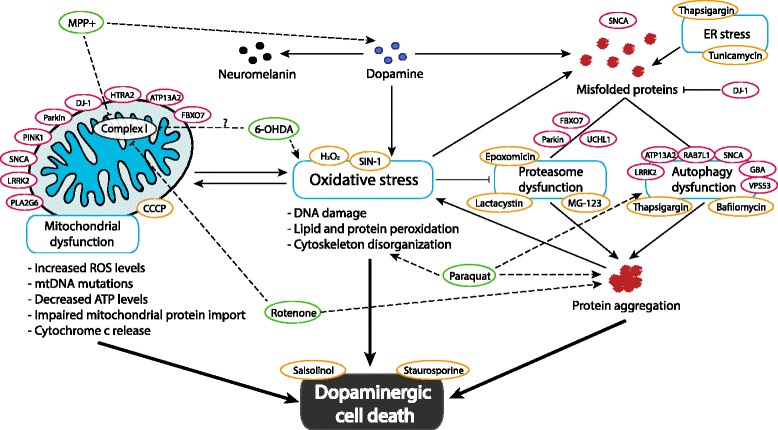
The molecular mechanisms dysregulated in PD and thought to lead to DAergic neuronal cell death. Up to now, 14 genes have been consistently associated with familial PD (red circles; [38]). The analysis of the functions of the corresponding (mutated) proteins and the resulting cellular abnormalities has allowed the identification of the depicted main pathways underlying PD: mitochondrial, proteasomal and autophagy dysfunction, protein aggregation, dopamine metabolism and oxidative stress, leading to DAergic cell death [–44]. Green circles: compounds dysregulating multiple cellular processes linked to PD and used to mimic PD with dotted lines pointing towards their targets. Orange circles: drugs that specifically act on one of the processes are placed next to their targeted pathway

References

    1. Dorsey ER, Constantinescu R, Thompson JP, Biglan KM, Holloway RG, Kieburtz K, et al. Projected number of people with Parkinson disease in the most populous nations, 2005 through 2030. Neurology. 2007;68(5):384–6. doi: 10.1212/01.wnl.0000247740.47667.03. - DOI - PubMed
    1. Wirdefeldt K, Adami H-O, Cole P, Trichopoulos D, Mandel J. Epidemiology and etiology of Parkinson’s disease: a review of the evidence. Eur J Epidemiol. 2011;26(Suppl 1):1–58. doi: 10.1007/s10654-011-9581-6. - DOI - PubMed
    1. Chaudhuri KR, Schapira AH. Non-motor symptoms of Parkinson’s disease: dopaminergic pathophysiology and treatment. Lancet Neurol. 2009;8(5):464–74. doi: 10.1016/S1474-4422(09)70068-7. - DOI - PubMed
    1. Xia R, Mao Z-H. Progression of motor symptoms in Parkinson’s disease. Neurosci Bull. 2012;28(1):39–48. doi: 10.1007/s12264-012-1050-z. - DOI - PMC - PubMed
    1. Dexter DT, Jenner P. Parkinson disease: from pathology to molecular disease mechanisms. Free Radic Biol Med. 2013;62:132–44. doi: 10.1016/j.freeradbiomed.2013.01.018. - DOI - PubMed

Publication types