Review
. 2017 Jan 10:7:224.
doi: 10.3389/fgene.2016.00224. eCollection 2016.

Advances in Gut Microbiome Research, Opening New Strategies to Cope with a Western Lifestyle

Affiliations
Review

Advances in Gut Microbiome Research, Opening New Strategies to Cope with a Western Lifestyle

Gina P Rodriguez-Castaño et al. Front Genet. .

Abstract

The "westernization" of global eating and lifestyle habits is associated with the growing rate of chronic diseases, mainly cardiovascular diseases, cancer, type 2 diabetes mellitus, and respiratory diseases. The primary prevention approach is to make nutritional and behavioral changes, however, there is another important determinant of our health that only recently has been considered and is the presence of beneficial microorganisms and their products in our gastrointestinal tract. Microorganisms living in our body can alter the fate of food, drugs, hormones, and xenobiotics, and recent studies point to the use of microorganisms that can counteract the harmful effects of certain compounds introduced or produced endogenously in our body. This review considers the effects of the western lifestyle on adiposity, glucose metabolism, oxidative markers and inflammation profile, emphasizes on the studies that have investigated bacterial strains and products of their metabolism that are beneficial under this lifestyle, and examines the screening strategies that recent studies are using to select the most promising probiotic isolates. In addition, we consider the relevance of studying the microbiota of metabolically healthy people under a western lifestyle for the understanding of the key components that delay the development of chronic diseases.

Keywords: inflammation; lifestyle; microbiome; nutrition; obesity.


Figures
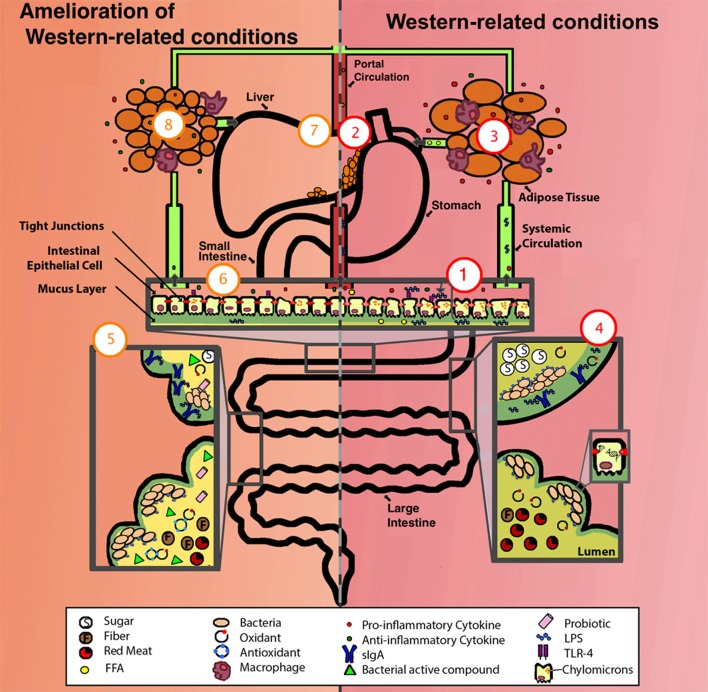
Figure 1
Figure 1
Comparison of a system suffering from western-related conditions (right, in red) and a system with amelioration of western-related conditions (left, in orange). One aspect of a western lifestyle is the higher intake of ω-6 PUFA (depicted as FFA), this enhances the formation of chylomicrons allowing the translocation of LPS, these then activate basolateral TLR which initiates a pro-inflammatory response, one overall consequence is the alteration of the gut epithelium and its permeability (depicted as deteriorated epithelium and compromised tight junctions), exacerbating inflammation by allowing the translocation of more LPS, pro-inflammatory cytokines, FFA, among other luminal compounds (1). LPS/ pro-inflammatory cytokines/ FFA can enter portal and systemic circulation, one consequence is the alteration of fat metabolism, thus enhancing fat accumulation in liver (2), and in adipose tissue, adipocytes increase in size, FFA synthesis is enhanced (depicted as FFA in circulation), and an elevated pro-inflammatory state occurs (depicted as increased infiltration of macrophages and production of pro-inflammatory cytokines) (3). The western lifestyle includes higher intake of simple sugars and red-meat, lower intake of antioxidants (depicted as presence of oxidants), and sedentarism (depicted as low production of sIgA), some of the consequences are lower-capacity for antigen neutralization (depicted as LPS not bound to sIgA) and damage to the DNA of epithelial cells (depicted as DNA strand breakage) (4). For the amelioration of these conditions, a person can take different approaches, these include exercise (depicted as high production of sIgA), intake of dietary nutrients (i.e., polyphenols and ω-3 PUFAs) (depicted as antioxidants), probiotics, prebiotics, and SCFA (depicted as fiber, bacterial active compounds and probiotics) (5). Some of the effects of these approaches include the reestablishment of gut epithelium permeability and a decrease in LPS translocation, TLR activation, chylomicron formation, presence of LPS/cytokines/FFA in portal and systemic circulation (6), liver fat (7), adipocyte size, FFA synthesis, macrophage infiltration in adipose tissue (8), and an overall amelioration of the inflammatory state (depicted as a higher concentration of anti-inflammatory cytokines compared to pro-inflammatory cytokines [6 and 8]). FFA, free fatty acids. For more details see the text.

References

    1. Adlercreutz H. (1990). Western diet and Western diseases: some hormonal and biochemical mechanisms and associations. Scand. J. Clin. Lab. Invest. Suppl. 50(Suppl. 201), 3–23. - PubMed
    1. Anhê F. F., Roy D., Pilon G., Dudonné S., Matamoros S., Varin T. V., et al. (2015). A polyphenol-rich cranberry extract protects from diet-induced obesity, insulin resistance and intestinal inflammation in association with increased Akkermansia spp. population in the gut microbiota of mice. Gut 64, 872–883. 10.1136/gutjnl-2014-307142 - DOI - PubMed
    1. Armougom F., Henry M., Vialettes B., Raccah D., Raoult D. (2009). Monitoring bacterial community of human gut microbiota reveals an increase in Lactobacillus in obese patients and Methanogens in anorexic patients. PLoS ONE 4:e7125. 10.1371/journal.pone.0007125 - DOI - PMC - PubMed
    1. Asemi Z., Khorrami-Rad A., Alizadeh S. (2014). Effects of synbiotic food consumption on metabolic status of diabetic patients: a double-blind randomized cross-over controlled clinical trial. Clin. Nutr. 33, 198–203. 10.1016/j.clnu.2013.05.015 - DOI - PubMed
    1. Atkinson K. J., Rao R. K. (2001). Role of protein tyrosine phosphorylation in acetaldehyde-induced disruption of epithelial tight junctions. Am. J. Physiol. Gastrointest Liver Physiol. 280, G1280–G1288. - PubMed

LinkOut - more resources
