


Targeting calcium signaling in cancer therapy
- PMID: 28119804
- PMCID: PMC5237760
- DOI: 10.1016/j.apsb.2016.11.001
Targeting calcium signaling in cancer therapy
Abstract
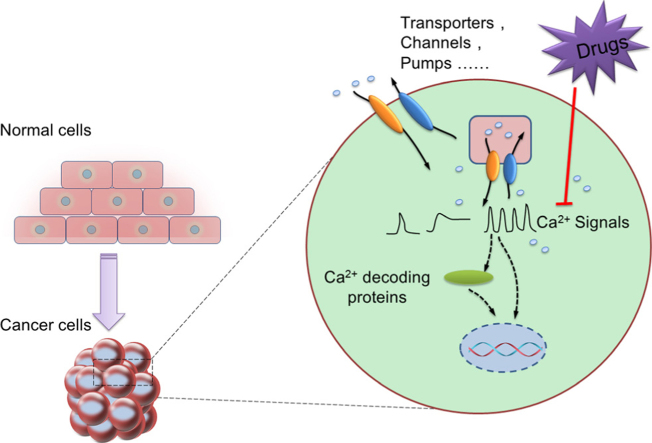
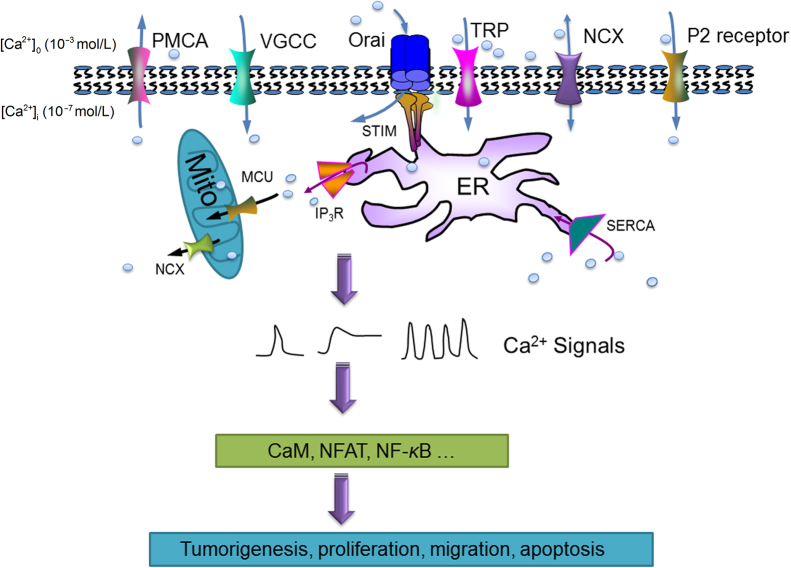
The intracellular calcium ions (Ca2+) act as second messenger to regulate gene transcription, cell proliferation, migration and death. Accumulating evidences have demonstrated that intracellular Ca2+ homeostasis is altered in cancer cells and the alteration is involved in tumor initiation, angiogenesis, progression and metastasis. Targeting derailed Ca2+ signaling for cancer therapy has become an emerging research area. This review summarizes some important Ca2+ channels, transporters and Ca2+-ATPases, which have been reported to be altered in human cancer patients. It discusses the current research effort toward evaluation of the blockers, inhibitors or regulators for Ca2+ channels/transporters or Ca2+-ATPase pumps as anti-cancer drugs. This review is also aimed to stimulate interest in, and support for research into the understanding of cellular mechanisms underlying the regulation of Ca2+ signaling in different cancer cells, and to search for novel therapies to cure these malignancies by targeting Ca2+ channels or transporters.
Keywords: 20-GPPD, 20-O-β-D-glucopyranosyl-20(S)-protopanaxadiol; Apoptosis; CBD, cannabidiol; CBG, cannabigerol; CPZ, capsazepine; CRAC, Ca2+ release-activated Ca2+ channel; CTL, cytotoxic T cells; CYP3A4, cytochrome P450 3A4; Ca2+ channels; CaM, calmodulin; CaMKII, calmodulin-dependent protein kinase II; Cancer therapy; Cell proliferation; Channel blockers;; ER/SR, endoplasmic/sarcoplasmic reticulum; HCX, H+/Ca2+ exchangers; IP3, inositol 1,4,5-trisphosphate; IP3R (1, 2, 3), IP3 receptor (type 1, type 2, type 3); MCU, mitochondrial Ca2+ uniporter; MCUR1, MCU uniporter regulator 1; MICU (1, 2, 3), mitochondrial calcium uptake (type 1, type 2, type 3); MLCK, myosin light-chain kinase; Migration; NCX, Na+/Ca2+ exchanger; NF-κB, nuclear factor-κB; NFAT, nuclear factor of activated T cells; NSCLC, non-small cell lung cancer; OSCC, oral squamous cell carcinoma cells; PKC, protein kinase C; PM, plasma membrane; PMCA, plasma membrane Ca2+-ATPase; PTP, permeability transition pore; ROS, reactive oxygen species; RyR, ryanodine receptor; SERCA, SR/ER Ca2+-ATPase; SOCE, store-operated Ca2+ entry; SPCA, secretory pathway Ca2+-ATPase; Store-operated Ca2+ entry; TEA, tetraethylammonium; TG, thapsigargin; TPC2, two-pore channel 2; TRIM, 1-(2-(trifluoromethyl) phenyl) imidazole; TRP (A, C, M, ML, N, P, V), transient receptor potential (ankyrin, canonical, melastatin, mucolipin, no mechanoreceptor potential C, polycystic, vanilloid); VGCC, voltage-gated Ca2+ channel; mAb, monoclonal antibody.
Figures
References
-
- Berridge M.J., Lipp P., Bootman M.D. The versatility and universality of calcium signalling. Nat Rev Mol Cell Biol. 2000;1:11–21. - PubMed
-
- McConkey D.J., Orrenius S. The role of calcium in the regulation of apoptosis. Biochem Biophys Res Commun. 1997;239:357–366. - PubMed
-
- Baudouin-Legros M., Brouillard F., Tondelier D., Hinzpeter A., Edelman A. Effect of ouabain on CFTR gene expression in human Calu-3 cells. Am J Physiol Cell Physiol. 2003;284:C620–C626. - PubMed
Publication types
Grants and funding
LinkOut - more resources
Full Text Sources
Other Literature Sources
Research Materials
Miscellaneous
