


Listeners can extract meaning from non-linguistic infant vocalisations cross-culturally
- PMID: 28120878
- PMCID: PMC5264397
- DOI: 10.1038/srep41016
Listeners can extract meaning from non-linguistic infant vocalisations cross-culturally
Abstract
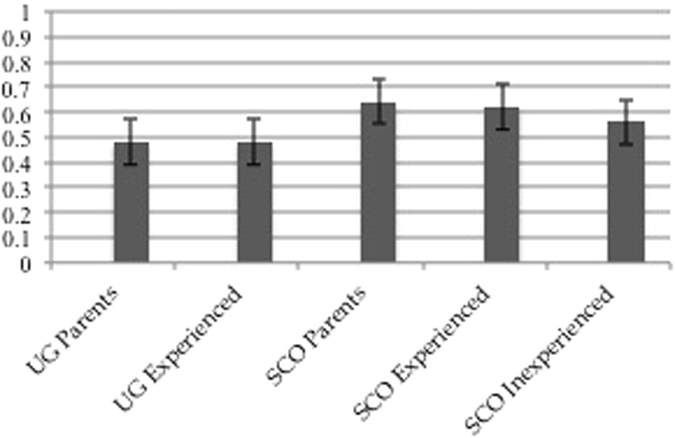
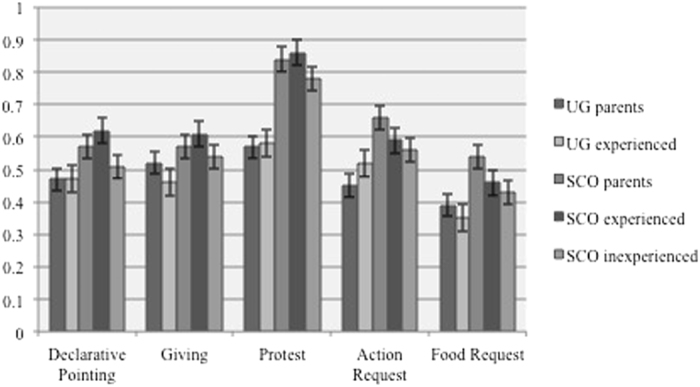
We present empirical evidence showing that the acoustic properties of non-linguistic vocalisations produced by human infants in different cultures can be used cross-culturally by listeners to make inferences about the infant's current behaviour. We recorded natural infant vocalisations in Scotland and Uganda in five social contexts; declarative pointing, giving an object, requesting an action, protesting, and requesting food. Using a playback paradigm, we tested parents and non-parents, who either had regular or no experience with young children, from Scotland and Uganda in their ability to match infant vocalisations of both cultures to their respective production contexts. All participants performed above chance, regardless of prior experience with infants or cultural background, with only minor differences between participant groups. Results suggest that acoustic variations in non-linguistic infant vocalisations transmit broad classes of information to listeners, even in the absence of additional cues from gesture or context, and that these cues may reflect universal properties similar to the 'referential' information discovered in non-human primate vocalisations.
Figures
References
-
- Kreiman J. & Sidtis D. V. L. Foundations of voice studies: An interdisciplinary approach to voice production and perception. (Wiley-Blackwell 2011).
-
- Banse R. & Scherer K. R. Acoustic profiles in vocal emotion expression. J. of Personality and Social Psych. 70(3), 614–636 (1996). - PubMed
-
- Scherer K. R., Banse R. & Wallbott H. G. Emotion inferences from vocal expression correlate across languages and cultures. J. of Cross-cultural Psych. 32(1), 76–92 (2001).
-
- Lester B. M. & Boukydis C. F. Z. No language but a cry. (eds Papoušek H. & Jurgens U. ) Nonverbal Vocal Communication: Comparative and Developmental Approaches (Cambridge University Press 1989).
-
- Oller D. K. The emergence of the speech capacity. (Psychology Press 2000).
Publication types
MeSH terms
Grants and funding
LinkOut - more resources
Full Text Sources
Other Literature Sources
Medical
