


Interluekin-17A (IL17A)
- PMID: 28122268
- PMCID: PMC5394985
- DOI: 10.1016/j.gene.2017.01.016
Interluekin-17A (IL17A)
Abstract
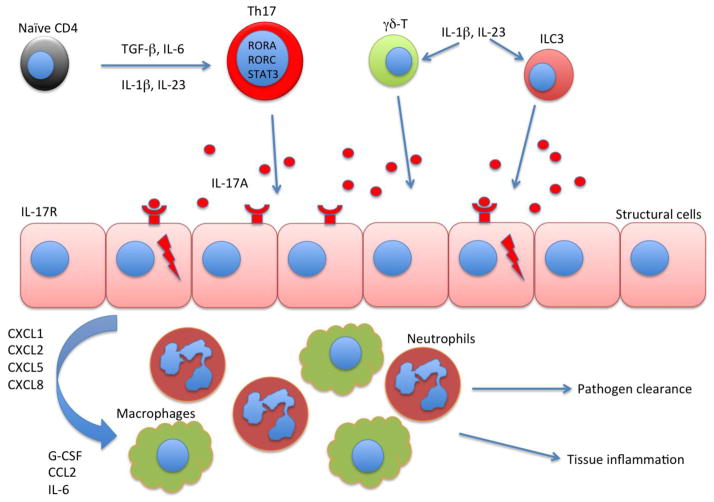
The discovery of the key roles of interleukin-17A (IL-17A) and IL-17A producing cells in inflammation, autoimmune diseases and host defense has led to the experimental targeting of the IL-17A pathway in animal models of diseases as well as in clinical trials in humans. These therapeutic agents include biological products that target IL-17A and IL-23, an upstream regulator of IL-17A production. IL-17A producing T helper cells (Th17 cells) are a distinct lineage from the Th1 and Th2 CD4+ lineages and have been suggested to represent a good drug target in certain inflammatory conditions. Targeting IL-17A has been proven to be a good approach as anti-IL-17A is FDA approved for the treatment of psoriasis in 2015. In host defense, IL-17A has been shown to be mostly beneficial against infection caused by extracellular bacteria and fungi. This review will overview the discovery of IL-17A, the receptors used by this cytokine and its role in mucosal immunity and inflammation.
Keywords: Cancer; Inflammation; Interleukin-17A; Neutrophil.
Copyright © 2017 Elsevier B.V. All rights reserved.
Figures
References
-
- Alcorn JF, Crowe CR, Kolls JK. TH17 cells in asthma and COPD. Annu Rev Physiol. 2010;72:495–516. - PubMed
-
- Balasa R, Bajko Z, Hutanu A. Serum levels of IL-17A in patients with relapsing-remitting multiple sclerosis treated with interferon-beta. Mult Scler. 2013;19:885–890. - PubMed
-
- Barczyk A, Pierzchala W, Sozanska E. Interleukin-17 in sputum correlates with airway hyperresponsiveness to methacholine. Respir Med. 2003;97:726–733. - PubMed
-
- Barnes PJ. Therapeutic approaches to asthma-chronic obstructive pulmonary disease overlap syndromes. J Allergy Clin Immunol. 2015;136:531–545. - PubMed
-
- Beringer A, Noack M, Miossec P. IL-17 in Chronic Inflammation: From Discovery to Targeting. Trends Mol Med. 2016;22:230–241. - PubMed
Publication types
MeSH terms
Substances
Grants and funding
LinkOut - more resources
Full Text Sources
Other Literature Sources
Research Materials
