Review
. 2017 Jan 25;10(1):34.
doi: 10.1186/s13045-017-0403-5.

PD-1, PD-L1 (B7-H1) and Tumor-Site Immune Modulation Therapy: The Historical Perspective

Affiliations
Review

PD-1, PD-L1 (B7-H1) and Tumor-Site Immune Modulation Therapy: The Historical Perspective

Jun Wang et al. J Hematol Oncol. .

Abstract

The current success of targeted inhibition against cytotoxic T-lymphocyte-associated protein 4 (CTLA-4) and Programmed Death 1/Programmed Death Ligand 1 (PD-1/PD-L1, herein collectively referred to as PD) pathways is hailed as a cancer immunotherapy breakthrough. PD-L1, known also as B7 homolog 1 (B7-H1), was initially discovered by Dr. Lieping Chen in 1999. To recognize the seminal contributions by Chen to the development of PD-directed therapy against cancer, the Chinese American Hematologist and Oncologist Network (CAHON) decided to honor him with its inaugural Lifetime Achievement Award in Hematology and Oncology at the CAHON's 2015 annual meeting. This essay chronicles the important discoveries made by Chen in the exciting field of immuno-oncology, which goes beyond his original fateful finding. It also argues that PD-directed therapy should be appropriately considered as Tumor-Site Immune Modulation Therapy to distinguish it from CTLA-4-based immune checkpoint blocking agents.

Keywords: B7-H1; CD28; CTLA-4; PD-1; PD-L1; T cells; immune checkpoint; immuno-oncology; immunotherapy; tumor-site immune modulation therapy.


Figures
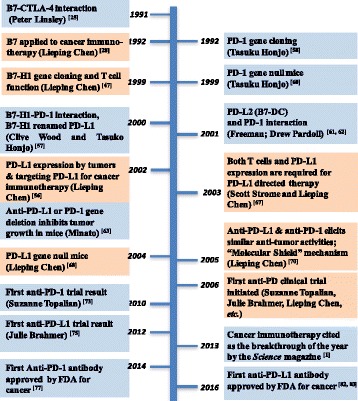
Fig. 1
Fig. 1
Timeline for major events leading to the development of anti-PD drugs. The contributions by Lieping Chen are highlighted in light orange. The contributions by Lieping Chen are highlighted in light orange
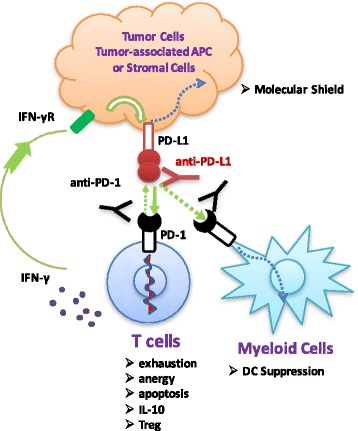
Fig. 2
Fig. 2
Mechanism of the PD pathway in driving tumor-associated immune evasion. Tumor cells, tumor-associated antigen-presenting cells (APCs), and stromal cells upregulate PD-L1 in response to ongoing immune responses, mainly through the action of IFN-γ. The ligation of PD-1 by PD-L1 delivers inhibitory signals to T cells, leading to T cell anergy, functional exhaustion, and apoptosis. PD-1-PD-L1 interaction also favors conversion of T cells to the regulatory T cell (Treg) phenotype with secretion of inhibitory cytokines, such as IL-10. PD-1 on myeloid cells also impairs dendritic cell functions. In addition, PD-L1 reversed signaling on tumor cells can serve as a “Molecular Shield” protecting tumor cells from CTL-mediated killing. IFN-γR: IFN-γ receptor
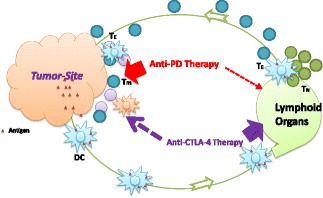
Fig. 3
Fig. 3
Anti-PD modality: Tumor-site immune modulation therapy. Anti-PD therapy is mechanistically distinct from anti-CTLA-4 therapy: the latter affects immune responses more systemically, whereas anti-PD therapy primarily targets its actions at the tumor site. Anti-PD modality is thus capable of repairing tumor-induced immune defects, ultimately leading to resetting of the anti-tumor immunity to a desirable level. TN: Naïve T cells; TE: T effector cells; Tm: memory T cells; DC: dendritic cells

References

    1. Couzin-Frankel J. Breakthrough of the year 2013. Cancer Immunother Sci. 2013;342(6165):1432–1433. - PubMed
    1. Pardoll D. Immunotherapy: it takes a village. Science. 2014;344(6180):149. doi: 10.1126/science.344.6180.149-a. - DOI - PMC - PubMed
    1. Chen L, Han X. Anti-PD-1/PD-L1 therapy of human cancer: past, present, and future. J Clin Invest. 2015;125(9):3384–3391. doi: 10.1172/JCI80011. - DOI - PMC - PubMed
    1. Zou W, Wolchok JD, Chen L. PD-L1 (B7-H1) and PD-1 pathway blockade for cancer therapy: Mechanisms, response biomarkers, and combinations. Sci Transl Med. 2016;8(328):328rv324. doi: 10.1126/scitranslmed.aad7118. - DOI - PMC - PubMed
    1. Chen L. From the guest editor: Tumor site immune modulation therapy. Cancer J. 2014;20(4):254–255. doi: 10.1097/PPO.0000000000000062. - DOI - PMC - PubMed

Publication types

MeSH terms

Personal name as subject

LinkOut - more resources